
Resources
Explore a wide range of valuable resources on GCED to deepen your understanding and enhance your research, advocacy, teaching, and learning.
8,363 Results found
 School Closures and Regional Policies to Mitigate Learning Loss due to COVID-19: A Focus on the Asia-Pacific Year of publication: 2021 Corporate author: UNESCO Institute for Statistics (UIS) Global school closures as a result of COVID-19 have caused learning losses for millions of children despite efforts to deploy remote learning options. Greater economic insecurity among families may also affect school enrolment as many struggle to pay school fees, or require children to work to supplement family income. Ultimately, this will lead to rising dropout rates, estimated to be as much as 4% in a region where 128 million children and young people were already out of school before COVID-19. The largest number of learners at risk reside in South and West Asia.Together, the education and economic fallout from the pandemic threaten progress toward the Sustainable Development Goal for education (SDG 4). Even prior to the COVID-19 disruptions, progress towards SDG 4 was lagging in many countries in the Asia-Pacific and without significant contributions to education finance, the pandemic threatens to push the region even further behind.This report breaks down the effects of school closures. It considers, for example, how many schools were closed, and when, across the Asia-Pacific, and the effects on different levels of education from early childhood education, through to primary and secondary school. The report analyses country efforts to implement remote learning, and strategies to mitigate learning losses as the proportion of students expected to fall below minimum proficiency levels is expected to rise.To achieve SDG 4, all children and young people, and especially those in marginalized groups, need support to get the education they need and deserve.
 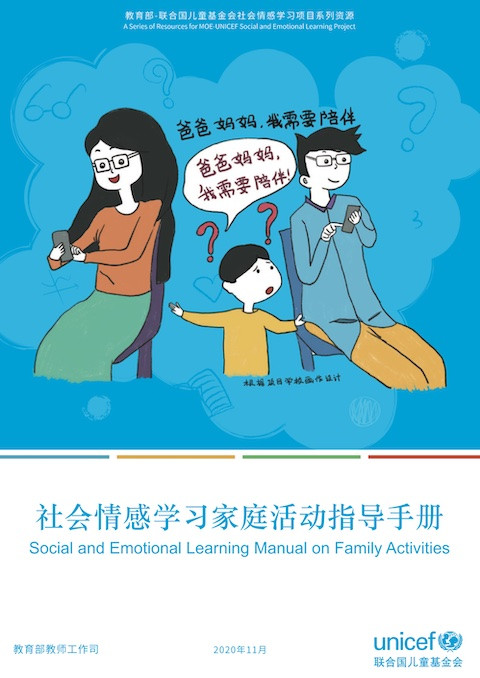 Social and Emotional Learning Manual on Family Activities Year of publication: 2020 Corporate author: China. Ministry of Education | United Nations Children's Fund (UNICEF) This material is a guide for schools to promote family-school cooperation and for family to carry out social and emotional learning at home. It provides guidances for family to organise parent-child activities to facilitate children's social and emotional development.
  Media Literacy Education to Counter Truth Decay: An Implementation and Evaluation Framework Year of publication: 2021 Author: Alice Huguet | John F. Pane | Garrett Baker | Laura S. Hamilton | Susannah Faxon-Mills Corporate author: RAND Corporation Media literacy (ML) education has emerged as a promising approach to slowing the spread of Truth Decay, described as the diminishing role that facts, data, and analysis play in political and civil discourse. Several factors contribute to Truth Decay, including a rapidly evolving information ecosystem and overburdened educational institutions. Many teachers believe their students lack the complex skills that are necessary to navigate today’s information- saturated world. This gap—between students’ existing competencies and those required to engage responsibly in a fast-paced media environment— could lead to negative consequences for individuals and society writ large.However, teachers report a lack of guidance around promoting ML education in their practice, and rigorous research about what kinds of ML educationwork best, and in what conditions, remains limited. This report presents a framework for implementing and evaluating ML educational efforts. Following an introduction to the framework, the authors discuss six steps of ML implementation and evaluation: setting ML learning expectations; identifying conditions that can influence ML instructional efforts; exploring instructional resources; identifying measures of ML competencies; monitoring progress; and finally, measuring the summative impacts of ML education on student learning. By bringing this information together for implementors—such as district decisionmakers and teachers—as well as evaluators, the authors emphasize the important connections between these too often separate groups.
 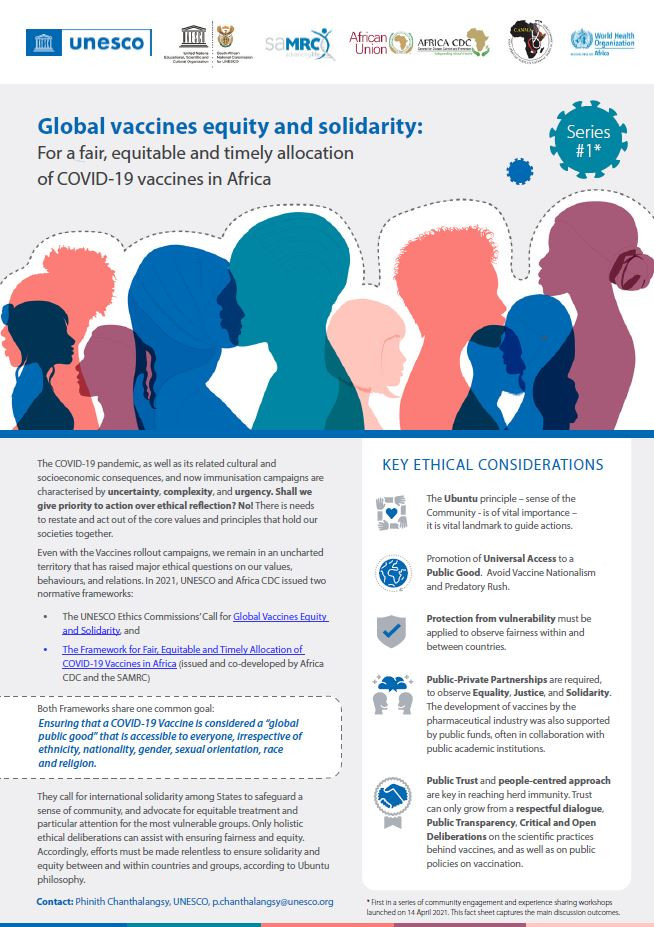 Global Vaccines Equity and Solidarity: For a Fair, Equitable and Timely Allocation of COVID-19 Vaccines in Africa; Series #1 Year of publication: 2021 Corporate author: UNESCO Harare African populations have been side-lined through the COVID-19 Vaccination roll-out process. A vaccination timeline taking Africa into 2023 would be unethical. African countries need to invest in their own structures and stop relying on colonial structures. There is a moral obligation to safeguard the population through equal distribution. This not only makes moral and ethical sense but also scientific and economic sense as a slow roll out in Africa will impact the rest of the world. First in a series of community engagement and experience sharing workshops launched on 14 April 2021. This fact sheet captures the main discussion outcomes.
 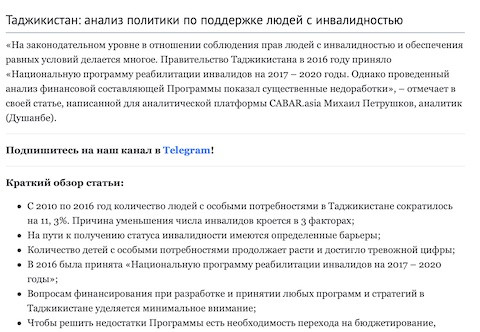 Tajikistan: Policy Analysis to Support Persons with Disabilities Year of publication: 2018 Author: Mikhail Petrushkov Corporate author: Central Asian Bureau for Analytical Reporting (CABAR) | Institute for War and Peace Reporting (IWPR) “Much is being done at the legislative level with regard to the observance of the rights of people with disabilities and ensuring equal conditions. In 2016, the Government of Tajikistan adopted the National Program for the Rehabilitation of Persons with Disabilities for 2017-2020. However, the analysis of the financial component of the Program showed significant shortcomings, ”says Mikhail Petrushkov, an analyst (Dushanbe), in his article written for the analytical platform CABAR.asia.
 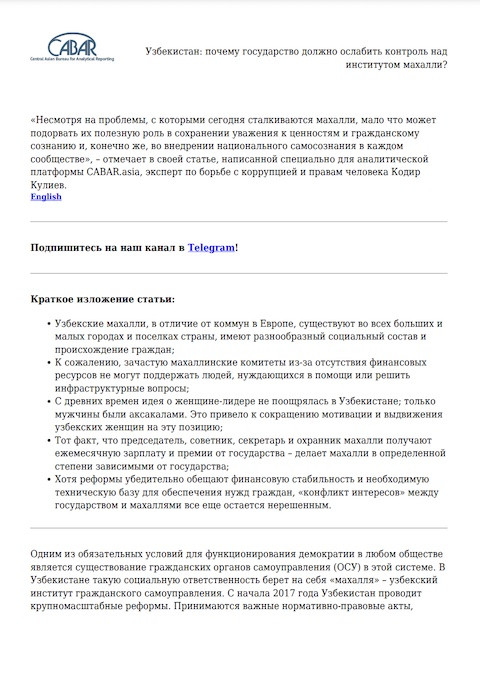 Uzbekistan: Why Should the State Weaken Control Over the Institute of Makhalla? Year of publication: 2019 Author: Kodir Kuliev Corporate author: Central Asian Bureau for Analytical Reporting (CABAR) | Institute for War and Peace Reporting (IWPR) One of the vital conditions for the functioning of democracy in any society is the existence of citizens’ self-governing bodies (CSB) within that system. In Uzbekistan, such social responsibility is assumed by “mahalla” – the Uzbek citizens’ self-governing institution. Since the beginning of 2017 Uzbekistan has been carrying out large-scale reforms. Important laws and regulations are being adopted, which should create favorable conditions for quality life and ensure freedom for the Uzbek people. With mahallas, however, such positive change in the long-run seems to be just a lip-service. The main challenges mahallas are facing today are, inter alia, obscured freedom they have in ruling themselves and controlling their own affairs and incapability to effectively tackle citizens’ problems, thus leaving people’s trust unjustified.
 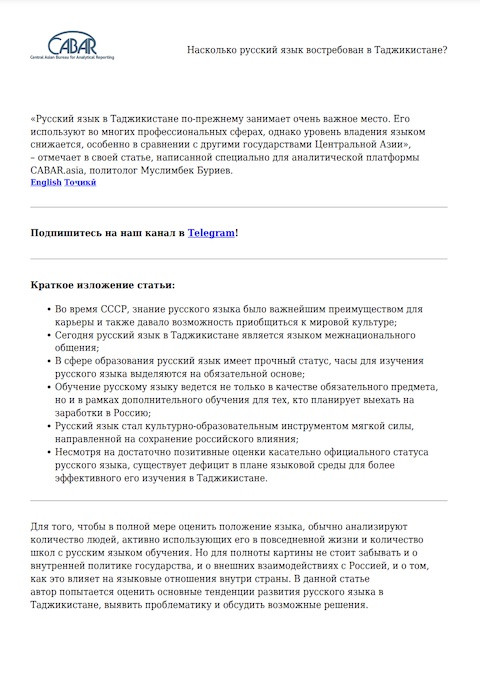 How Popular Is The Russian Language In Tajikistan? Year of publication: 2019 Author: Muslimbek Buriev Corporate author: Central Asian Bureau for Analytical Reporting (CABAR) | Institute for War and Peace Reporting (IWPR) «Russian language still occupies in Tajikistan a very important place. It is used in many professional spheres, but the proficiency level is being reduced in comparison with other Central Asian countries», -notes a political analyst Muslimbek Buriev in his article written specifically for analytical platform CABAR.asia.
  Pathways Towards Quality Primary Education: Improving Completion and Learning Outcomes Year of publication: 2021 Author: Moizza Binat Sarwar | Susan Nicolai | Diego Benitez Moreno | Olha Homonchuk | Jose Manuel Roche Corporate author: ODI Global This paper explores pathways towards quality primary education by identifying and analysing strategies used in 38 countries that have made faster progress in primary completion rates (PCR) – and, where discernible, learning outcomes – between 2000 and 2017. It further considers which social and economic groups within these countries are being left behind or excluded from the rise in completion rates, why that may be happening and what governments are doing to address those gaps.
 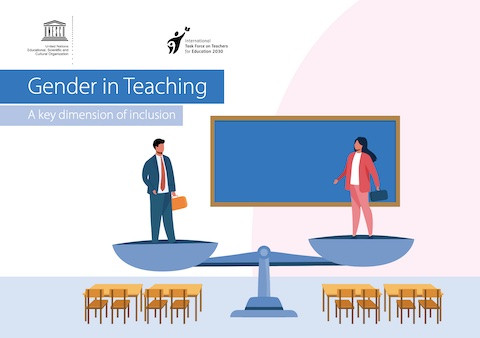 Gender in Teaching: A Key Dimension of Inclusion Year of publication: 2020 Corporate author: UNESCO | International Task Force on Teachers for Education 2030 Without teachers, Sustainable Development Goal 4 to ensure inclusive and equitable, quality education for all by 2030 will not be achieved.Since teachers act as role models for students, inclusion in education means that the teaching workforce mirror the diversity of the classroom. As countries look to recruit more teachers to meet SDGs, one significant factor important to creating inclusive classrooms is gender.This document has been prepared for the 2020 World Teachers’ Day celebrated by UNESCO and the Teacher Task Force with the theme Teachers: Leading in crisis, reimagining the future.
  Resources: For SDG Target 4.7 Year of publication: 2021 Author: Sandra Oliveira Corporate author: Bridge 47 This paper is part of a series of publications commissioned to support advocacy for more space for SDG Target 4.7 of Agenda 2030 in European and global policies. In November 2019, Bridge 47 organised an event called Envision 4.7, which brought together civil society organisations, national governments, MEPs, European and global organisations, and together wrote a Roadmap for SDG Target 4.7 for Europe.Focusing on the key themes of this Envision 4.7 Roadmap and drawing on the Envision 4.7. policy papers as key references, this paper focuses on providing a global overview and identification of the types of resources re- quired to achieve this target.\