
Resources
Explore a wide range of valuable resources on GCED to deepen your understanding and enhance your research, advocacy, teaching, and learning.
8,363 Results found
 Indicators: The Need and Challenges of Tracking Implementation of Target 4.7 Year of publication: 2021 Author: Johanna Helin Corporate author: Bridge 47 This paper investigates the existing and proposed indicators and monitoring frame- works for 4.7. Examining efforts at national, regional, and global levels will identify the main challenges in measurement initiatives. The paper will start by looking at the context of SDGs and the special character of Target 4.7. Thereafter, it will discuss the process and limitations of defining the indicators at the global level. It will also review regional developments, tools, and ideas for national and local level assessment frameworks in Asia-Pacific and Europe. The paper ends with conclusions and policy recommendations.
  Transformative Competencies: How to Define and Implement Competencies for SDG Target 4.7 Year of publication: 2021 Author: Johanna Helin Corporate author: Bridge 47 This paper was commissioned to support advocacy for SDG Target 4.7 in European and global policies by exploring the concept of ‘Competencies for SDG Target 4.7’. This advocacy paper draws from a desk review of existing global and regional competency frameworks at national, regional and global levels. The aim is to get a clearer understanding of these transformative competencies and how they help the implementation and assessment of Target 4.7.This paper is divided in three sections. The first section provides background to the different world views that frame the discussion on competencies, before turning to presenting some of the competency frameworks for Target 4.7. The second section gives some examples of how these competencies are being introduced into national education policies, professional skills training and lifelong learning. The paper finishes with conclusions and policy recommendations.
  Unlocking the Transformative Potential of Education: The Alliance Between Lifelong Learning and SDG Target 4.7 Year of publication: 2021 Author: Chris Millora Corporate author: Bridge 47 This paper has found that Lifelong learning as a spectrum of formal, informal and non-formal learning, offers a framework to embrace different forms of learning people gain in various spaces across their lifespan. While several lifelong learning policies emphasise economic benefits, evidence shows that lifelong learning also facilitates active citizenship, tolerance to diversity, empathy, learning to live together, leadership, intergenerational learning, and awareness of social injustices. This paper demonstrated the impact of ALE provisions that bring to centre stage the needs of adults – particularly women – in resource-poor contexts. These programmes recognise the ‘funds of knowledge’ and ‘banks of skills’ already existing in these communities – challenging the deficit discourse that is dominant particularly in development circles even today.Based on these findings, this paper puts forward seven interrelated policy recommendations: (1) acknowledgement, within SDG 4.7 policies, that learning occurs in all life stages, forms and spaces; (2) prioritisation of lifelong learning and transformative approaches to education into local, national, regional and global level policies, including provisions of funding; (3) a focus on the transformative competencies and outcomes of lifelong learning; (4) positioning lifelong learning as a cross- cutting (rather than separate) approach to achieving the SDGs; (5) increased attention to recognising, validating and accrediting (RVA) non-formal and informal learning; (6) involving marginalised groups as stakeholders that can shape policy and not only recipients; (7) increased government support and financing to adult educators and literacy facilitators.
  Transformative Education: Bridging Education for Change Year of publication: 2021 Author: Jana Arbeiter | Maja Bučar Corporate author: Bridge 47 This publication suggests that improvements in the areas of coordination, cooperation, awareness raising and capability development are needed, as outlined in the recommendations below. Policies and strategies at national, regional and global level should adopt overarching visions for transformative education in the form of overarching strategies for SDG Target 4.7. Mechanisms for coordination and collaboration between the different components of SDG Target 4.7 should be established at national, regional and global levels. Awareness of the role of transformative education and SDG Target 4.7 in contributing to more just and sustainable futures should be raised jointly between the different components of SDG Target 4.7. Opportunities for capacity building and upskilling of practitioners and learners linked to transformative education should be enabled and created at national, regional and global levels.
  Cross-Sectoral Cooperation for Sustainable Futures Year of publication: 2021 Author: Jana Arbeiter | Maja Bučar Corporate author: Bridge 47 Cross-sectoral cooperation is important to strengthen the coherence and collaboration, as well as mobilization of resources needed for addressing systemic challenges, implementing the Sustainable Development Goals (SDGs), and enabling transformative change. Building or strengthening cross-sectoral multi-stakeholder groups or coalitions within SDG Target 4.7, can support equipping everyone with the knowledge, skills and competencies needed to contribute to a more sustainable and just future.Multi-stakeholder groups or coalitions in support of SDG Target 4.7 on a local, regional and global level are essential mechanisms for promoting and implementing sustainable development. They can enable coherence and collaboration, as well as pooling of expertise and resources needed for co-creation of the relevant policy proposals linked to the implementation of SDG Target 4.7. Building and strengthening multi-stakeholder groups or coalitions require a clear basis for establishing well-defined relationships within the multi-stakeholder groups or coalitions, well-designed structures and operating procedures and strong coordination. But most importantly, they have the potential to combine key stakeholders from relevant sectors of society, which can advocate for the implementation of SDG Target 4.7 and the (co)-creation of appropriate policies that address global justice, sustainability, and key global challenges. This publication identifies the following recommendations for establishing multi-stakeholder groups or coalitions in support of SDG Target 4.7: Multi-stakeholder groups or coalitions in support of SDG Target 4.7 on a local, regional and global level should be established, and resources should be made available for this. Stakeholders wishing to establish multi-stakeholder groups in the context of SDG Target 4.7 should clearly define their main goals and objectives. Stakeholders involved in multi-stakeholder groups in the context of SDG Target 4.7 need to be strategically identified and cover all major societal sectors, including different components of SDG Target 4.7. Coalitions in support of SDG Target 4.7 should place focus on facilitation, active listening, and peer learning opportunities. Inclusive and flexible coordination and leadership should be applied, stressing transparency, accountability and joint commitment to the cause.
  Roadmap for Integrating Global Citizenship and Liberation History in Teaching and Learning in SADC Member States Year of publication: 2021 Corporate author: UNESCO The Roadmap for integrating GCED and SALH in teaching and learning in SADC member states is grounded in two visions: Identify common values and learning outcomes that can be advanced by GCED and SALH, with a view of promoting the sense of belonging, solidarity, and regional identity and integration. Guide education planners and practitioners to mobilize the GCED and SALH contents to contribute to the SADC vision of reconciliation, social cohesion, resilience, peace, solidarity, development, and freedom for future generations through promoting an education that equips young people with skills, values, knowledge, behaviours, and attitudes that critically and creatively address today’s local, national, regional, and global challenges through an inclusive lens. The objectives of this Roadmap are to: Provide general guidance and steps for the integration of SALH and GCED in curricula and teaching and learning practices in SADC member states; Provide articulations between the regional and local philosophical concepts and the GCED core values, such as ubuntu, to support a contextualized teaching of GCED values; Support countries to identify priority topics and steps towards integrating GCED and SALH in education policies in a manner that highlights the regional dimensions of liberation history, as well as universal values; Propose learning outcomes and competencies as well as teaching and learning approaches for GCED and SALH; Provide guidance on integration of GCED and SALH in teacher education programmes, as well as possible assessment methods.
  How to Improve the Availability of Pre-School and Primary Education in Kazakhstan? Year of publication: 2019 Author: Meruert Seidumanova Corporate author: Central Asian Bureau for Analytical Reporting (CABAR) | Institute for War and Peace Reporting (IWPR) «Equal access for all social groups to quality pre-school and primary education is the key to sustainable development, both for the individual and society as a whole», – notes Meruert Seidumanova, independent researcher from Kazakhstan, in her special article for CABAR.asia.
  Advantages and Risks of Introducing the “Multilingual and Multicultural Education” Program in Kyrgyzstan Year of publication: 2019 Author: Kanzada Zayirbekova Corporate author: Central Asian Bureau for Analytical Reporting (CABAR) | Institute for War and Peace Reporting (IWPR) «Multilingual education makes it possible to simultaneously master the state and official languages, along with one of the foreign ones. It also creates social cohesion, enhances the culture of interethnic communication, and all this in total strengthens interethnic relations,» notes Kanzada Zayirbekova, a participant of the CABAR.asia School of Analytics, in her article.
 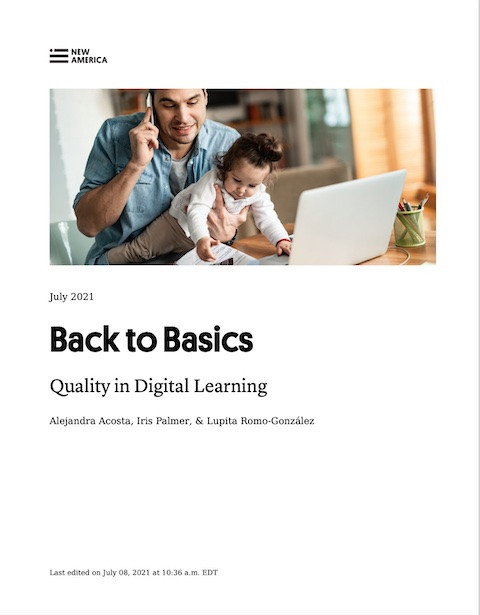 Back to Basics: Quality in Digital Learning Year of publication: 2021 Author: Alejandra Acosta | Iris Palmer | Lupita Romo-González Corporate author: New America | Bill and Melinda Gates Foundation The pandemic was, in some ways, a sneak preview of higher education’s future, one in which technology-mediated and -enabled education is ubiquitous, but with the potential for deep inequities in access to high-quality learning. This report describes some of the ways in which higher education succeeded and fell short during the remarkable 2020–21 year of distance learning. It proposes a trio of federal policy changes to build the ecosystem needed for online learning to ensure it is more equitable for students of color and low-income students, and to improve the quality for everyone (Acosta et al., 2021, p. 6).
 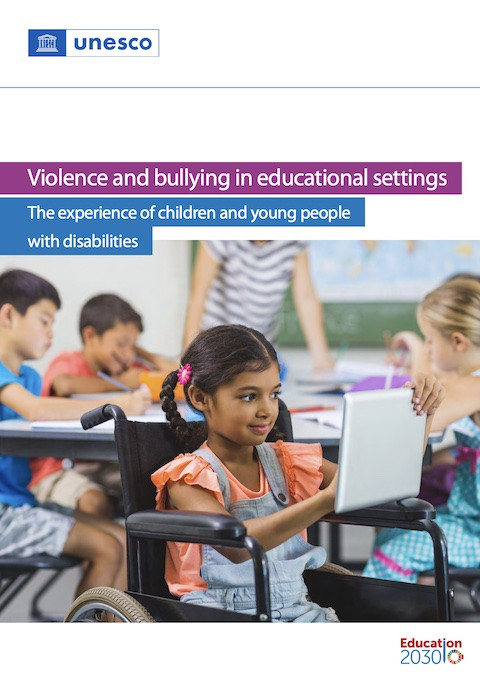 Violence and Bullying in Educational Settings: The Experience of Children and Young People With Disabilities Year of publication: 2021 Corporate author: UNESCO Learners with disabilities are disproportionately affected by school violence and bullying at all ages and in all learning settings. This has significant adverse impacts on their education, health and well-being. This document aims to raise awareness of the problem and encourage action to ensure that children and young people with disabilities have access to a safe learning environment.