
Resources
Explore a wide range of valuable resources on GCED to deepen your understanding and enhance your research, advocacy, teaching, and learning.
8,363 Results found
 Voluntary National Review on the Implementation of the Sustainable Development Goals in the Kyrgyz Republic 2020 Year of publication: 2020 Corporate author: Kyrgyzstan. Ministry of Economy | United Nations (UN) This voluntary review contains information on the implementation of the 2030 Sustainable Development Goals by the Kyrgyz Republic, objectives and directions for further activities. Special attention is paid to SDG 4 "Education", where the priority is to improve the quality and coverage of education at all levels, as well as the development of the lifelong education system.
  DEAR, Action Through Campaigning and Advocacy Year of publication: 2020 Corporate author: Development Education and Awareness Raising (DEAR) Programme | European Commission This video gives an overview of the kind of work that DEAR-funded projects do in campaigning and advocacy. It also emphasizes the principles of Global Citizenship Education and the active involvement of citizens.
  Gender and Rural Development in Eastern Europe and Central Asia: Key Issues Year of publication: 2016 Corporate author: Food and Agriculture Organization of the United Nations (FAO) This report provides a brief overview and description of the critical issues affecting the situation of rural women in the region. This overview has been compiled with the aim of informing all stakeholders and using this information in public campaigns and to achieve greater impact of interventions for development.
  Media and Information Literacy: Training Materials Year of publication: 2015 Corporate author: UNESCO This compendium contains the reports of four studies on religion and democracy conducted by the International Alert project "Constructive Dialogues on Religion and Democracy". The studies were carried out by young professionals trained in the framework of the project in 2017 and 2018.
  Promoting Media and Information Literacy in Uzbekistan Year of publication: 2015 Corporate author: UNESCO The manual presents in popular visual form the fundamentals of Media and Information Literacy (MIL), using UNESCO's teacher education programs and other materials from the organization. This manual was developed within the framework of the joint program of the UN and the Government of the Republic of Kazakhstan "Improving the well-being and quality of life in the Kyzylorda region through the introduction of innovative approaches to the provision of economic, social and environmental services to the local population, including the most vulnerable", carried out jointly by the Government of the Republic Kazakhstan and UN agencies in Kazakhstan: UNESCO, UNDP, UNFPA, UN Women, WHO and UNICEF until December 2016.
  Regional Consultations of the National Human Rights Institutions of Central Asia: Conference Proceedings Year of publication: 2016 Corporate author: UN. Office of the United Nations High Commissioner for Human Rights (UN. OHCHR) | United Nations Development Programme (UNDP) For the first time, the conference became a platform for consultations of national human rights institutions (NHRIs) of Central Asia to help strengthen partnerships and provide opportunities for mutual support and exchange of expertise. Special attention the role of NHRIs in their interaction with the government and other partners in the country, as well as the role of NHRIs in terms of achieving the Sustainable Development Goals (SDGs).
  Do All Students Have Equal Opportunities to Learn Global and Intercultural Skills at School? (PISA in Focus; No.109) Year of publication: 2020 Author: Tarek Mostafa Corporate author: Organisation for Economic Co-operation and Development (OECD) Many education systems seek to create an open, diverse and tolerant society, as education can play a significant role in countering racial, ethnic and national prejudice among children and adolescents. Education for living in an interconnected and diverse world could also contribute to forming generations of citizens who care about global and intercultural issues and who are able and willing to take action for sustainable development and collective well-being.In its 2018 assessment, PISA assessed the competences needed to live in an interconnected and diverse world. Global competence is defined in PISA 2018 as a multi-dimensional capacity that encompasses the ability to: 1) examine issues of local, global and cultural significance; 2) understand and appreciate the perspectives and worldviews of others; 3) engage in open, appropriate and effective interactions across cultures; and 4) take action for collective well-being and sustainable development. This PISA in Focus examines the equity of the learning opportunities for global and intercultural skills.
 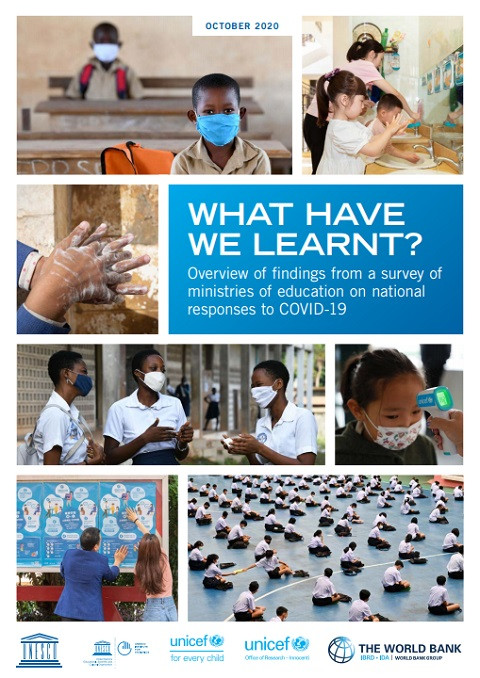 What Have We Learnt?: Overview of Findings From a Survey of Ministries of Education on National Responses to COVID-19 Year of publication: 2020 Corporate author: UNESCO | United Nations Children's Fund (UNICEF) | World Bank As part of the coordinated global education response to the COVID-19 pandemic, UNESCO, UNICEF and the World Bank conducted a Survey on National Education Responses to COVID-19 School Closures. In this joint report, the results of the first two rounds of data collection administered by the UNESCO Institute for Statistics (UIS) were analysed. They cover government responses to school closures from pre-primary to secondary education.
  Discourse on Peace-Oriented Citizenship in the Korean Peninsula: Form Unification Education in the Divided Society Into the Citizenship Education in the Peaceful Coexistence Era (Journal of Education for International Understanding; Vol. 15, No. 2) Year of publication: 2020 Author: Soonwon Kang Corporate author: Korean Society of Education for International Understanding (KOSEIU) This paper puts emphasis on designing the peace-oriented citizenship education towards the peaceful coexistent era beyond unification education in the divided society, analyzing the limits and possibility of democratic citizenship education connected with unification education which has been reflected by the peace process of present governments since liberation from the colonial period in 1945. According to the changes of unification education connected the peace process of each government, the name of historical subjects to take the initiative to overcome the division has been changed from civics saving the country to patriotic nation and onto the democratic citizen. Since Yushin reformation period, raising the democratic citizenship has been set up as the goal of unification education. But some critics of democratic citizenship were given to the limitation of the democratic citizen on overcoming the division and realizing peaceful coexistence and to the birth of hybrid citizenship with national commonality, Asian citizenship and global citizenship to challenge Korean peninsula agenda. Thus peace·unification education beyond division should be reconceptualized on the ground of the discourse of peace-oriented citizenship, which is applied to North Korea and South Korea as a global peace education framework.
  BRIGHTS Course Curriculum Year of publication: 2017 Author: Federica Funghi | Francesca Vannucchi Corporate author: Brights Project | European Union (EU) | European Commission This document presents the organization of the course to be delivered in the framework of the BRIGHTS project by specifying its diverse phases, the objectives and the learning outcomes, the kind of contents to be issued and how the participants (Teachers and Trainers working with youth) will be involved.