
Resources
Explore a wide range of valuable resources on GCED to deepen your understanding and enhance your research, advocacy, teaching, and learning.
8,363 Results found
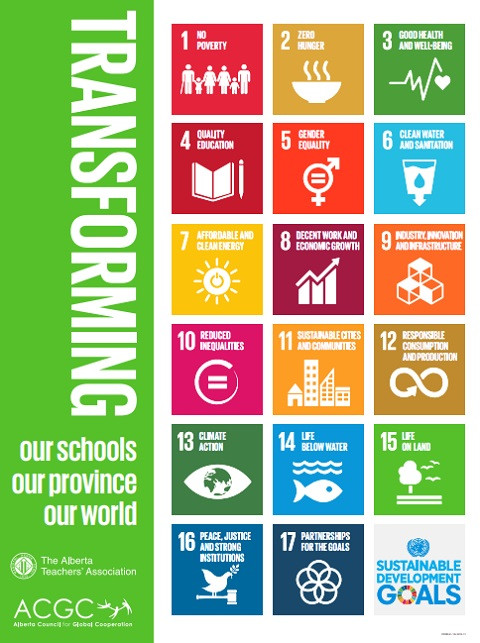 Transforming Our Schools, Our Province, Our World Year of publication: 2015 Corporate author: Alberta Council for Global Cooperation (ACGC) | The Alberta Teachers' Association (ATA) This is a poster about the SDGs for classrooms, made by ACGC and the Alberta Teachers’ Association.
  Pointed: High School Poetry Lesson Plan Year of publication: 2019 Corporate author: Alberta Council for Global Cooperation (ACGC) In this lesson, students will read and analyse the poem “Pointed” by Edmonton-based poet and scientist, Nermeen Youssef. Students will extend their learning through creating their own piece exploring inequities they see or face in health care services locally and globally.
 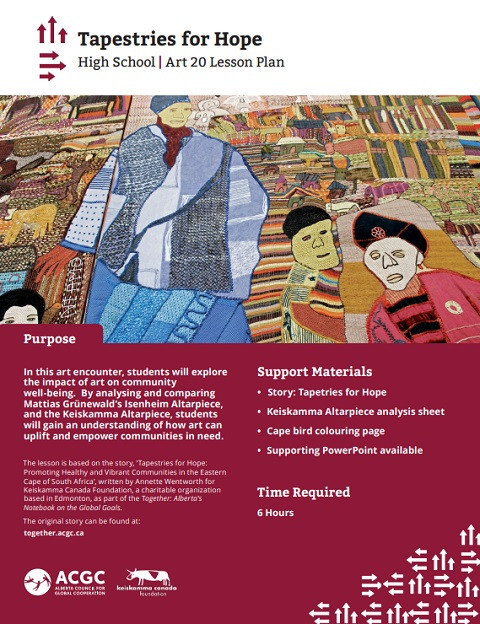 Tapestries for Hope: High School Art 20 Lesson Plan Year of publication: 2018 Corporate author: Alberta Council for Global Cooperation (ACGC) | Keiskamma Canada Foundation In this art encounter, students will explore the impact of art on community well-being. By analysing and comparing Mattias Grünewald’s Isenheim Altarpiece, and the Keiskamma Altarpiece, students will gain an understanding of how art can uplift and empower communities in need. The lesson is based on the story, ‘Tapestries for Hope: Promoting Healthy and Vibrant Communities in the Eastern Cape of South Africa’, written by Annette Wentworth for Keiskamma Canada Foundation, a charitable organization based in Edmonton, as part of the Together: Alberta’s Notebook on the Global Goals.
 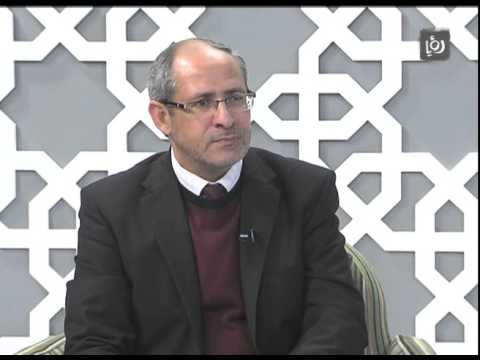 Islam, Diversity and Peacebuilding Year of publication: 2016 Author: Ramy Atta | Ahmed Naji Corporate author: Roya TV An interesting dialogue between the speakers about diversity and the extent to which Islam deals with this term. The speakers discuss the wealth of the Islamic religion in the root of diversity and pluralism, and how that leads to peace.
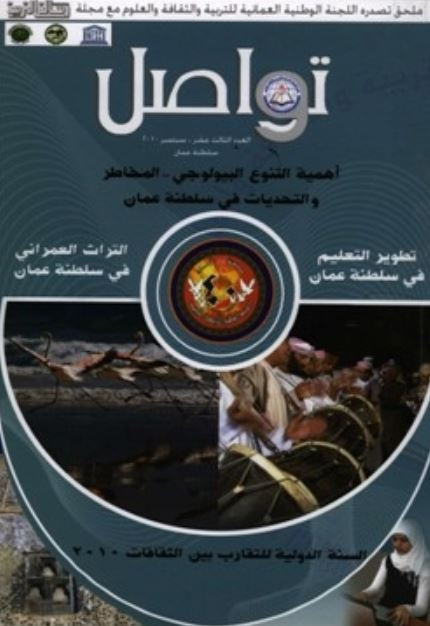
 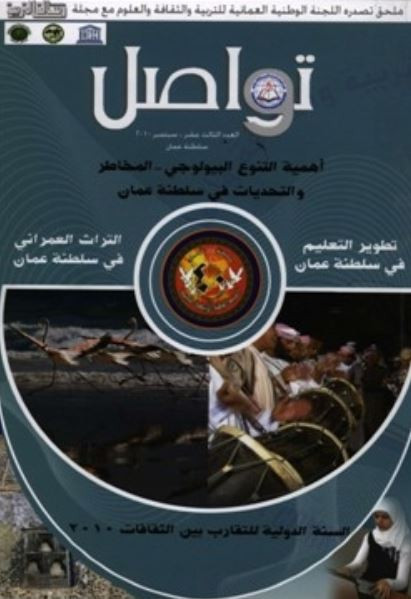 Education for Sustainable Development Conference in Support of Cultural and Biological Diversity, 24-26 January 2011 Year of publication: 2011 Author: Salem bin Hilal Al-Habsi | Mahmoud bin Abdullah Al-Abri Corporate author: Oman National Commission for Education, Culture and Science The text talks about a conference held in the Omani capital, Muscat. The conference focuses on sustainable development to support cultural and biological diversity. This conference comes to support international efforts and help educational systems understand diversity and its importance in the renaissance of peoples.
 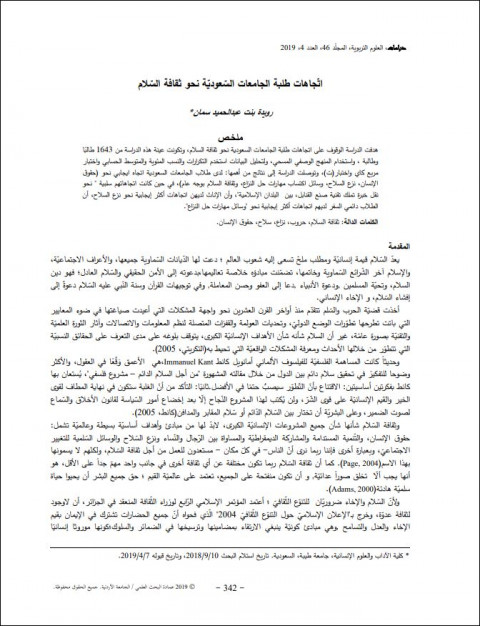 Saudi University Students’ Attitude Towards a Culture of Peace Year of publication: 2019 Author: Rowaidah Abdulhameed Saman Corporate author: University of Jordan The aim of this study is to identify the attitudes of Saudi Universities’ students towards peace culture. The descriptive surveying approach was used on a sample of 1643 students. The frequency, percentages, arithmetic mean, Kay-box test, and T-test were used in the analysis. The results showed that Saudi students have a positive attitude towards (human rights, disarmament, conflict resolution skills, peace culture) while their attitudes were negative towards transferring bomb-making experience to Islamic countries. Also, females had more positive attitudes towards disarmament than male students.
  The UNESCO and the Culture of Peace Year of publication: 2008 Author: Ahmed Al-Azri Corporate author: Oman National Commission for Education, Culture and Science The author presents the projects undertaken by the Sultanate of Oman to spread the culture of peace in its educational institutions. The author links this movement with what UNESCO aims to spread the culture of peace around the world.
 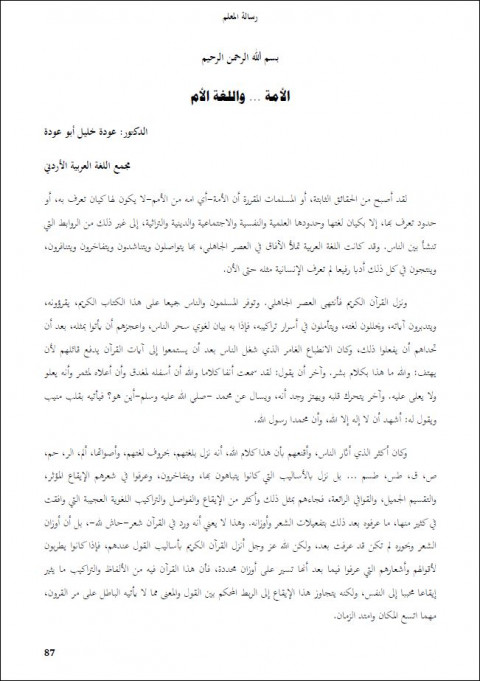 The Nation .. and the Mother Tongue Year of publication: 2016 Author: Odeh Khalil Abu Odeh The author talks in a brief way about the importance of the mother tongue of nations, and the need to preserve it. And he refers to the Arabic language as a language that must be taken care of, given its role in preserving culture.
 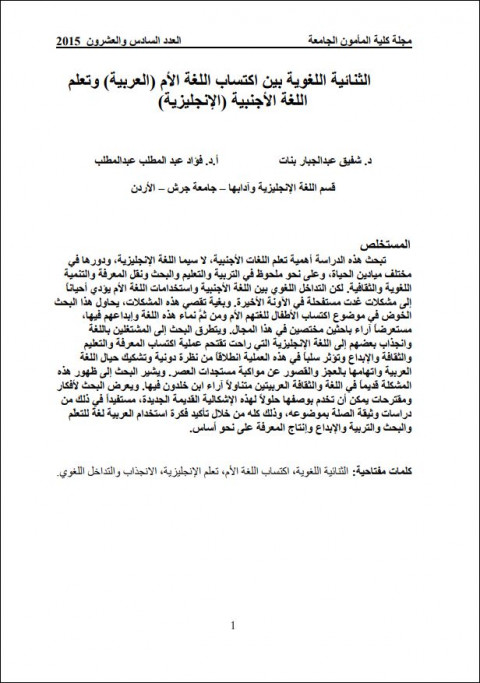 Bilingualism Between Mother Tongue (Arabic) Acquisition and Foreign Language (English) Learning Year of publication: 2015 Author: Fuad Abdul Muttalib | Shafeeq Banat Corporate author: AlMamon University College This research work considers the importance of learning of foreign languages, especially English, and their role in education, research, knowledge transfer, language and cultural growth. Language overlapping, between English and Arabic, leads sometimes to acute problems. To approach these problems, the work tries to discuss the acquisition of children of their mother tongue, its expansion and its use creatively in different disciplines.The work tackles the attraction of English to some experts in their fields, the thing that drives them to look suspiciously and down at Arabic accusing it of incompetence to catch up with new changes. Since language overlapping is an old problem, this has entailed a reference to Iben Khaldoun’s diagnosis of it with commentary. The work asserts eventually the essential use of Arabic as a language of education, research, culture and knowledge production, without neglecting foreign languages learning, above all English. The work is carried out in the light of the available studies on this issue.
 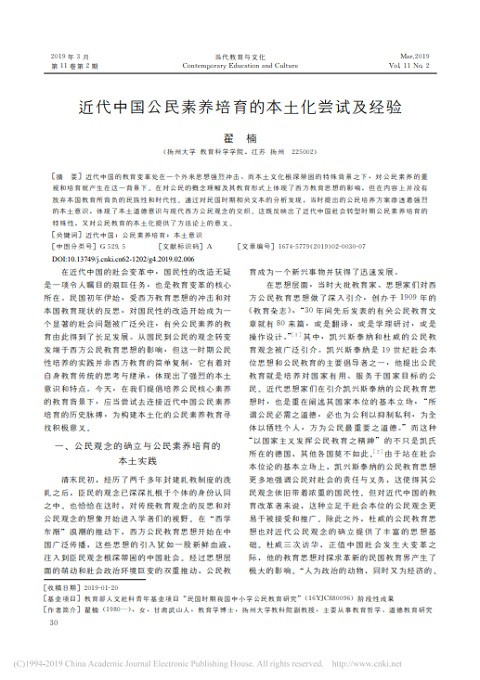 Attempts in and Experiences of the Cultivation of Civic Literacy in Modern China (Contemporary Education and Culture; Vol. 11, No. 2) Year of publication: 2019 Author: Zhai Nan Corporate author: Northwest Normal University The educational reform in modern China takes place in a special context of strong impact of foreign ideas and deep-rooted local culture where the importance is attached to the cultivation of Chinese citizens’ civic literacy. The concept of the citizen and its educational form reflect the influence of western educational thought, while the contents of education stick to the features of the Chinese nationality and modern times. Through an analysis of the publications in the Republic China period, it is found that the scheme was permeated with a strong local awareness, and reflected the combination of the native moral consciousness and the modern western civic concept. This not only reflects the particularity of the cultivation of civic literacy in the period of social transformation in modern China, but also is of methodological significance to the localization of citizen education.