
Resources
Explore a wide range of valuable resources on GCED to deepen your understanding and enhance your research, advocacy, teaching, and learning.
8,363 Results found
 Focus on Global Common Good: The New International Research Trend on World Citizenship Education (Modern Education Management; No. 2) Year of publication: 2018 Author: Song Qiang | Rao Congman Corporate author: Liaoning Institute of Education Globalization has posed challenges for national-states to develop traditional citizenship education. To develop the citizenship education in the world needs to regard education and knowledge as global common good, surpass short-term benefit, and promote learners to be world citizens by 2030. Start with the dialectical logic on global benefit and national benefit, the researches of world citizenship education focus on “human rights protection and joint development”, “from national identity to world identity”, “ from global governance to world government”, and “ western universal mind vs. multi-civilizations intergrowth”. Chinese citizenship education needs to reinforce the national identity in socialism national citizenship education; cultivateing socialism world citizenship and promoteing international discourse power; seek human common good and build community of common destiny for all mankind.
  Research on Civic Literacy Assessment Tools for Primary and Middle School Students (Journal of Shanghai Educational Research; No. 7) Year of publication: 2018 Author: Qin Jianping | Zhanf Hui | Chen Feipeng Corporate author: General Education Research Institute | Shanghai Academy of Educational Sciences Civic literacy is highly valued by international organizations and countries all over the world. China’s Ministry of Education has taken civic literacy as a key indicator for the comprehensive evaluation of the quality of primary and secondary education. Based on citizen, civic literacy connotation, civic education objective content, and common factors of civic literacy test, the dimensional structure hypothesis of civic literacy assessment for primary and middle school students was proposed, and the hypothesis was tested and corrected by using structural equation model, and the civic literacy test for primary and middle school students was developed. The reliability and validity meet the requirements of measurement and have a broad application prospect.
 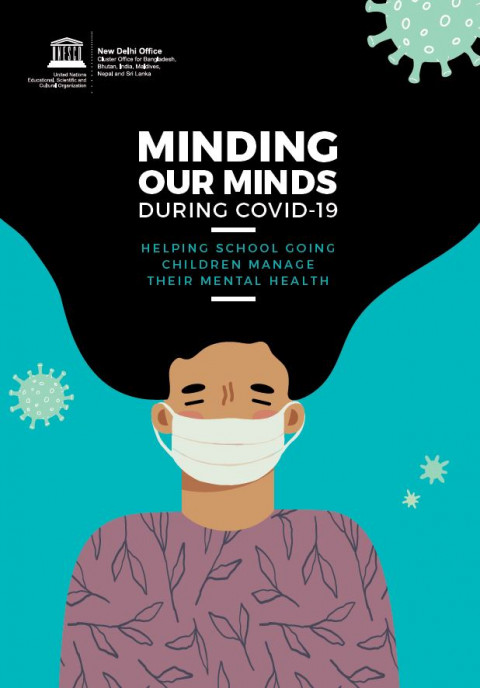 Minding Our Minds during COVID-19: Helping School Going Children Manage Their Mental Health Year of publication: 2020 Author: Huma Masood | Cynthia Saxena Corporate author: UNESCO New Delhi This guide provides an outline of how teachers and parents can address the issue of mental health amongst students. The sections in this guide cover basic information about coronavirus, explanation of anxiety in school going children, as well as ways by which students can take care of their mental health during this crisis. The sub-sections of the guide comprise guidelines outlining the duties and responsibilities that teachers and parents/ caregivers must follow to ensure students’ mental health is not negatively impacted by the COVID-19 pandemic. Additionally, sub-sections of the guide provide activities and exercises that teachers and parents can utilize to engage children with to ensure their wellbeing during these difficult times.
  Report of the Committee on the Rights of the Child (General Assembly Official Records Sixty-fifth Session Supplement No. 41) Year of publication: 2010 Corporate author: UN. Committee on the Rights of the Child (UN. CRC) This report reviews the efforts of the Committee on the Rights of the Child, published in 2010. The report is considered a tool to review the Convention on the Rights of the Child and what has been done to achieve it.
 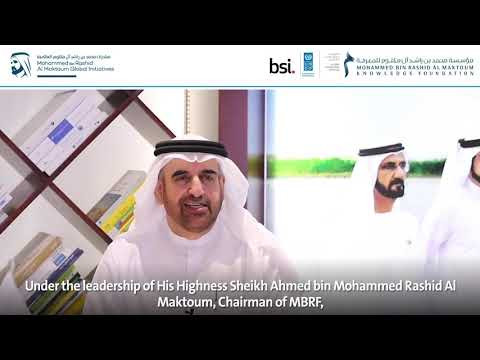 The Role of Knowledge in Achieving Sustainable Development Goals Year of publication: 2020 Corporate author: Mohammed Bin Rashid Al Maktoum Knowledge Foundation (MBRF) This video discusses the role of knowledge in achieving the sustainable development goals. In which the interlocutors host a group of specialists to talk about the efforts made in achieving the goals of sustainable development, and how the Arab nation can achieve the goals.
 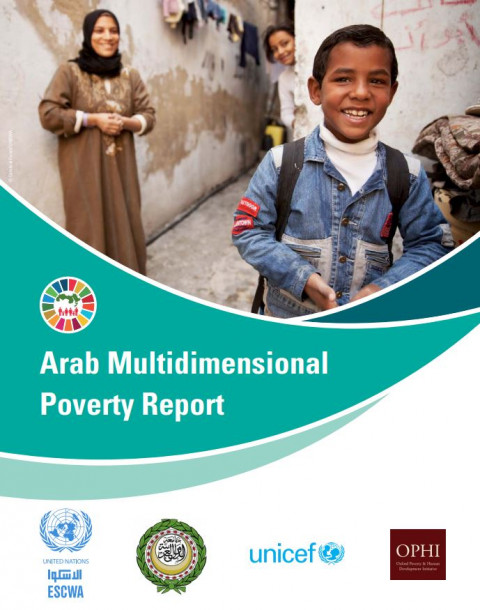 Arab Multidimensional Poverty Report Year of publication: 2017 Corporate author: UN. Economic and Social Commission for Western Asia (UN. ESCWA) | United Nations Children's Fund (UNICEF) | Oxford Poverty and Human Development Initiative (OPHI) The Arab Multidimensional Poverty Report, the first of its kind following the launch of the 2030 Agenda, is the result of three years of collaboration between the League of Arab States’ Council of Arab Ministers for Social Affairs, the Economic and Social Commission for Western Asia (ESCWA), the United Nations Children's Fund (UNICEF), and Oxford Poverty and Human Development Initiative (OPHI).
  Poverty Culture Impact on Some Educational Values and Attitudes of Secondary Stage Students in Al-Madinah Al-Munawarah Province Year of publication: 2013 Author: Aysha Al-Ahmadi Corporate author: University of Jordan The study aimed at identifying the impact of the culture of poverty on some educational values and attitudes of high school students in Madinah. The researcher adopted the descriptive approach through the application of a questionnaire concerned with monitoring the moral and sensory trends of the study sample. The questionnaire was developed towards measuring some educational values and attitudes, and collecting data related to the student’s gender and family income Ownership and type of housing, and parenting education.
 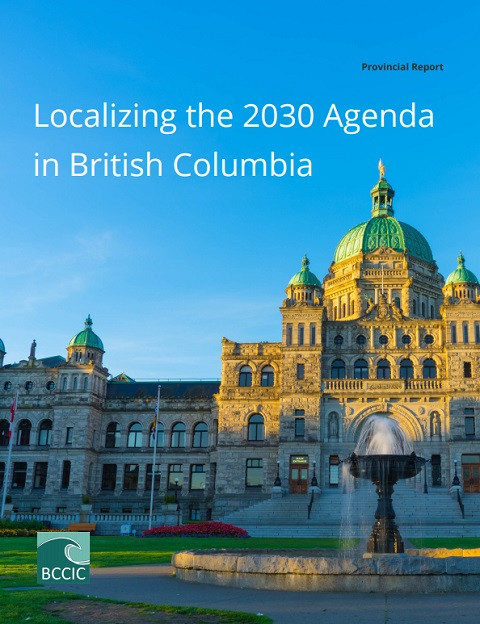 Localizing the 2030 Agenda in British Columbia Year of publication: 2020 Author: Zosa De Sas Kropiwnicki-Gruber | Dan Harris Corporate author: British Columbia Council for International Cooperation (BCCIC) This report details a British Columbian civil society response to the Government of Canada’s current interim national Sustainable Development Goals strategy. The report provides feedback on the interim strategy and Canada’s engagement with the United Nations Sustainable Development Goals (SDGs) including recommendations linked to the interim strategy’s key actions. At this time it represents the only provincial scale civil society consultation on the strategy in Canada. The report begins by introducing the origin of the interim national SDG strategy and the rationale for holding the consultation. While the following section on “What we heard” captures common themes on how to improve the strategy and Canada’s engagement with the SDGs, the report then concludes with recommendations synthesized from these suggestions on the ways in which we can strengthen and enact the interim national SDG strategy.
  Uzbekistan: Voluntary National Review 2020 Year of publication: 2020 Corporate author: United Nations (UN) This voluntary review contains information on the implementation of the 2030 Sustainable Development Goals by the Republic of Uzbekistan, objectives and directions for further activities. Special attention is paid to SDG 4 "Education", where the priority is to improve the quality and coverage of education at all levels, as well as the development of the lifelong education system.
 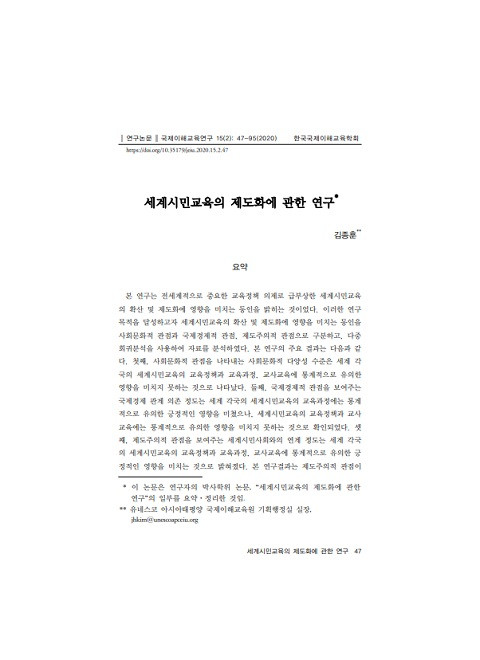 The Institutionalization of Global Citizenship Education as a Global Policy Agenda (Journal of Education for International Understanding; Vol. 15, No. 2) Year of publication: 2020 Author: Jonghun Kim Corporate author: Korean Society of Education for International Understanding (KOSEIU) The purpose of this study was to examine the driving forces that affect the global diffusion and institutionalization of Global Citizenship Education (GCED), which is rapidly emerging as an important global education agenda. In order to achieve the objective of this study, driving forces affecting the diffusion and institutionalization of GCED were categorized into three perspectives, namely, sociocultural perspective, international economic perspective and institutional perspective. The data were analyzed using multiple regression analysis. The main findings of this study are as follows. First, the degree of sociocultural diversity that represents sociocultural perspective did not have a statistically significant effect on education policies, curriculum and teacher education on GCED in each country. Second, the degree of dependence on international economic relations, which shows international economic perspective, had a positive statistically significant effect on the curriculum of GCED in countries around the world but it did not have a statistically significant effect on education policy and teacher education of GCED. Third, the degree of linkage to the global civil society that represents institutional perspective has a positive statistically significant effect on the GCED education policies, curricula and teacher education of different countries around the world. The results of this study show that institutional perspectives are more persuasive drivers of the spread and institutionalization of GCED in individual countries than from sociocultural perspective and international economic perspective. The result of this study shows that the adoption of policies for GCED is an institutional embodiment reflecting education norms and values at the global level embedded in an institutional environment of the world society rather than instrumental means that meet immediate and concrete socioeconomic needs and demands of individual countries. This study is of significance in that it has identified the driving forces for the diffusion and institutionalization of GCED through empirical analysis.