
Resources
Explore a wide range of valuable resources on GCED to deepen your understanding and enhance your research, advocacy, teaching, and learning.
8,364 Results found
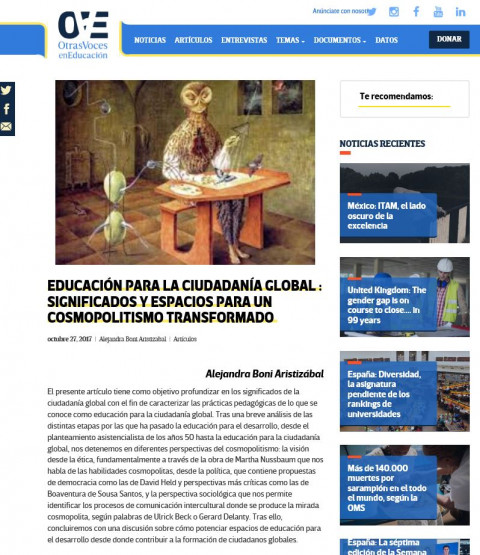 Education for Global Citizenship: Meanings and Practices for a Transformative Cosmopolitism Year of publication: 2017 Author: Alejandra Boni Aristizabal According to the author: "The article aims to analyze in depth the meanings of global citizenships in order to characterize the pedagogical practices of what is known as education for global citizenship. After a brief analysis of the different stages that education for development has gone through, from the assistencialist approach of the 50s to education for global citizenship, we study different perspectives of cosmopolitanism: a vision from the field of ethics, mainly from Martha Nussbaum's perspective that talks about cosmopolitan abilities, from politics, that has democratic proposals such as David Held's, critical perspectives as Boaventura de Souza Santos' ones, and the sociological perspective that allows us to identify intercultural communicative processes where the cosmopolitan view is produced, according to Ulrick Beck's or Gerald Delanty's words. After this, we conclude with a discussion about how to encourage education for develpment spaces that foster global citizenship."
 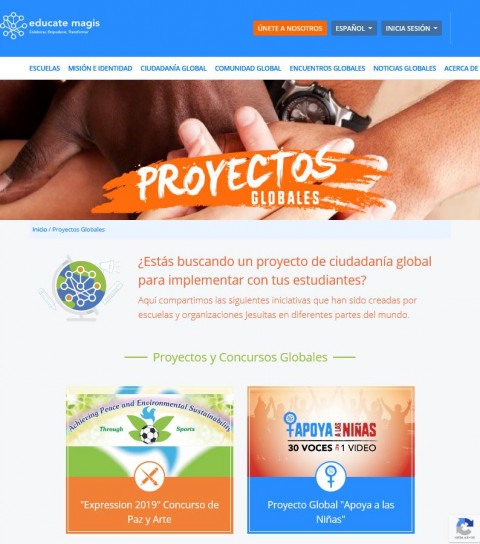 Are You Looking for a Global Citizenship Project to Implement with Your Students?: Global Projects and Contests Year of publication: 2019 Corporate author: Educate Magis In this part of the Educate Magis' webpage from the Society of Jesus one can access a calendar with global activities and events and information about different initiatives that have been organized by different jesuit schools and organizations around the world. One can access different global citizenship educational projects such as "Global red chair", "Walk a mile in my shoes", or "Stand with Girls global project".
  Planetary Citizenship Year of publication: 2016 Author: Edgar Montiel The blog contains and article where many worldiwide problems that humans are facing are described, and it states that it is necessary to modifiy the way in which we live by adopting a practical education that will enable sustainable life in the planet as it would consider environmental sustainability and peaceful international cooperation from diverse perspectives.
  Epistemology from the South: A Decolonized Vision of the Objectives for Sustainable Development Year of publication: 2016 Author: Javier Collado Ruano Corporate author: Universidade de Sao Paulo The research object of this article is to identify the different epistemological and methodological perspectives that have emerged from the global South. It also addresses the irruption of globalization and cross-border processes of climate change from the called “epistemology of the South” perspective. As a result, it claims the need for cross-cultural bridges between people from all over the world to overcome the paradigmatic crossroads at which we find ourselves as a world-system, with the aim to achieve the Sustainable Development Goals set by the United Nations for the year 2030.
 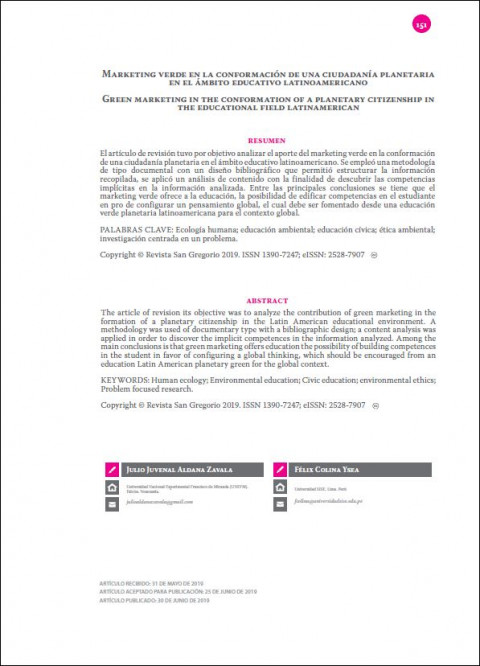 Green Marketing in the Conformation of a Planetary Citizenship in the Educational Field Latinamerican Year of publication: 2019 Author: Julio Juvenal Aldana Zavala | Félix Colina Ysea The article reviews and analyzes the contribution of green marketing in the formation of a planetary citizenship in the latin american educational systems. A documental and biblographic review methodology was used to gather and structure the information. The content of the documents was analyzed trying to discover the implicit competences for global citizenshipo present in the information. One of the main conclusions is that green marketing offers education the possibility of building competences that favour global thinking in students; thing that should be encouraged from a latin american green education perspective for the global context.
 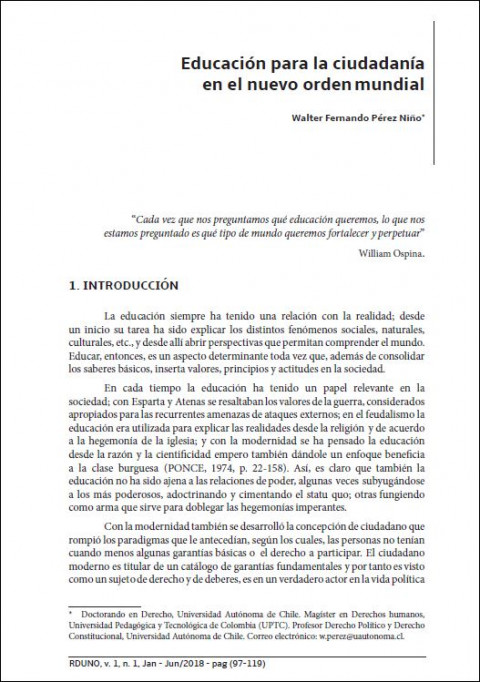 Education for Citizenship in the New Global Order Year of publication: 2018 Author: Walter Fernando Pérez Niño This article analyzes the concept of citizenship from a historical perspective and confronting it with an analysis of the different hegemonies that have tried to impose a global order and the consequences of applying policies that obey to this order. After this, it revises the right of receiving an education bearing in mind the new global realities; and, finally, it centers the study in the different problems education is facing as a consquence of the world order and proposes a perspective to follow.
 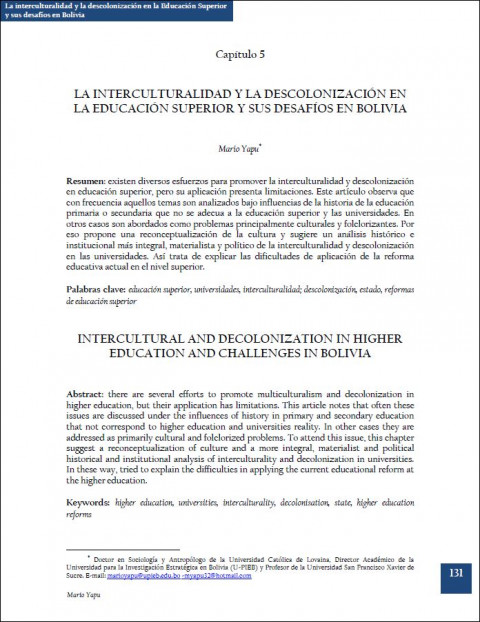 Intercultural and Decolonization in Higher Education and Challenges in Bolivia Year of publication: 2016 Author: Mario Yapu Corporate author: CELEI Chile There are several efforts to promote multiculturalism and decolonization in higher education, but their application has limitations. This article notes that often these issues are discussed under the influences of history in primary and secondary education that not correspond to higher education and universities reality. In other cases they are addressed as primarily cultural and folclorized problems. To attend this issue, this chapter suggest a reconceptualization of culture and a more integral, materialist and political historical and institutional analysis of interculturality and decolonization in universities. In these way, tried to explain the difficulties in applying the current educational reform at the higher education.
 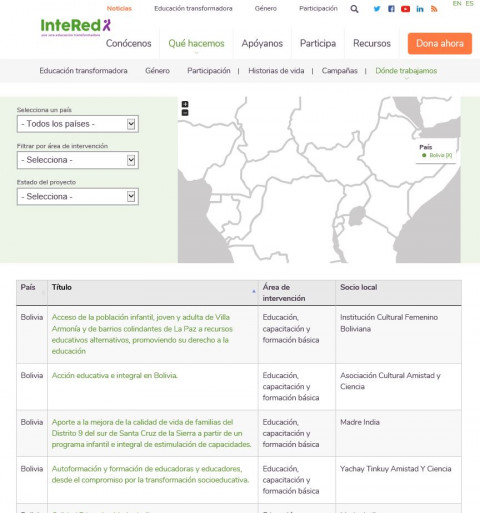 InteRed. Educational Projects in Bolivia Year of publication: 2019 Corporate author: InteRed InteRed carries out educational projects to solve specific social problems around the planet. The projects tackle things such as poverty, health, access to education, Human Rights, access to food, among other things.
  Education for Develpment and for Global Citizenship: Proposals from the University Year of publication: 2018 Author: Manuel- Jesús Hermosín-Mojeda | Begoña Mora-Jaureguialde | Heliodoro Manuel Pérez-Moreno From the “Education for Development and International Cooperation” course, which is part of the Social Education career at the University of Huelva, students are performing some social activities to experience different theoretical concepts through social-educational projects that the students, in teams, organize and carry out during the semester. These projects promote, committed and responsible global citizens who can promote social changes in the careers they are persuing.
  Addressing Global Citizenship Education in Adult Learning and Education; Summary Report Year of publication: 2019 Author: Christiana Nikolitsa-Winter | Werner Mauch | Philippe Maalouf Corporate author: UNESCO Institute for Lifelong Learning (UIL) | APCEIU The Asia-Pacific Centre of Education for International Understanding (APCEIU) has published the summary report on Addressing Global Citizenship Education in Adult Learning and Education (ALE) in partnership with UNESCO Institute for Lifelong Learning (UIL). In regard to GCED in ALE the publication looks at the developments, gaps and challenges in Finland, Mauritania, the Republic of Korea, South Africa, and Uruguay and highlights a number of good practices in the field. As the role of ALE and GCED has been emphasized in realizing the 2030 Sustainable Development Agenda, it aims to raise awareness of the significance of GCED in ALE and to inspire various stakeholders to develop and strengthen this field of education. ForewordIntroduction Part I: Thematic Studies Global citizenship education(GCED): Conceptual considerationsRealizing the 2030 Sustainable Development Agenda: The role of GCED in ALEALE’s contribution to fostering GCED - ALE as GCEDLiteracy: The foundation of ALE and GCED - Contribution of adult literacy programmes to GCED outcomes - GCED in ALE: Global trends and outcomesProfessionalization of adult educators in GCED - Competency framework for adult educators in GCED - Curriculum framework for adult educators in GCED - Examples of curricula for adult educatorsConclusion on the thematic studies Part II: Case Studies GCED in ALE: Case studies from the five UNESCO regions - State of the art of ALE in the five countries - Legal frameworks and discourse - Selected ALE programmes and mechanisms that touch on GCED in the case studies - Professionalizing ALE educators as a means of fostering GCED in ALE: examples - Key outcomes of the country case studies - Addendum: GCED in ALE as a response to acute need - The BEF Alpha programme Conclusion and way forwardBibliography