
Resources
Explore a wide range of valuable resources on GCED to deepen your understanding and enhance your research, advocacy, teaching, and learning.
8,364 Results found
 NISSEM Global Briefs: Educating for the Social, the Emotional and the Sustainable Year of publication: 2019 Author: Andy Smart | Margaret Sinclair | Aaron Benavot | Jean Bernard | Colette Chabbott | S. Garnett Russell | James Williams Corporate author: Networking to Integrate SDG Target 4.7 and SEL skills into Educational Materials (NISSEM) The NISSEM global briefs are a collection of peer-reviewed essays from over 60 contributors with standing within the field of education. At the junction of SDG Target 4.7, SEL, and education in post conflict and low-resource settings, the NISSEM global briefs are a key resource for current research and practice.NISSEM is a Networking to Integrate SDG Target 4.7 and SEL(Social and emotional learning) into Educational Materials launched in March, 2018.
 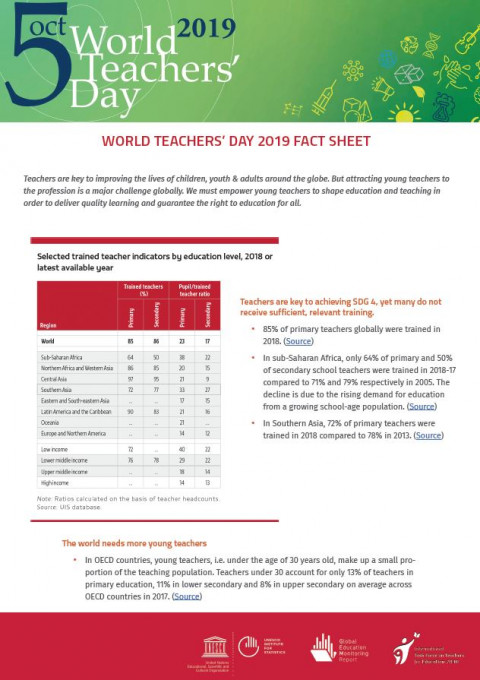 World Teachers' Day 2019: Fact sheet Year of publication: 2019 Corporate author: UNESCO Institute for Statistics (UIS) | International Task Force on Teachers for Education 2030 To mark World Teachers’ Day, GEM(Global education monitoring) report partnered with the UNESCO Institute for Statistics (UIS) and the International Task Force on Teachers for Education 2030 to pull together key facts and statistics on challenges for teachers around the world.The new factsheet provides the latest UIS data on trained teachers, the global indicator for SDG target 4.c. Globally, 85% of primary teachers were trained in 2018 but only 64% in sub-Saharan Africa. The proportion of teachers that are trained in sub-Saharan Africa is falling, mostly due to the rising demand for education from a growing school-age population.
  Journal on Education in Emergencies: Special Issue on Refugees and Education, Part I (Vol. 5, No.1 December 2019) Year of publication: 2019 Author: Sarah Dryden-Peterson | Jo Kelcey | S. Garnett Russell Corporate author: Inter-agency Network for Education in Emergencies (INEE) This special issue of JEiE—the first of two parts—showcases research on important developments in the field of refugee education across several regions, including the Middle East, Latin America, and Africa. The issue includes four research articles, one interview, two field notes, and three book reviews.The contributing authors describe and analyze how international agencies, state bureaucracies, local organizations and their partners, and refugees shape the structures that influence the education of refugees, both historically and in the present, and how these actors imagine their roles. In so doing, the authors help to untangle key questions about how responsibility for meeting refugees’ educational needs and aspiration is taken up and shared. The articles in this issue include immediate and long-term lessons for how refugee education is designed and experienced.
  Regional Capacity Development Resource Book on Monitoring SDG4-Education 2030 in Asia-Pacific Year of publication: 2019 Corporate author: UNESCO Bangkok | UNICEF East Asia and the Pacific The Education 2030 Agenda calls for robust monitoring, reporting, and evaluating indicators from Early Childhood Education (ECE) to adult education. The new agenda demands clear indicators and measurement to generate evidence-based international discourses and advocacy. Ensuring availability of education data and statistics for evidence based policy making and planning is also crucial. Countries’ capacity to respond to these demands will depend on quality mechanism for monitoring in place and technical capacity of data providers and users. The modules included in the this Regional Capacity Development Resource Book on Monitoring SDG 4-Education 2030 in Asia Pacific covers various topics that are relevant to building an effective national monitoring system, such as the creation of a national indicator framework and the development of national strategies for education statistics; strengthening the administrative data production system; and increasing the household survey application in monitoring education at the national level, as well as reporting at the global level.
 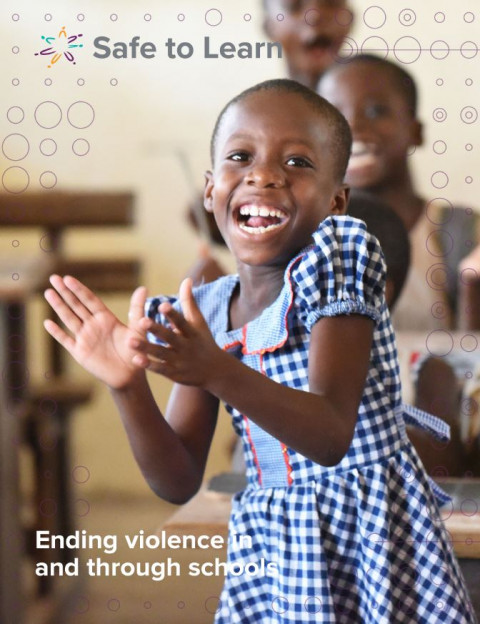 Safe to Learn: Ending Violence in and Through Schools Year of publication: 2019 Corporate author: End Violence Against Children Safe to Learn – is an initiative dedicated to ending violence in and through schools so children are free to learn, thrive and pursue their dreams. Safe to Learn presents an opportunity to unlock the multiple win of ending violence in schools, improving learning outcomes, better leveraging investments in education, and raising awareness and change attitudes towards violence against children. To date, 11 countries have endorsed Safe to Learn’s Call to Action, which sets out in high-level terms what needs to happen to end violence in schools. These countries include Cambodia, Georgia, Ghana, Honduras, Mexico, Moldova, Nepal, Sierra Leone, South Africa, South Sudan, Uganda and El Salvador.
  Learning to Leapfrog: Innovative Pedagogies to Transform Education Year of publication: 2019 Author: David Istance | Alejandro Paniagua | Rebecca Winthrop | Lauren Ziegler Corporate author: Center for Universal Education at Brookings This report follows up on the book “Leapfrogging Inequality: Remaking Education to Help Young People Thrive,” published in 2018 by the Center for Universal Education (CUE) at the Brookings Institution. The book argued the importance of education leapfrogging–creating transformative shifts rather than incremental evolution by harnessing the power of innovation to advance a breadth of skills. The book put forth a framework for leapfrogging that outlined two core elements (teaching and learning, and recognition of learning) and two support elements (people and places, and technology and data).This report focuses on the teaching and learning element of the leapfrog framework, especially on pedagogical approaches and the role of teachers, but draws on the others as relevant. It does not attempt to be exhaustive and does not pretend to address neither all education policy variables, nor critical system factors such as political will and adequate funding, nor demand-side factors such as student and parent support for innovative approaches.
 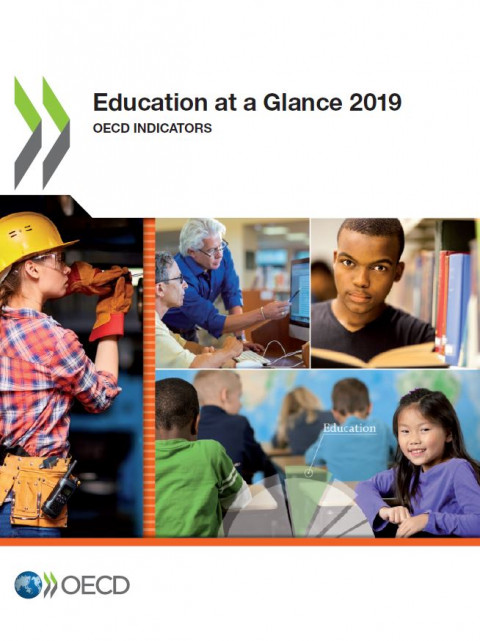 Education at a Glance 2019: OECD Indicators Year of publication: 2019 Corporate author: Organisation for Economic Co-operation and Development (OECD) Education at a Glance is the authoritative source for information on the state of education around the world. It provides data on the structure, finances and performance of education systems across OECD countries and a number of partner economies.The 2019 edition includes a focus on tertiary education with new indicators on tertiary completion rates, doctoral graduates and their labour market outcomes, and on tertiary admission systems, as well as a dedicated chapter on the Sustainable Development Goal 4.
 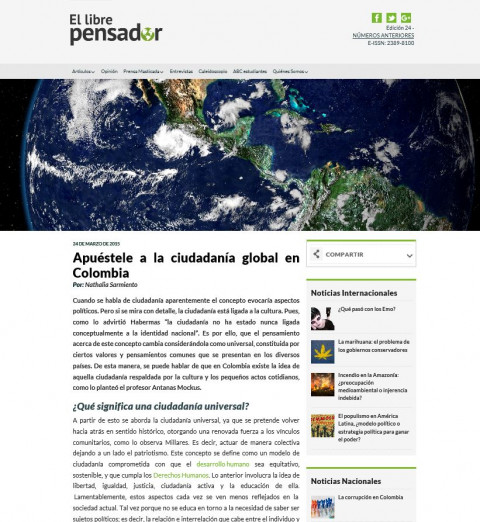 Bring Global Citizenship in Colombia Year of publication: 2015 Author: Nathalia Sarmiento The blog from the Universidad Extremado from Colombia defines what global citizenship is and its ideals, and promotes a citizenship of this type for Colombia. It states that a humanistic and universal perspective, committed with human development, will foster greater liberty, equality, justice, an active citizenship and the education that goes with it.
 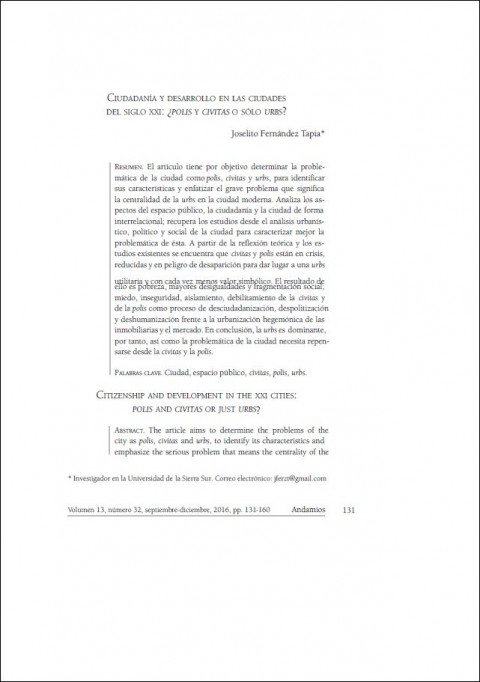 Citizenship and Development in the XXI Cities: Polis and Civitas or Just Urbs? Year of publication: 2016 Author: Joselito Fernández Tapia The article aims to determine the problems of the city as polis, civitas and urbs, to identify its characteristics and emphasize the serious problem that means the centrality of the urbs in the modern city. It analyzes aspects of public space, citizenship and city, as interrelated, recovering from urban studies, political and social analysis of the city, to better characterize their problems. From the literature and existing studies we found that civitas and polisare in crisis, and reduced danger of disappearing, to result in a urbs, utilitarian and less and less symbolic value. The result is poverty, greater inequality and social fragmentation, fear, insecurity, isolation, weakening of the civitas and polis, disenfranchisement, depoliticization and dehumanization; against the hegemonic and development of real estate market. It is concluded that dominates the urbs, which, as all the problems of the city needs to be rethought from the civitas and polis.
 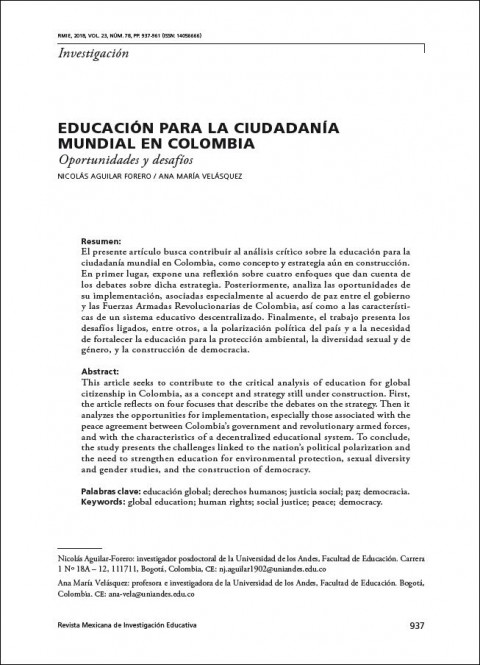 Education for Global Citizenship in Colombia: Opportunities and Challenges Year of publication: 2018 Author: Nicolás AguilAr Forero | Ana María Velásquez This article seeks to contribute to the critical analysis of education for global citizenship in Colombia, as a concept and strategy still under construction. First, the article reflects on four focuses that describe the debates on the strategy. Then it analyzes the opportunities for implementation, especially those associated with the peace agreement between Colombia’s government and revolutionary armed forces, and with the characteristics of a decentralized educational system. To conclude, the study presents the challenges linked to the nation’s political polarization and the need to strengthen education for environmental protection, sexual diversity and gender studies, and the construction of democracy.