
Resources
Explore a wide range of valuable resources on GCED to deepen your understanding and enhance your research, advocacy, teaching, and learning.
8,364 Results found
 Planning and Producing Radio Programs and Their Role in Spreading a Culture of Peace Year of publication: 2014 Author: Ibrahim, Salma Ibrahim Corporate author: Sudan University of Science and Technology The research is a master thesis entitled: Planning and producing radio programs and its role in spreading a culture of peace. Omdurman radio case study. Where the official media, represented by the Sudanese National Radio, works to support the peace process in the required manner so that the contents of program planning and popular media can be taken advantage of because of its great characteristics in supporting the culture of peace. The method used in this study is descriptive and historical.The most important objectives of the study: Promote, deepen and deepen the culture of peace through the various media outlets represented in the audio station. Know how to plan radio programs that support a culture of peace.The most important results that the researcher reached: The radio, through its various programs and its planning of programs, did not succeed in consolidating the culture of peace. There is no program planning now in the general program in order to stop researches, through which the outcome of peace messages can be known.Among the most important recommendations that came out of the research: Work in earnest to establish a culture of peace with individuals with appreciable spaces for this purpose, because peace is the foundation for development and stability. Program planning is of great importance. Therefore, budgets must be set up to conduct research periodically, because of its importance in knowing what the listener wants, and through planning it is possible to know enough time spaces to broadcast peace messages in order for the recipient to be entrenched in the mind of the recipient.
  Women Empowerment in Saudi Arabia - Human Rights Commission Year of publication: 2019 Corporate author: HRCSaudi The symposium on women's empowerment in the Kingdom was held on Thursday, 03/30/1440 H, organized by the Human Rights Commission and in cooperation with the United Nations Office in Riyadh at the Ritz Carlton Hotel.
  Human Security and Human Rights: A Comparative Analytical Study Year of publication: 2017 Author: Al-Qahtani | Wazaa bin Ghanem Corporate author: Naif Arab University for Security Sciences (NAUSS) Study Problem: The study problem is determined by the following main question: What are the similarities and differences between the concepts of human security and human rights?
  Civil Society and Building a Democratic Civil State: A Political Approach Year of publication: 2016 Author: Tareq Ziad Abu Hazeem The purpose of this study is to find a foundation for the concepts of the 'civil society' and the 'civil state'. It examines and compares both from different dimensions: description, purpose, objectives, history, the reality of the civil society and finally, to what extent they are similar. Most discussion is about civil society and civil democratic state, including studies, discussions and arguments, because of their importance in the Arab countries. In addition, this discussion seeks to clarify the role of civil society in building a democratic civil state. The researcher uses the systems analysis to point out the relationship between how active the civil society is and the establishment of the democratic civil state. After collecting and analyzing related statistics, this study has shown how much the civil society, the concept of democracy, and the state are related. The three represent the most important channels of public participation. In addition, the activeness of the civil society increases opportunities of political participation, supports the values of democracy and citizenship, and enhances the sovereignty of law.The three are the major components of the civil state. The results have revealed a number of facts: (1) there is a strong positive relation between the reasons behind the establishment of an active civil society and the establishment of the democratic civil society. Furthermore, (2) the civil society, its institutions and organized units, its ability of social coordination have created a strong state with powerful active institutions and limited the dominance of the society's powers over individuals. This has created a democratic civil state. (3) Individual and communicative will, increasing the public awareness of the importance of modernization and development, as well as stimulating the role of the active civil society lead to the development of a simple state to a democratic one. The study concludes with a major recommendation: the classical concept of the modern state as an independent uni-center of an isolated social coordination should be abandoned for the civil social organizations.
  Critical Global Semiotics: Understanding Sustainable Transformational Citizenship Year of publication: 2019 Author: Maureen Eills Critical Global Semiotics: Understanding Sustainable Transformational Citizenship incorporates powerful unifying frameworks which make explicit a developing global consciousness. It explores transdisciplinary ‘common wealth’ through focus on multimodality, media, and metaphor, testing two universally applicable humanitarian frameworks: critical realism (CR) and systemic functional semiotics (SFS).Every day global citizens encounter an overwhelming host of genres and sub-genres, emergent semantic triangles, evolving semiotic trinity. Embodying philosophy, incorporating active engagement, this book addresses the political economy and cultural politics of diverse domains.Challenging daily drama and performative dharma, 24 analysts from 13 countries present current issues in Anthropology, Architecture, Dance, Feminism, Film, Health, Law, Management, Medicine, Music, Politics, Pharmaceuticals, Sociology, Sustainability Education, and Urban Development.The book’s integrative, unifying foundations will be of interest to researchers, academics, and post-graduate students in the fields of linguistics, semiotics, and critical realist philosophy, as well as to policy makers, curriculum developers, and civil society.
  Charlevoix Declaration on Quality Education for Girls, Adolescent Girls and Women in Developing Countries Year of publication: 2018 Corporate author: G7 The Charlevoix Declaration is a commitment from the Leaders of the G7 to work towards inclusive, quality, equitable education for girls, adolescent girls, and women in developing countries and crisis contexts.The Charlevoix Declaration on Quality Education for Girls, Adolescent Girls and Women in Developing Countries represents a joint effort from the Leaders of G7 countries to step up for girls and women in conflict and crisis contexts. Focusing both on dismantling the barriers to education and improving the quality of education, the G7 have committed to promote and improve learning outcomes for both refugees and host communities, while also working to reduce the time children and youth, especially girls, are out of school as a result of conflict and displacement.To support the implementation of the Charlevoix Declaration, Canada also led the mobilization of CDN $3.8+ billion. With contributions from the World Bank, the European Union, Japan, Germany, and the United Kingdom, this initiative represents the single largest investment in education for girls in conflict and crisis settings.
  "It is Very Painful to Talk About”: The Impact of Attacks on Education on Women and Girls Year of publication: 2019 Author: Holly Cartner Corporate author: Global Coalition to Protect Education from Attack (GCPEA) This report presents the key findings of GCPEA’s multi-country study on the impact of attacks on education on women and girls.10 GCPEA’s research focuses on the types and causes of abuse most typically committed against female students in the context of attacks on education, and the long-term consequences that female students may face as a result of such attacks.11 GCPEA initiated this study to contribute to a better understanding of the implications for girls and women when education is attacked and to inform our advocacy for better strategies to protect girls and women, prevent attacks and abuse, and diminish harmful consequences against them.This report relies on previous GCPEA research, including Education Under Attack 2018 and 2014, and updates, and the organization’s field research in Nigeria and the Democratic Republic of Congo, which focused specifically on the experiences of women and girls when education is attacked. In addition, the report draws from interviews with numerous country and regional experts and an extensive review of secondary data sources, including reports by United Nations (UN) agencies, development and humanitarian non-governmental organizations (NGOs), human rights organizations, government bodies, and think tanks, including numerous contributions from GCPEA’s member organizations.
 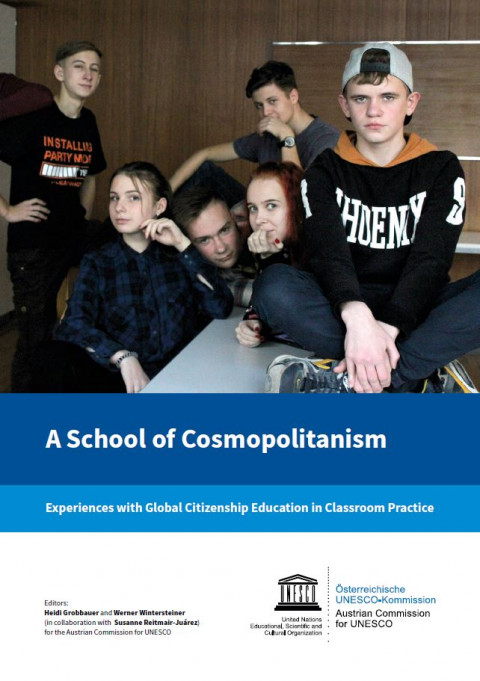 A School of Cosmopolitanism: Experiences with Global Citizenship Education in Classroom Practice Year of publication: 2019 Author: Heidi Grobbauer | Werner Wintersteiner Corporate author: Austrian Commission for UNESCO This publication focuses on examples from academic practice: this best practice collection demonstrates how young people can successfully be inspired to “think globally, act locally”. What is crucial is maintaining a view of the wider world; in particular, cooperation efforts with educational institutes outside of Europe (e.g. “élèves pour élèves” in Burkina Faso) provide a critical awareness of global connections. Learning to know/Learning to do/Learning to be/Learning to live together – these four pillars form the pedagogical foundation of the work carried out at more than 90 UNESCO schools throughout the whole of Austria. Since their founding in 1957, UNESCO schools have been considered model schools at which lessons are structured in a project-oriented, participative and even topic-specifc way. The unique ‘spirit’ of UNESCO schools often makes special projects possible. In the programme for the annual meetings of recent years, for example, Global Citizenship Education has been an ongoing topic of focus, accompanied by experts from various specialised institutions and NGOs. The pedagogical preparation of contents in a manner that ensures they are actually absorbed in the classroom presents a major challenge. Different types of schools have different educational goals, and the themes have to be made accessible for different age groups. The pedagogical finesse of each class team or individual teacher lies in finding the most motivating approaches.
  A Guide for Gender Equality in Teacher Education Policy and Practices Year of publication: 2015 Author: María C. Arango Restrepo | Esther Corona-Vargas Corporate author: UNESCO Transforming the culture of teacher education institutions and making them gender-sensitive entities is a daunting task. However, it is not an impossible task. Understanding gender and applying gender mainstreaming are critical foundations for fostering social cohesion that goes beyond teacher education institutions and the school. Teachers are increasingly expected to play crucial roles in preparing young people to face the future with confidence, purpose, responsibility and gender sensitivity. Teacher education institutions must be ready to provide the enabling environment and training and continuing education for the development of knowledge, values, skills and gender-responsive practices that the teachers need in the 21st century.This Guide, through its ten Modules, takes the reader through step by step on how gender can be mainstreamed in all areas of teacher education and training: from policy and planning, administration and management, gender-responsive budgeting, social services, the environment, curriculum, pedagogy, research, and to advocacy. Through this Guide, teacher educators are also reminded what teachers must know and be able to do in order to promote gender equality through education. The Modules can be used individually or comprehensively depending on the situation and context of countries.This Guide is dedicated to all teacher educators, whose intellectual rigour and tireless efforts to foster enabling environments for inclusive and gender sensitive education, are indispensable for success in continuing education.
  Environment and Sustainable Development: Concept and Content Year of publication: 2010 Author: Ellah Murat There is no doubt that environmental problems have become increasingly important across all levels, where all countries have been preoccupied with, and held many conferences. The world has become the forefront of the concerns of the year, and the protection of the environment - without doubt - a necessity of life in order to preserve. Environmental and economic balance, through the rational management of natural resources to preserve their sustainability for future generations.Their link to sustainable development, which calls for a new pattern of development that preserves available natural resources and creates clean alternatives that do not destroy the environment. The environmental dimension is a deeper dimension in sustainable development.From the effects on the natural environment of the universe, we will try through our modest study these research into the implications of the environment on the one hand and sustainable development on the other.