
Resources
Explore a wide range of valuable resources on GCED to deepen your understanding and enhance your research, advocacy, teaching, and learning.
8,364 Results found
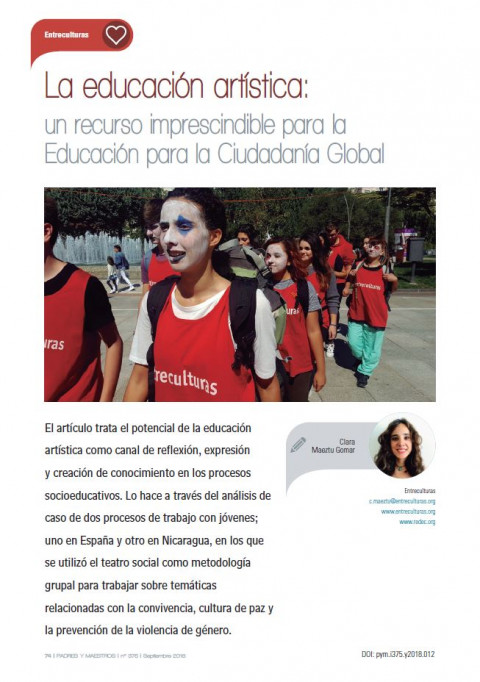 Artistic Education: An Essential Resource for Global Education Year of publication: 2018 Author: Clara Maeztu Gomar The article is about the potential of artistic education as a means of reflection, expression and production of knowledge in socioeducative processes. It details a case study were two working processes with youth are explained: one in Spain and the other one in Nicaragua. In both cases social theatre was used as a group methodology to work on thematics related with coexistence, culture of peace, and prevention of gender violence.
 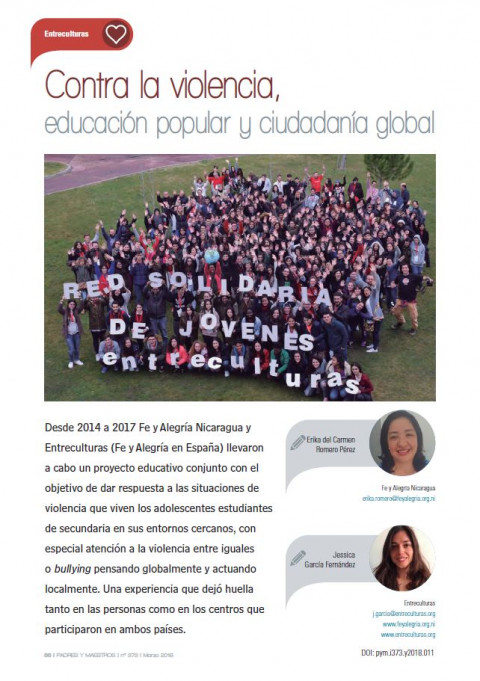 Against Violence, Popular Education and Global Citizenship Year of publication: 2018 Author: Erika del Carmen Romero Pérez | Jessica García Fernández The article is about a project that was carried out between 2014 and 2017 by two countries: Nicaragua and Spain, on behalf of the organizations "Fe y alegría Nicaragua" and "Entreculturas (Fe y Alegría España)". It was an educative project among both nations that had two main objectives: promoting both local and global citizenship, and to give answer to violent situations that adolescent students hae to face in secondary education contexts, with special attention to the violence among equals or bullying.
 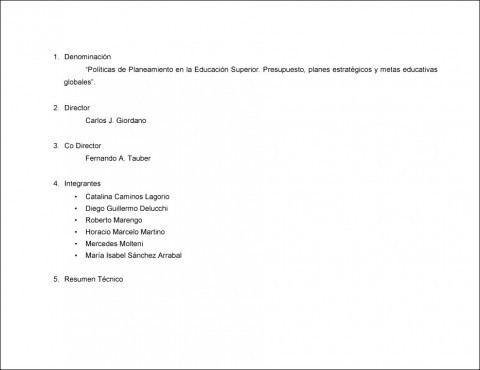 Policies in Higher Education Planning: Budget, Strategic Plans and Global Educative Goals Year of publication: 2016 Author: Carlos José Giordano | Fernando Tauber | Catalina Caminos Lagorio | Diego Guillermo Delucchi | Roberto Marengo | Horacio Marcelo Martino | Mercedes Molteni | María Isabel Sánchez Arrabal The document is a report from the Universidad Nacional de la Plata (UNLP), Argentina, that tries to explain de development of the Higher education planning policies from an analysis of the budgets and the strategic plans regarding global educative goals that have been accepted to constitute the macroinstitutional ideals of the system. The report tries to promote the circulation of a complex reflection of the place of the Universidad Nacional de la Plata in the Argentinian Higher Education system and of the discussion of the integral development of public policy models in the context of international globalized and cooperative-interinstitutional intentions.
 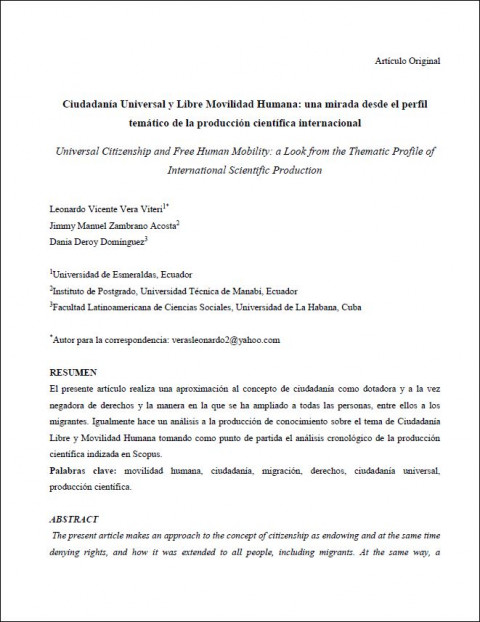 Universal Citizenship and Free Human Mobility: A Look from the Thematic Profile of International Scientific Production Year of publication: 2019 Author: Leonardo Vicente Vera Viteri, Jimmy Manuel Zambrano Acosta | Dania Deroy Dominguez In the summary the author explains that: "The present article makes an approach to the concept of citizenship as endowing and at the same time denying rights, and how it was extended to all people, including migrants. At the same way, a chronological analysis of the scientific production about Free Citizenship and Human Mobility in Scopus is carried out." In the article the author analyzes these aspects and ends by concluding that the academy may promote universal citizenship.
 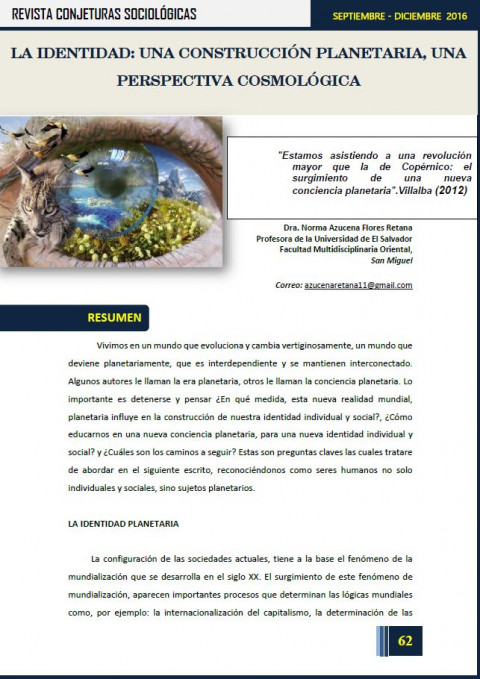 Identity: A Planetary Construction, a Cosmological Perspective Year of publication: 2016 Author: Norma Azucena Flores Retana In the article the author asks herself what a planetary citizenship is and how it should be promoted. She starts by questioning econocimic perspectives and ends by focusing on an ideal based on solidarity. In the article summary she states: "We live in a world that evolves and changes at a very high speed, a world that is become planetary, that is interdependant and interconnected. Some authors call it the planetary era, others a planetary consciousness. The important thing is to stop and think. Up to what extent, this new world reality, planetary, influences our individual and social identities? How can we educate ourselves in a new planetary conciousness, for a new individual and social identity?, and, which are the paths that we should follow? These are key questions which I will try to analyse in the article, recognizing ourselves not only as human beings that are individual and social, but also planetary." In the article the author provides broad answers and perspectives to the questions stated in the summary.
  Strategies to Exit Modernity: The Need of an Educative and Epistemological Turn to Overcome the Crisis Year of publication: 2019 Author: Mauro Rodrigo Avilés Salvador According to the author: "the crisis of modernity has led to a crisis in education; and by no means can this crisis be tackled in a unique or uniform way. Every context has to respond to the demands of change that are requested. If education is conceived as the key tool for social transformation, its role in promoting new civilization models cannot be neglected. One way of overcoming the crisis may be by reflecting about the symbol, its presence in art and religion, areas that may promote new elements for a future humanization." Then, in the article, from a critical pespective, the author enfatizes the role of Latin America a leader for a "different" kind of change, a change based on the cultural latinamerican ethos. The author quotes Edgar Morin, and mentions the need of a plural education that favours democracy, based on Human Rights. However, although he mentions universal aspects, he does not mention a planetary citizenship and he criticizes the european model.
  University Internationalization: A Higher Education Imperative in the Latin American Context Year of publication: 2016 Author: Rosario Leon Robaina | Luz Inmaculada Madera Soriano According to the author: "The article analyzes the challenge of being able to harmonize institutional, national and international interests, in order to fulfill the social mission of contributing to solving social problems and promoting human development, for which a global context has to be taken into account. The resurgence of educational internationalization is actually a consequence of this. Its development is founded on the will to enhance the capacity and identity of the university community for internationalization. Theoretically, the researchers started setting up the foundations from a qualitative approach, methodologically based on structural and systemic action research to establish the university internationalization strategy. The results show that the proposed strategy is an instrument that has enhanced the development of the internationalization culture, defining objectives and strategies, which from the praxis, are materialized in different action plans, using specific measurement criteria, and levels of achievement" The authors argument that a socially committed globalization is promoted.
  Intercultural Communication Human and Social Dimensions of Higher Education Year of publication: 2016 Author: Ingrid Steinbach Méndez Corporate author: Universidad Privada de Santa Cruz de la Sierra The starting point of this work is verifying the absence of and disregard for the human and social dimensions (knowing how to be and knowing how to coexist) in university education, including deficient intercultural communication manifested in discrimination ora lack of acknowledgement of the other. The problem is studied from the standpoints of the institution, the students and the faculty of the Faculty of Humanities and Communication of the Universidad Privada de Santa Cruz de la Sierra, Bolivia (FHC-UPSA). Using a qualitative quantitative methodology and a hermeneutic interpretation, voids are confirmed in the areas of "knowing how to be" and "knowing how to coexist" in the curricular designs as well as in the practices, behaviors and attitudes (habitus) of the students and faculty when faced with diversity.
 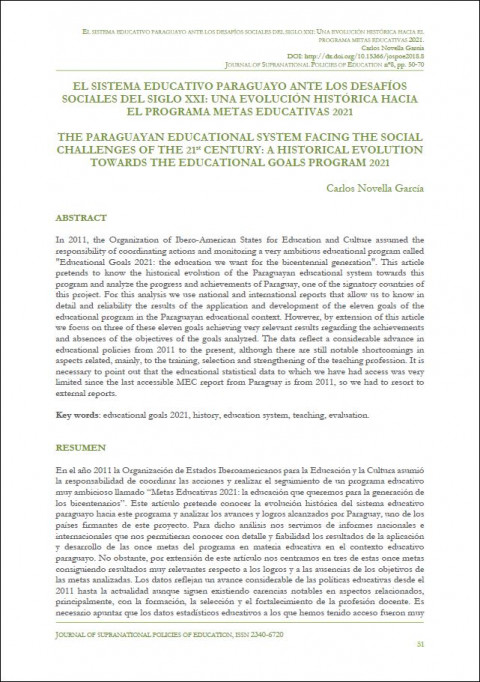 The Paraguayan Educational System Facing the Social Challenges of the 21st Century: A Historical Evolution Towards the Educational Goals Program 2021 Year of publication: 2018 Author: Carlos Novella García Corporate author: Autonomous University of Madrid In the summary the author sustains: "In 2011 the Iberoamerican States Organization for Education and Culture assumed the responsibility of coordinatin the actions and follow a challenging educative programa called "Educative Goals 2021: the education that we want for the generations of the bicentenary". This article pretends to learn the full details of this program and analyze the progresses and achievements made by Paraguay, one of the countries that signed this project. Different national and international reports were analysed in order to know, in detail and in a reliable way, the results of the application and development of the eleven goals of the program regarding education in the Paraguayan context. Nevertheless, due to the extension of this article, the authors focused on three of the eleven goals and obtained very relevant results concerning the absences and achievements of the objectives of these goals. The data evidences considerable progress in the education policies since 2011 although education, selection and professional development of teachers is still lacking development." I would add that the author highlights the importance of an international and Iberoamerican citizenship.
 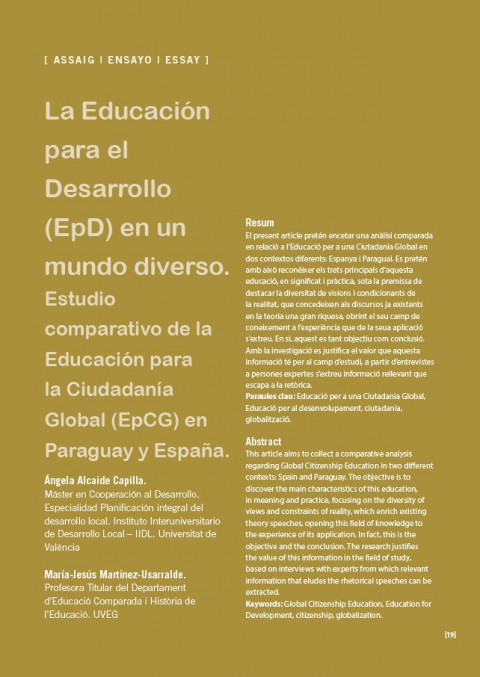 Education for Develpment (EdD) in a Diverse World: Comparative Study of Education for Global Citizenship (EdGC) in Paraguay and Spain Year of publication: 2017 Author: Ángela Alcaide Capilla | María Jesús Martínez Usarralde Corporate author: University of Valencia According to the summary of the author: "This article aims to collect a comparative analysis regarding Global Citizenship Education in two different contexts: Spain and Paraguay. The objective is to discover the main characteristics of this education, in meaning and practice, focusing on the diversity of views and constraints of reality, which enrich existing theory speeches, opening this field of knowledge to the experience of its application. In fact, this is the objective and the conclusion. The research justifies the value of this information in the field of study, based on interviews with experts from which relevant information that eludes the rhetorical speeches can be extracted."