
Resources
Explore a wide range of valuable resources on GCED to deepen your understanding and enhance your research, advocacy, teaching, and learning.
8,364 Results found
 Aligning for Learning: Strategies for Teaching Effectiveness Year of publication: 2008 Author: Donald H. Wulff | Wayne H. Jacobson Faculty and educational and administrative development experts in the changing environment of higher education should seek innovative ways to approach the complexities of teaching and learning. The Harmonization Model suggests that teachers, in order to be effective in achieving learning objectives, should engage in an ongoing process of alignment between them and the content and students in a given environment. This book combines a model of alignment with the authors' years of experience as teachers and development experts.
  Libyan Experience in Literacy and Adult Education Year of publication: 2017 Corporate author: Masouda Ali Al Aswad Libya, like other Third World countries, has suffered from the illiteracy problem as one of the most important challenges it has faced and continues to face the progress it is seeking. The country has gone through stages of underdevelopment, colonialism and mandate that have had a bad impact on the individual and societal level, which has delayed human development and weakened the pace of development and construction. Given the importance of education in nation-building, Libya has long sought to spread science and learning among different segments of society, young and old, and has had great ambitions for the literacy program from the 1950s to the present day.The methods and methods of illiteracy have been varied, from the alphabetical illiteracy targeted to segments of society that have lost their opportunity to read and write in a timely manner, to try to eradicate vocational illiteracy, vocational training, craft preparation, home training and health education, by acquiring these categories. Adequate skills to achieve autonomy, to combat civilizational, functional, technical and training illiteracy aimed at training cadres capable of meeting the needs in the labor market. The Libyan state has adopted all possible means and methods to eliminate illiteracy, from adult education schools to evening schools to extraordinary classes in leisure time, to mosques, lighthouses and corners that contributed to spreading the culture of memorizing and studying the Holy Qur'an, which reflected positively on the level of learning among large groups of people who were unable to From entering schools.This is in addition to the Open University program, which is an achievement that provided golden opportunities for those who missed the opportunity of university education. The State also achieved a balance between the workforce and the high levels of education for these forces. Libya has achieved high levels in terms of its ability to cope with illiteracy, spread awareness and alphabet culture, as well as achieve tangible stages in terms of technical illiteracy. Reports have proved to be high on the list of countries that have succeeded in fighting illiteracy. At the same time, however, they continue to face significant challenges and problems that require thorough studies and efforts to eliminate them.
  Her Atlas: Girls’ and Women's Right to Education Atlas Year of publication: 2019 Corporate author: UNESCO Her Atlas, the online atlas of girls’ and women’s right to education, is developed as part of Her education, our future, UNESCO’s initiative to accelerate action for girls’ and women’s education by leveraging political and financial commitments. Her Atlas aims to enhance public knowledge and monitor the status of national constitutions, legislation and regulations related to girls’ and women’s education rights in order to encourage countries to improve their legal and policy frameworks.
  Reporting on Violence against Women and Girls: A Handbook for Journalists Year of publication: 2019 Author: Anne-Marie Impe Corporate author: UNESCO Ethical journalism is inseparable from fact-based journalism that seeks to promote gender equality in and through the media. This handbook aims to support media professionals in their coverage of the various types of violence against girls and women.It provides advice, benchmarks and resources to help journalists and reporters ensure quality media coverage that is accurate, regular, engaged and respectful of the fundamental principles of the profession.By adopting these principles, the media has the power to shed light on the extent and implications of violence against women and girls, and to inform victims about available resources for support. This can, in turn, influence public opinion and help stop violence against girls and women through collective awareness-raising of the human rights at stake.
 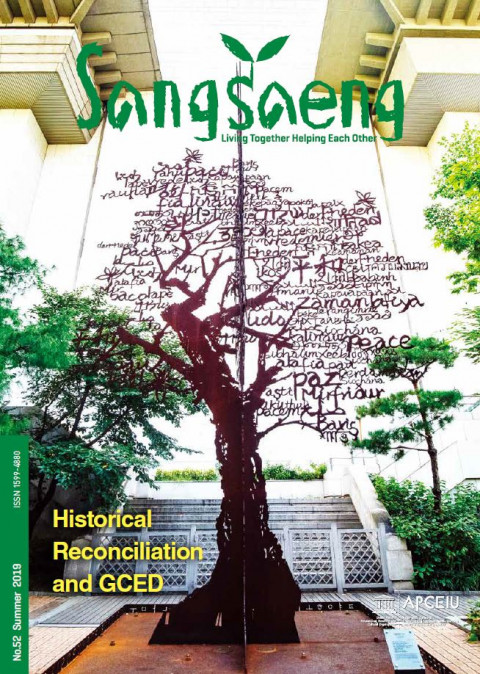 Historical Reconciliation and GCED (SangSaeng no. 52 Summer 2019) Year of publication: 2019 Corporate author: APCEIU The 52th issue of SangSaeng has been published with the theme “Historical Reconciliation and GCED.” This issue explores various endeavours aimed at attaining historical reconciliation and peace, as well as the important role education plays to achieve this goal. How we teach and learn about our past and present conflicts is critical in shaping our future. It can help enhance global citizenship and lead us to peaceful reconciliation and peacebuilding, or it can intensify the hatred of others and build up more conflicts. 3 Editor’s Note4 Special ColumnToward Reconciliation in a Divided, Dangerous World / Jonathan Jansen8 Focus: Historical Reconciliation and GCED8 Historical Dialogue among Korea, China and Japan / Jeongin Kim12 Teaching Shared Histories in Southeast Asia / Doung Bich Hanh16 Learning about Europe’s Common History / Dominik Pick19 Dual Narrative to Teach History / Sami Adwan21 Mystic of ‘General History of Afica’ / Ali Moussa Iye 24 Best Practices24 The Power of Silence / Dylan Wray27 Mobile Library / Andri Nurcahyani31 Special Report31 Migration, Displacement and Education: Building Bridges, Not Walls / Manos Antoninis33 Harmonizing ‘Heart, Head and Hand’ in Hanoi / APCEIU37 InterviewFour Students for One Common Good / Sabine Detzel41 Understanding the Asia-Pacific RegionUniting Under Legends of Ghandhara / Nadeem Omar Tarar44 Youth NetworkHELP Nurtures Youth Citizenship through Collaboration / Nephtaly Pierre-Louis and Meaghan Balzer48 LetterSpeaking Silently in the Loud World / Elvira Sarsenova50 APCEIU in Action
  Global Framework for Refugee Education Year of publication: 2019 Corporate author: Global Refugee Forum Education Co-Sponsorship Alliance | UN. Office of the United Nations High Commissioner for Refugees (UNHCR) This Global Framework for Refugee Education has been produced by the Global Refugee Forum’s Education Co-Sponsorship Alliance, comprising more than 60 partners. It aims to help partners to translate the Global Compact on Refugees and the Refugee Education 2030: A Strategy for Refugee Inclusion into pledges for concrete action to help achieve inclusive and equitable quality education for all by 2030.
 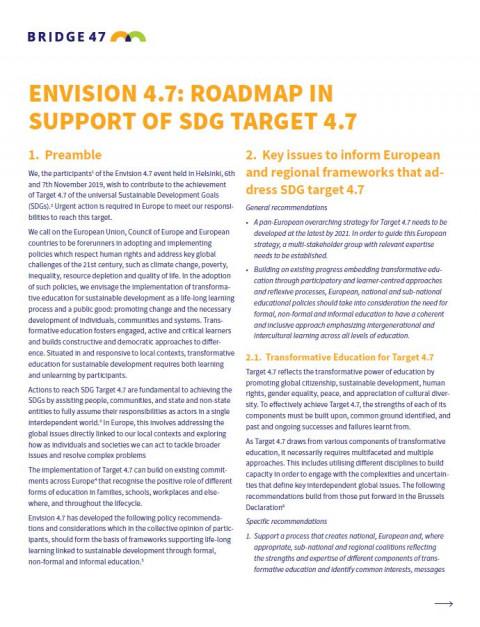 ENVISION 4.7: ROADMAP IN SUPPORT OF SDG TARGET 4.7 Year of publication: 2019 Corporate author: Bridge 47 In November 2019, 200 policy makers, civil society members and researchers from all over the world got together in Helsinki to make a roadmap for the future implementation of SDG Target 4.7 in Europe. The participants of the Envision 4.7 event held in Helsinki, 6th and 7th November 2019, made this document to contribute to the achievement of Target 4.7 of the universal Sustainable Development Goals (SDGs). This document was shaped and influenced by the expertise and insight of everyone who came to the conference. Bridge 47 is calling on this collective knowledge and community of experts to continue moving these recommendations forward as we all aim to achieve SDG Target 4.7 and use transformative education as a mechanism for achieving all of the Sustainable Development Goals.
 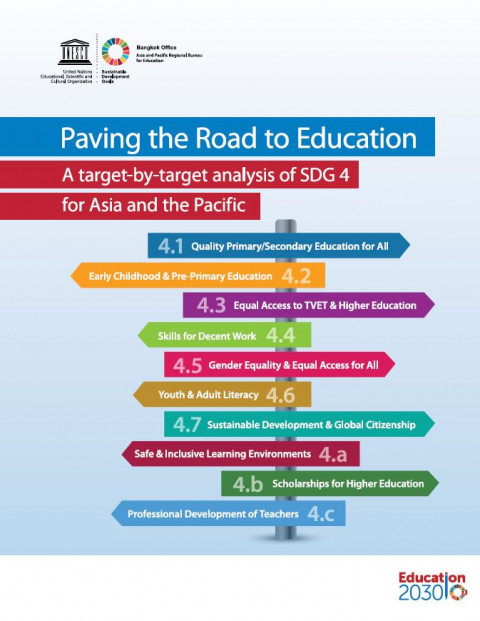 Paving the Road to Education: A Target-by-Target Analysis of SDG 4 for Asia and the Pacific Year of publication: 2018 Corporate author: UNESCO Bangkok The globally adopted development agenda “Transforming our World: the 2030 Agenda for Sustainable Development” has established ambitious intentions that build on the past Millennium Development Goals but also expand on their achievements.The Sustainable Development Goal 4 on education propels forward the vision of ensuring inclusive and equitable quality education and to promote lifelong learning opportunities for all through a holistic, aspirational and systematic education agenda. Education monitoring is an integral part in this process.This publication delivers a data-rich snapshot of Sustainable Development Goal 4, its targets and their monitoring indicators while analyzing available data through a lens of inequality.Assessing the progress which countries have made in the recent past as well as where countries currently stand, this publication sets a baseline against which Member States from Asia and the Pacic are able to monitor progress in achieving the Goal 4 over time but at latest by 2030.Finally, after discussing emerging opportunities and remaining challenges in the region, this publication seeks to assist Member States in identifying what steps can be taken to ensure that the region will achieve the new education agenda.
 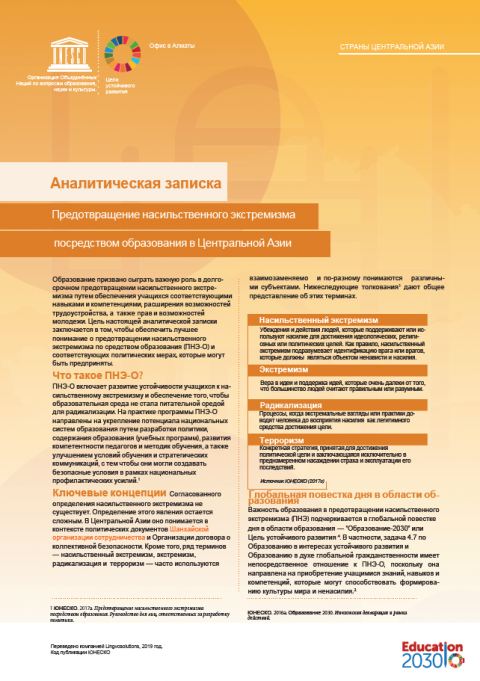 Policy Brief: Prevention of Violent Extremism Through Education in Central Asia Year of publication: 2019 Corporate author: UNESCO Almaty Education has a powerful role to play in long-term prevention of violent extremism by equipping learners with the right skills and competencies, increasing employment opportunities and empowering youth. This policy brief aims to provide a better understanding of Preventing Violent Extremism through Education (PVE-E) and the relevant policy interventions that could be taken.
 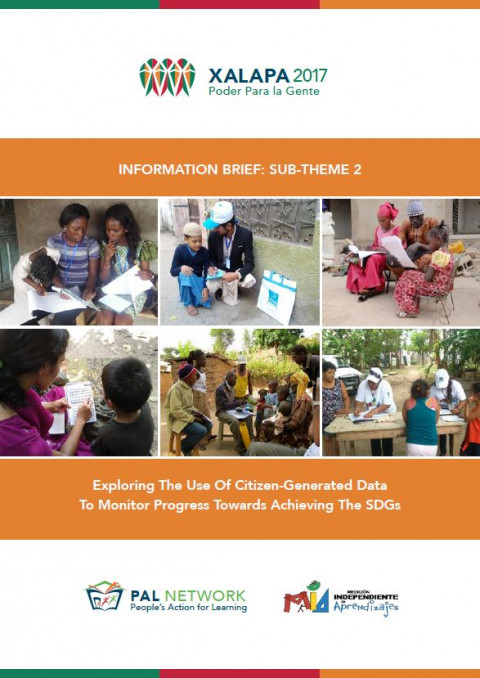 Exploring the Use of Citizen-generated Data to Monitor Progress Towards Achieving the SDGs Year of publication: 2017 Corporate author: People's Action for Learning Network The 5th Annual PAL Network meeting was held in Xalapa, Mexico from 13th to 16th March 2017. The meeting was jointly hosted by Medición Independiente de Aprendizajes (MIA) and the PAL Network. The meeting provided structured opportunities for deep exploration of this year’ theme: ‘Power to the People’. The theme was critically explored by over 80 participants from more than 19 Global South countries in four different sub‑theme groups. Each sub-theme focused on a different aspect of citizen participation in conducting household-based learning assessments with a focus on value, potential and next steps.