
Resources
Explore a wide range of valuable resources on GCED to deepen your understanding and enhance your research, advocacy, teaching, and learning.
8,364 Results found
 Promoting Global Citizenship in the Chilean Classrooms Year of publication: 2016 Author: Cinzia Bizama Borotto | Nicolás Lobo Carrasco This article focuses on the analysis and clarification of the term "global citizenship". For this, different ways in which this concept is applied in canadian classrooms is analysed while suggesting ways of integrating it in chilean classrooms bearing in mind the educational history of the country and the benefits this would bring not only for teachers and students, but also for families, educational institutions and the country itself.
  What is Global Citizenship? Year of publication: 2017 Corporate author: Spanish Agency for International Development Cooperation (AECID) | Spain. Ministry of Education, Culture and Sport Inteviews carried out to experts that participated in a debate regarding global citizenship during the V National Teachers' Meeting for development. Coordinated by AECID and MECD (Spain).
  Global Citizenship: A Study on the Socio-political Identities in an Interconnected World Year of publication: 2017 Author: Antonio Martín-Cabello This paper aims to study the possible emergence of a new type of citizenship: global citizenship. For some time much of the literature in social science has related a weakening of nation-state and national-citizenship as a result of the globalization process. The consequence would be an increase in cosmopolitanism and emergence of a global citizenship identity. This, in principle, would be especially pronounced amongst the most globalized groups. The paper discusses two of these: backpackers and corporate expatriates. However, we show here that contradictory features arise when the available empirical evidence is studied. Both backpackers and corporate expatriates share a cosmopolitan rhetoric that has no clear correlation with the areas of social practice.
  A Transdisciplinary Biomimetic Perspective on Global Citizenship Education Year of publication: 2016 Author: Javier Collado Ruano Corporate author: University of the Andes This paper reflects on the Global Citizenship Edu- cation (GCE) and Sustainable Development Goals (SDGs) discussed in 2015 during the Second UNESCO Forum on Global Citizenship Education in January, the Second Global Education Forum in May and the Millenium Summit in September. The study is supported by a transdisciplinary methodolo- gy and the biomimetic principles in order to streng- then the bonds between education and sustainabili- ty. As a result, this research identifies the operational principles that constitute the interdependence of ecosystems in order to make a biomimetic imple- mentation in the social, political and educational structure in human systems. To conclude, three pro- posals to achieve SDGs are given.
  When Feeling and Action Come Together in Educational Practice. Relations Between Development Education and Learning Service for a Global Citizenship Year of publication: 2016 Author: Yolanda Fernández Carrión | Mª Jesús Martínez Usarralde The difficulties based on the development are a usual topic in education. After emphasizing the relevance of the development education as an essential element for the construction of the global citizenship, the challenge stands out by its innovative intention of trying to implicate it with service learning. This one tries to be an explorative and interpretative theoretic analyses about the potentialities which can be provided by service learning in the achievement of the objectives planned by the development education. This correlation not only affects the substantial improvement of both practices by building positive synergies but also its universalization forms a clear positive influence in the endogenous development of the village people, carrying out the real empowerment of the critical, sensible and global citizenship. The possibility of giving the main role as a human developmental engine to education is within our reach and the union between development education and service learning teaches us the keys.
 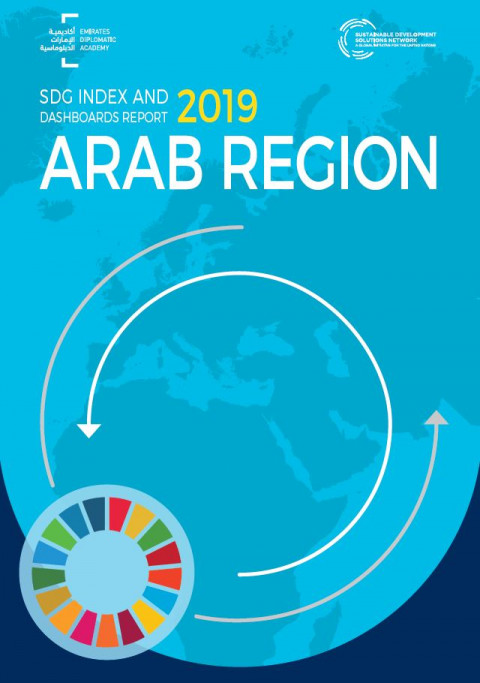 2019 Arab Region SDG Index and Dashboards Report Year of publication: 2019 Author: Lara Dahan Corporate author: Emirates Diplomatic Academy (EDA) | Sustainable Development Solutions Network (SDSN) The Arab Region SDG Index and Dashboards are intended as a tool for governments and other stakeholders to measure progress on the Sustainable Development Goals (SDGs), and to highlight gaps in both implementation and data. The 2019 Arab Region SDG Index is the first in its kind and is therefore also intended as a conversation-opener about priority areas, policies and actions.The 2019 Arab Region SDG Index comprises 105 indicators, each of which have an assigned score (0–100) and a traffic light colour (green, yellow, orange, or red) to indicate performance. In addition, arrows indicate trends in progress towards achieving the goals for those indicators where data for multiple years are available.Compared to the Sustainable Development Report 2019, which contains the SDG Index and Dashboards for all UN Member States, the Arab Region Index introduces 30 new indicators that reflect regional priorities and challenges. The selection of these indicators, along with related thresholds, was greatly informed by two rounds of regional expert consultations, which were conducted in May and August 2019 and collected more than 200 comments from more than 40 individuals. The regional Index also removes indicators that are not useful or relevant for the region or where data coverage is currently insufficient.In addition, the 2019 Arab Region Index includes Palestine, which has so far not been included in the global SDG Index reports. It also provides a total SDG achievement score for two countries – Libya and Somalia – that did not receive one in the global Index due to low data availability.
  Reconciliation, Peace and Global Citizenship Education: Pedagogy and Practice Year of publication: 2019 Corporate author: APCEIU The Asia-Pacific Centre of Education for International Understanding launched the publication entitled Reconciliation, Peace and Global Citizenship Education: Pedagogy and Practices. This book is the result of the fruitful discussions and presentations made during the 4th International Conference on Global Citizenship Education held on 3-4 September 2019 in Seoul, Republic of Korea.The intention of this publication is not only to continue and deepen the discourses made by the speakers of the Conference, but also to provide the readers with opportunity to explore how pedagogy and practices of Global Citizenship Education can contribute to building peace and reconciliation across the globe. Part. I Global Citizenship Education for peace and reconciliation: OverviewLearning to live together and a life worth livingHow GCED can contribute to peace, reconciliation and sustainable developmentTransformative pedagogy for building peacePromoting peace through mindfulness programmes in schoolsGlobal memory, global citizenship and reconciliationThe role of Media and Information Literacy Part. II Global Citizenship Education for peace and reconciliation: Putting it into practiceFacing History and Ourselves in South AfricaClassrooms in Peace in ColombiaPreparing young people to be global citizens through integrated schools in Northern Ireland Part. III Global Citizenship Education for peace and reconciliation: Supporting effective implementationPolicy development and implementationChallenges in curriculum and textbook development for low-and middle-income country
 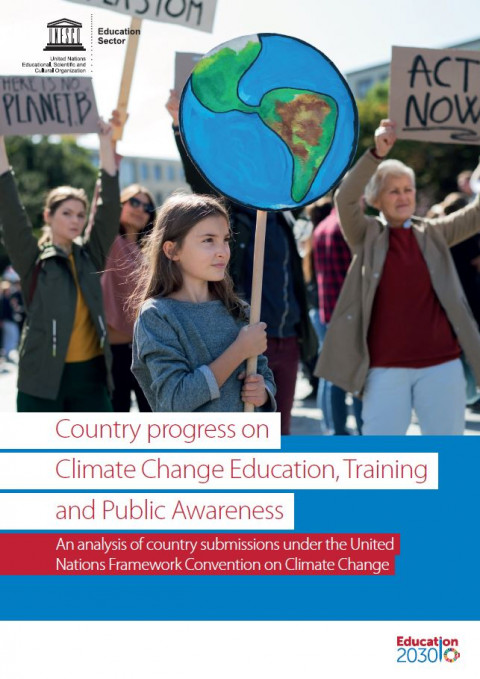 Country Progress on Climate Change Education, Training and Public Awareness: An Analysis of Country Submissions Under the United Nations Framework Convention on Climate Change Year of publication: 2019 Corporate author: UNESCO Since its entry into force, the 1992 United Nations Framework Convention on Climate Change (UNFCCC) in Article 6 has recognised the importance of ‘education, training and public awareness’ in mitigating ‘dangerous human interference with the climate system’. Article 12 of the Paris Agreement (2015) reaffirms this recognition.This document provides a status report on the implementation of climate change education in countries. It outlines key findings from an analysis of country submissions to the UNFCCC Secretariat as part of UNFCCC reporting processes and highlights achievements and remaining gaps in the area of climate change education.The analysis shows that almost all countries include some reference to climate change education in their country submissions under the UNFCCC reporting processes. This shows a certain level of commitment, which provides a good basis to further scale up educational responses to climate change. However, important gaps remain. Addressing them will be crucial in order to fully mobilize the power of education in response to this greatest challenge of our times.
  The Importance of Environmental Accounting in the Sustainability of Development Year of publication: 2013 Author: Jamila aljawzii Corporate author: Kasdi Merbah University The trend towards disclosure of environmental performance and the introduction of environmental accounting within the general framework of the accounting system has increased as a result of the concern of government and civil organizations for the environment and sustainable development, and the pressure exerted by international, professional and academic bodies on institutions and countries on the environment and the need to protect and develop them through the adoption of the concept of sustainable development. In this context, this paper explains the importance of environmental accounting for sustainable development through the following elements: - Sustainable development. - Environmental accounting. - The role of environmental accounting in sustainable development.
  Spatial Development ... Between Social Justice and Functional Competence Year of publication: 2012 Author: Mustafa Jalil Ibrahim Al-Zubaidi Corporate author: University of Baghdad The dialectic of the interrelationship between social justice in the spatial area and the functional efficiency of the distribution of financial investments of the different sectors within that area is a key focus in addressing the spatial development of that dialectic, and its attempt to reach the most optimal relative through analytical theses of these problems to reach the developmental goals that include social justice and functional efficiency.