
Resources
Explore a wide range of valuable resources on GCED to deepen your understanding and enhance your research, advocacy, teaching, and learning.
8,364 Results found
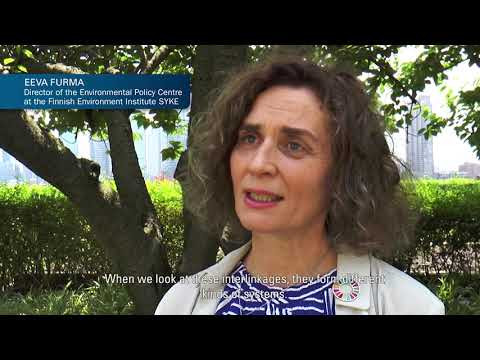 [Video] Global Sustainable Development Report 2019 Year of publication: 2019 Corporate author: United Nations (UN) The Global Sustainable Development Report (GSDR ) originated in the Rio + 20 outcome, when Member States were laying the groundwork for the 2030 Agenda and the Sustainable Development Goals (SDGs). The negotiators knew that the Agenda would be complex, and unprecedented in ambition, and that the traditional siloed approach to development would not be adequate.They recognised the power of science to understand and navigate relationships among social, environmental and economic development objectives, and so they called for a report to strengthen the science-policy interface.In 2016, Member States decided that the report should be produced once every four years, to inform the quadrennial SDG review deliberations at the General Assembly, and that it should be written by an Independent Group of Scientists appointed by the Secretary-General. They mandated that the Group would consist of 15 experts representing a variety of backgrounds, scientific disciplines and institutions, ensuring geographical and gender balance.
  COUNCIL OF EUROPE CONTRIBUTION TO THE UNITED NATIONS 2030 AGENDA FOR SUSTAINABLE DEVELOPMENT Corporate author: Council of Europe On 1 January 2016, the World started implementing the “UN 2030 Agenda for Sustainable Development”, an ambitious and universal vision, based on 17 Sustainable Development Goals (SDGs) and 169 associated targets, which are all integrated, indivisible and interlinked. They apply universally to all and are highly relevant for the Council of Europe; countries are expected to take ownership and establish national frameworks for the achievement of the 17 goals. Most, if not all, of the Council of Europe’s activities are relevant and contribute to the implementation of the UN 2030 Agenda and the achievement of the SDGs. Recognising the intrinsic links between sustainable development and the protection of human rights, the Council of Europe is committed to working with and supporting its 47 member states in implementing the UN 2030 Agenda through a wide range of actions.
 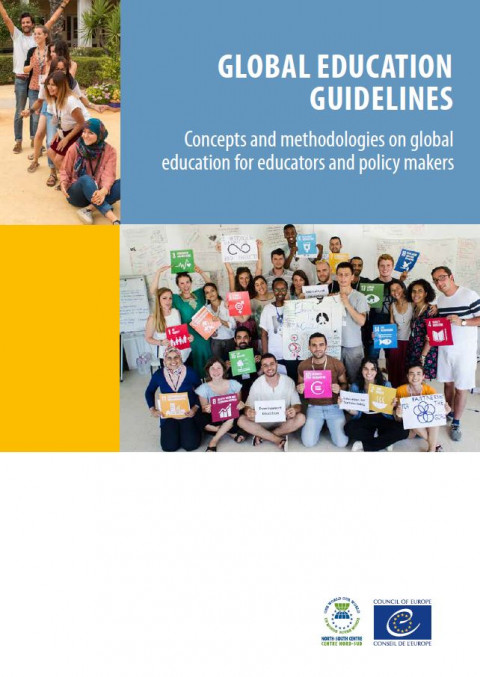 Global Education Guidelines 2019: Concepts and Methodologies on Global Education for Educators and Policy Makers Year of publication: 2019 Corporate author: North-South Centre of the Council of Europe | Council of Europe The Global Education Guidelines are an initiative of the Global Education Programme of the North South Centre of the Council of Europe, and answer a need expressed by the North-South Centre’s (NSC) network of global education practitioners – the Global Education network - to have a common tool, built on experience gained by the network and other partners, to support educators to comprehend and successfully design, implement and carry out global education initiatives and learning activities. This updated edition of the Guidelines includes novelties and responds to the challenge of being a user-friendly handbook, by (i) introducing the concept of competence-based learning, with the Council of Europe Reference Framework of Competences for Democratic Culture and the OECD concept of global competences, and explains in detail and with practical examples and user friendly tools how global education can make use of competence-based learning to empower learners; (ii) has broadened the content of the chapter on methodology and methods, with step by step guides for the daily work of practitioners, educators and facilitators, and further exemplifying the competence-based learning concept; and (iii) by including a new chapter on media literacy to support practitioners and learners to navigate today’s communication and digital challenges.
 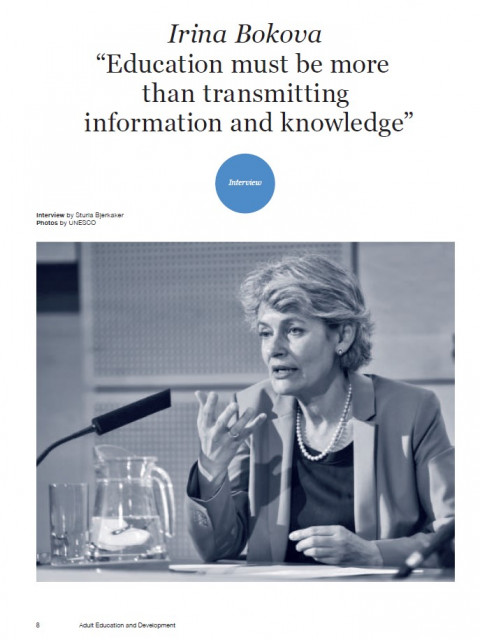 Education must be more than transmitting information and knowledge Year of publication: 2015 Author: Sturla Bjerkaker Corporate author: UNESCO. Director-General, 2009-2017 (Bokova, I.G.) Irina Bokova has been the Director-General of UNESCO since November 2009. She is the first woman to lead the organisation. Ms Bokova has served as Bulgaria’s Secretary of State for European Integration, Minister of Foreign Affairs, Ambassador to France and Monaco and Permanent Delegate to UNESCO, among other positions. She has been actively engaged in international efforts to advance quality education for all, gender equality, human rights, cultural dialogue and scientific cooperation. She also serves as Executive Secretary of the Steering Committee of the UN Secretary-General’s Global Education First Initiative.
  UNESCO and the right to education Year of publication: 2018 Corporate author: UNESCO Education is a fundamental human right of every woman, man and child. For UNESCO, this right is an absolute priority and at the heart of its global mission to ensure equal access to quality education for everyone.
  Citizenship and Globalization, Questionable difficult time Year of publication: 2016 Author: قايد دياب The book “Citizenship and Globalization… the Question of the Hard Time” by “Kayed Diab Kayed Mujahid” is considered as an intersection between a number of interdisciplinary fields of human sciences, including: It examines and analyzes the concept of Western citizenship, how it develops and develops it, as well as the social revolutions and various human rights declarations it exposes. A social towards its citizens towards the phenomenon of globalization .. Applied to the impact of globalization on Egyptian citizenship, in five sections.
  2030 Agenda for Sustainable Development Year of publication: 2018 Corporate author: United Nations System Staff College (UNSSC) By endorsing the 2030 Agenda for Sustainable Development and its seven goals for 2015, the international community emphasized sustainable development. In this table, one hundred and ninety three Member States pledged to ensure inclusive and sustained economic growth, social inclusion, environmental protection and the promotion of peaceful, just and inclusive societies through a new global partnership. The Agenda 2030 is rights-based and ambitious.It is an ambitious plan of action for countries, the United Nations system, and all other actors. The agenda goes beyond rhetoric and makes a concrete call to people, the planet and prosperity, and it encourages us to take bold and transformative steps urgently needed to guide the world towards a sustainable and resilient path.
  Transforming our world: the 2030 Agenda for Sustainable Development - United Nations General Assembly Year of publication: 2015 Corporate author: United Nations (UN) This plan represents a program of action for people and land and for prosperity. It is also aimed at promoting world peace in a more free atmosphere. We recognize that the eradication of poverty in all its forms and dimensions, including extreme poverty, is the world's greatest challenge and an indispensable condition for sustainable development. All countries and stakeholders will implement this plan within the framework of the cooperative partnership. We are determined to free mankind from the tyranny of poverty and want and to heal and preserve the wounds of our planet. We are determined to take the bold steps leading to the transformation that are urgently needed to move the world towards a path of sustainability and resilience. As we embark on this collective journey, we pledge that no one will be left behind. The 17 Sustainable Development Goals and the 169 targets that we will announce today demonstrate the breadth and ambition of this global agenda. The aim of these goals and objectives is to continue the process of the Millennium Development Goals and achieve what has not been achieved within the framework. They are also intended to realize human rights for all, achieve gender equality and empower all women and girls. These are integral and indivisible goals and objectives that balance the three dimensions of sustainable development: the economic, social and environmental dimensions.
 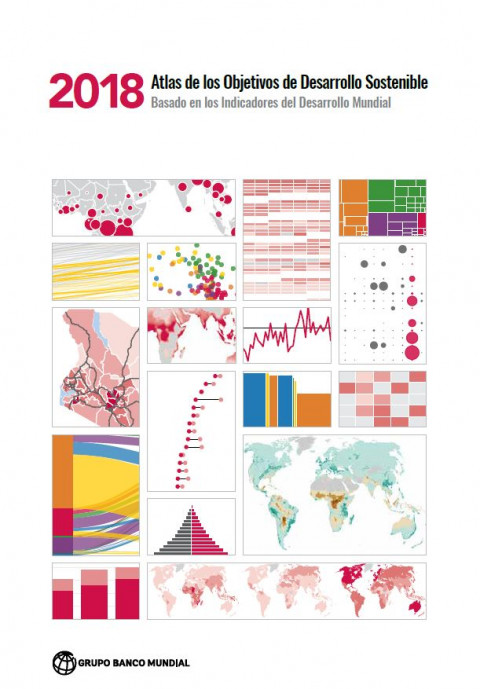 Atlas of the Sustainable Development Goals 2018 Year of publication: 2018 Corporate author: البنك الدولي للانشاء والتعمير Atlas of the Sustainable Development Goals 2018 presents maps, graphs and stories related to the SDGs. It discusses trends, comparisons and measurement issues using visible and accessible data. The data are based on the World Development Indicators database.
  [Video] World's Biggest Lesson 2018 - Sustainable Development Goals Year of publication: 2018 Corporate author: Oman. Ministry of Education This video is produced by the Ministry of Education in the Sultanate of Oman, and talks about the objectives of the Ministry of Education to achieve the concept of sustainable development in the field of education.