
Resources
Explore a wide range of valuable resources on GCED to deepen your understanding and enhance your research, advocacy, teaching, and learning.
8,364 Results found
 Out-of-School Children and Adolescents: Left Behind on the Road to Learning Opportunities for All Year of publication: 2017 Corporate author: UNESCO Institute for Statistics (UIS) | UNESCO Bangkok This document shows the most recent data from UIS (2017) on the rates and numbers of out-of-school children and adolescents since 2000, first globally and then within this region, examining common characteristics these young people share to provide insights into which groups are more likely to find themselves excluded from national education systems. The focus then turns to a closer examination of the obstacles out-of-school children and adolescents face in this regard and introduces educational programmes that can help them overcome these challenges. URL:http://www.flexlearnstrategies.net/out-of-school-children-and-adolescents-left-behind-on-the-road-to-learning-opportunities-for-all-2/
  The United Arab Emirates and the 2030 Agenda for Sustainable Development Year of publication: 2018 Corporate author: National Committee on Sustaiable Development Goals This report contains two main chapters: the role of the UAE in the development of the 2030 Agenda for Sustainable Development and Chapter Two of the National Committee for the Sustainable Development Goals in the United Arab Emirates.
  UNESCO World Conference on Education for Sustainable Development Year of publication: 2009 Corporate author: German Commission for UNESCO | Germany. Federal Ministry of Education and Research UNESCO held its Conference on Education for Sustainable Development, which highlighted the main contribution of education to sustainable development in education and its quality . This booklet contains a detailed overview of the meetings and proceedings of the International Conference.
 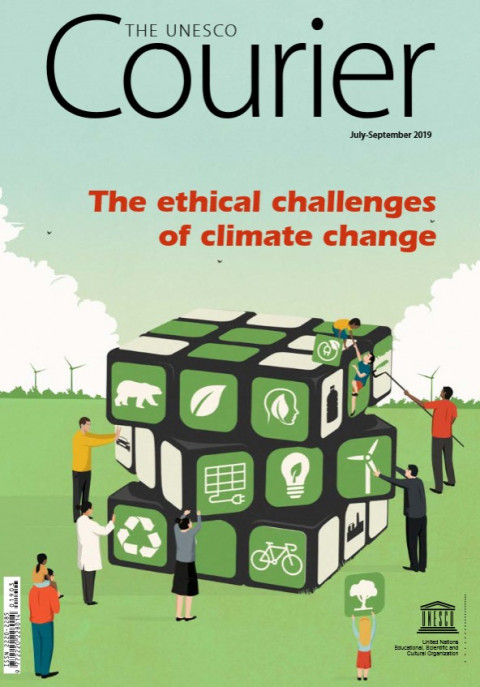 The ethical challenges of climate change (The UNESCO Courier no. 3, July-September 2019) Year of publication: 2019 Corporate author: UNESCO Climate change not only threatens our ecosystems, it undermines the foundation of our fundamental rights, deepens inequalities and creates new forms of injustice. Adapting to climate change and trying to mitigate its impacts are not just a matter of scientific knowledge and political will; they also demand a broader view of a complex situation. In order to help Member States and other stakeholders to make appropriate decisions and implement effective policies for sustainable development, adaptation to climate change and the mitigation of its negative effects, UNESCO adopted a Declaration of Ethical Principles in relation to Climate Change in November 2017.Ethics constitute the substantial core of any commitment. As a mobilizing force, ethics can steer action, facilitate arbitration, resolve conflicting interests, and establish priorities. Ethics have the capacity to connect theory with practice, general principles with political will, and global awareness with local actions.
  Implementation of the Sustainable Development Goal 4 in Korea Year of publication: 2019 Corporate author: Korean National Commission for UNESCO | Korean Educational Development Institute (KEDI) This report takes stock of progress made in Korea towards achieving SDGs and sheds light on major policy implications for its further implementation. The first chapter will touch on the background and objectives, the second on the monitoring of SDG4-Education 2030 at the global level, the third on the implementation structure of SDG4-Education 2030 in Korea, the fourth on the progress made toward meeting SDG4, and the fifth on the conclusion.
  Report of the 2019 Arab Forum for Sustainable Development "Empowering people and ensuring inclusion and equality in the Arab region" Year of publication: 2019 Author: United Nations (UN) Corporate author: United Nations (UN) The Economic and Social Commission for Western Asia (ESCWA), in partnership with the League of Arab States and the United Nations system working in the Arab region, organized the 2019 Arab Forum on Sustainable Development under the theme 'Empowering People and Ensuring Inclusion and Equality in the Arab Region', in Beirut, from 9 to 11 April 2019.
  Citizenship in the Digital Age: The Model of the Kingdom of Bahrain Year of publication: 2017 Author: ندى علي حسن بن شمس Corporate author: معهد البحرين للتنمية السياسية The research answers the following main question: What is the effectiveness of a proposed program based on the global network for developing citizenship values for students of the University of Bahrain in light of the requirements of the digital age? The main question of the research is divided into the following sub-questions: 1- What is the list of citizenship values required for a student at the University of Bahrain in light of the requirements of the digital age? 2- What is the image of the proposed program based on the global network (with dialogue activities - without the dialogue activities) to develop citizenship values for students of the University of Bahrain in light of the requirements of the digital age? 3 - What is the effectiveness of the proposed program based on the global network in its two forms (with dialogue activities - without the dialogue activities) to develop Citizenship values for a University of Bahrain student in light of the requirements of the digital age?
  Strategy to Combat Desertification to Achieve Sustainable Development in the Arab World: A Study of Algeria 's National Program to Combat Desertification Year of publication: 2019 Author: Boshwait Qairouz Regarding to its impacts on the economic, social and environnemental levels, desertification became one of critical environnemental issue that disturbs the international community. Especially in the dry land, semi dry land and semi humid dry lands. Desertification is the great durable development challenge based on three dimensions: economical efficiency, social justice and nature protection. Viewing the international trends towards achieving durable development, the Arab countries must create new durable strategies and methods, in order to face the phenomenon, these strategies should include the following dimensions: economical, social and environnemental one. Accounting the different reasons of desertification, its intensity and considering the financing capacity, it so difficult to expect one typical strategy that suits each Arab countries. To face such problem, Algeria like the other damaged countries takes needful procedures to combat this problem following a national programme which started in the sixteenth oh last century. To sum up, now days desertification till now a global issue, but the question which rest posing, If may we remove definitely such problem?
 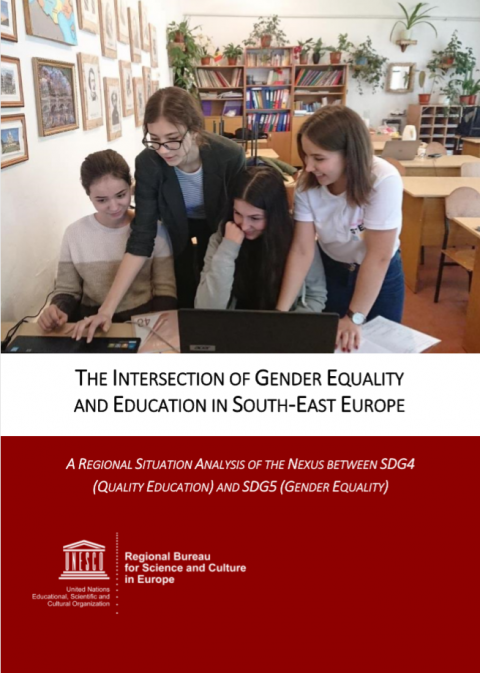 The Intersection of gender equality and education in South-East Europe: a regional situation analysis of the Nexus between SDG4 (Quality Education) and SDG5 (Gender Equality) Year of publication: 2019 Corporate author: UNESCO Venice This report focuses on highlighting both progress and persistent challenges.It does so by analyzing the current situation of gender equality in education, including gender parity in participation, education quality, and outcomes, aswell as issues related to gender equality in which education plays an important role, suchas policies that disproportionately affect women, early and unintended pregnancy, child marriage, and human trafficking. It relies on the most recent available data from the UNESCO Institute of Statistics (UIS), as well as supplemental data including from UNICEF, UN Women, and theOrganization for Economic Cooperation and Development(OECD), to descriptively analyze the rates for females and males, considering also progress over the last decade, and to identify where progress in gender equality has been made and whereactions are needed to ensure gender equality in and through education.
  The Big conversation: handbook to address violence against women in and through the media Year of publication: 2019 Corporate author: UNESCO This handbook provides guidance, tools and promising practices from countries across the globe for those working with and within media. It is our intention that this handbook provides entry points for accelerating progress towards gender equality in the systems and structures of organizations. We hope that it leverages what we know works in order to promote the values of diversity, equality and non-violence in the content that media produces.