
Resources
Explore a wide range of valuable resources on GCED to deepen your understanding and enhance your research, advocacy, teaching, and learning.
8,364 Results found
 Sexual harassment in the workplace: challenges and responses Year of publication: 2017 Author: Dase Kavasa This report contains information on legal and policy challenges related to sexual harassment and recommendations for improving legislation and practice in the Republic of Kazakhstan.
 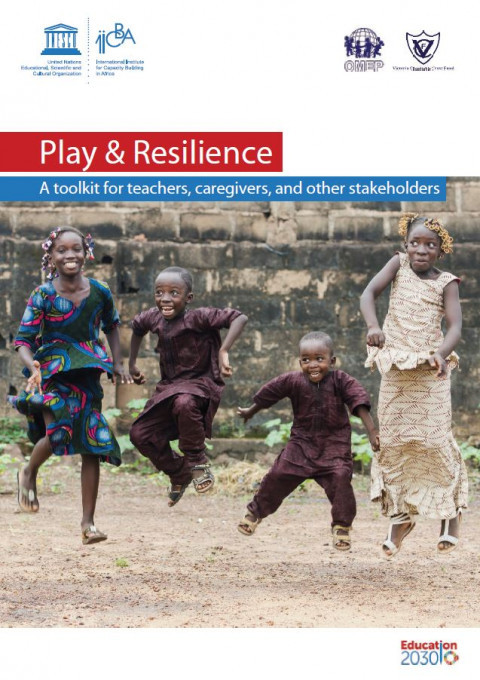 Play & Resilience: A toolkit for teachers, caregivers, and other stakeholders Year of publication: 2019 Corporate author: UNESCO International Institute for Capacity-Building in Africa (IICBA) This publication is a toolkit for teachers, caregivers, community members and other stakeholders in the Early Childhood Care and Education Landscape.This toolkit is aimed at fostering Resilience in children through playbased strategies.
  20 years of democratic development in Kyrgyzstan: internal and external perspectives Year of publication: 2012 Corporate author: Friedrich Ebert Foundation This publication comprises an analysis and assessment of the political, regulatory, legal, public and economic reforms that took place in Kyrgyzstan over the last two decades. It discusses the problems that are arise from the current situation and possible options for the KR’s future development - both in case of a success of the modernization approach and in case of its failure, with resulting stagnation and regress.
 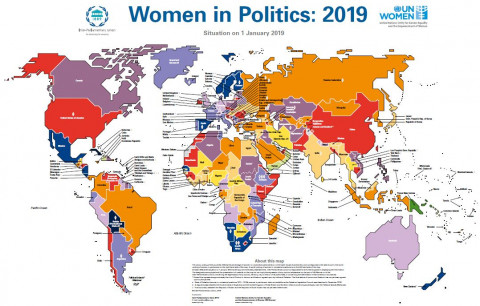 Women in politics: 2019 Year of publication: 2019 Corporate author: United Nations Entity for Gender Equality and the Empowerment of Women (UN Women) | Inter-Parliamentary Union (IPU) The “Women in politics: 2019” map, created by the Inter-Parliamentary Union (IPU) and UN Women, depicts global rankings for women in the executive and parliamentary branches of government as of 1 January 2019. The map shows progress towards gender equality in these areas at regional and national levels.
  Progress on the Sustainable Development Goals: The gender snapshot 2019 Year of publication: 2019 Corporate author: United Nations Entity for Gender Equality and the Empowerment of Women (UN Women) This publication was created to inform those discussions, by bringing together the latest available evidence on gender equality across all 17 Goals, underscoring the progress made as well as the action still needed to accelerate progress.
  Language Reforms in Central Asia: trends - goals - results Year of publication: 2008 Author: Pavel I. Dyatlenko The article considers the evolution of language reforms in Central Asia from the beginning of the twentieth century to the end of the 2000s and their significance as a reflection of changing trends. The author analyzes the goals and interests of the political elites who initiated the language reforms, as well as the consequences of the reforms in different areas of public life.
  Language and education in post-Soviet Central Asia Year of publication: 2008 Author: Monica Perotto In the article, the author tries to assess the dynamics of the changing role of Russian and the titular languages in the post-Soviet republics of Central Asia with reference to demographic and geopolitical data, as well as to determine the consequences of the language policy pursued in these countries.
  [Video] UNESCO - Futures of Education: Learning to Become Year of publication: 2019 Corporate author: UNESCO UNESCO’s Futures of Education initiative aims to rethink how knowledge and learning can shape the future of humanity and the planet. Looking to 2050 and beyond, the initiative seeks to reimagine how education and knowledge can contribute to the global common good. The initiative is catalyzing a global debate on how knowledge, education and learning need to be reimagined in a world of increasing complexity, uncertainty, and precarity. This initiative mobilizes the many rich ways of being and knowing in order to leverage humanity’s collective intelligence. It relies on a broad, open consultative process that involves youth, educators, civil society, governments, business and other stakeholders. The work is being guided by a high-level International Commission of thought-leaders from diverse fields and different regions of the world. In late 2021, the commission will publish a global report designed to share a forward looking vision on how education and learning can enable us to become what we want to become.
 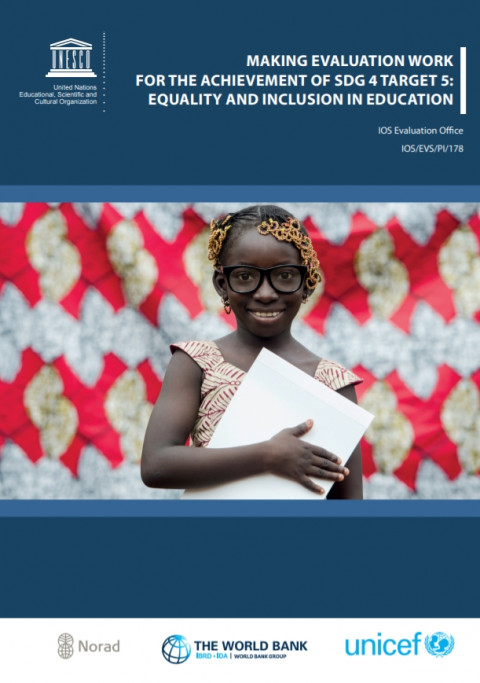 Making evaluation work for the achievement of SDG 4 target 5: equality and inclusion in Education Year of publication: 2019 Corporate author: UNESCO The adoption of the Sustainable Development Goals (SDGs) and the Education 2030 Framework for Action has placed gender parity, equality and inclusion in education at the heart of the international development agenda and is specifically formulated in SDG 4 Target 5. Now, as never before, relevant and contextualised evidence, driven in part by robust evaluation data, is needed to track and strengthen progress on educational equity. To this end, a group of international organisations, led by UNESCO, have combined efforts to explore how their education evaluations can better support Member States to strengthen progress on gender parity, equality and inclusion in education. The following report synthesises evidence from publicly available independent evaluations from 13 organisations, highlighting evidence gaps and summarising ‘what works’ for whom and in what contexts for advancing gender equality and equity for vulnerable groups. The study also reports on responses to the synthesis from national stakeholders in five countries: Ghana, Guatemala, Lebanon, Nepal and Peru. The report culminates in a discussion and recommendations, which outline the need for greater coordination and collaboration in four key areas to further enhance the contribution of evaluations to global and country level progress on SDG 4 Target 5.
  4th Meeting of the SDG-Education 2030 Steering Committee, Paris, 28 February-02 March 2018: meeting report Year of publication: 2018 Corporate author: UNESCO This report summarizes the deliberations, the main recommendations adopted, and the decisions made at the 4th meeting of the SDG-Education 2030 Steering Committee (Paris, 28 February - 2 March 2018).The objectives of the meeting were: To define positions and recommendations of the SDG-Education 2030 Steering Committee on key strategic areas. To agree on a strategy for global review, monitoring and reporting process, in view of HLPF 2018 and the 2019 Reviews. To refine the advocacy, communication and outreach strategy of the SDG-Education 2030 Steering Committee To define next steps for the SDG-Education 2030 Steering Committee (next meeting, rotation of members, and the Global Education Meeting 2018).