
Resources
Explore a wide range of valuable resources on GCED to deepen your understanding and enhance your research, advocacy, teaching, and learning.
8,364 Results found
 The influence of the European Union on Central Asia: review, analysis and forecast Year of publication: 2017 Author: V. Paramonov | A. Strokov | Z. Abduganieva The book is intended for government officials and representatives of large businesses, analysts and experts, scientists and teachers of higher educational institutions - in general, all those who are professionally interested in Central Asia are studying the European Union and his policies. The book is the result of a study conducted under the guidance of VVParamonova in the period 2014-2016, built in the form of an analytical report.In this article, we consider the legal aspects of combating extremism in Central Asia, as well as educational and ideological components to combat this phenomenon and cooperation of all three republics with international organizations and other countries of the world in the fight against extremism.
  Dialogue of cultures in integration processes in Central Asia Year of publication: 2017 Author: S. Kalimova The article discusses topical problems of intercultural dialogue in the countries of Central Asia. The overall place is given to Kyrgyzstan as a multientic and multicultural state in the post-Soviet space, which in the process of cultural integration with neighbors and friendly countries of the former Soviet Union.
  Terrorism and religious extremism in Central Asia: problems of perception. Case of Kazakhstan and Kyrgyzstan Year of publication: 2016 Author: Anastasiya Reshetnyak Based on the results of a sociological research, the paper presents a comprehensive analysis of public opinion on the problems of securitization of terrorism and religious extremism in modern Kazakhstan and Kyrgyzstan. The publication is addressed to researchers, teachers and students of social and humanitarian faculties, specializing in international relations, political science, sociology, religious studies, as well as employees of government agencies working in relevant areas.
  Mechanisms to overcome Islamic extremism in the context of ensuring the national security of the countries of Central Asia Year of publication: 2018 Author: Gandzina F. Safarova In this article, the author considers the legal aspects of combating extremism in Central Asia, as well as educational and ideological components to combat this phenomenon and cooperation of all three republics with international organizations and other countries of the world in the fight against extremism.
 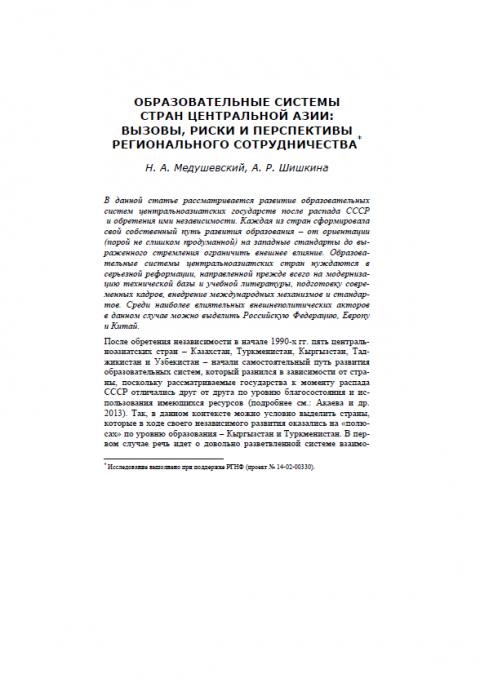 Educational systems of Central Asian countries: challenges, risks and prospects for regional cooperation Year of publication: 2014 Author: Nikolay A. Medushevskiy | Alisa R. Shishkina This article discusses the development of educational systems of Central Asian states after the collapse of the USSR and their independence. Each country has formed their own path of development of education - from orientation (sometimes not too thoughtful) on Western standards to a pronounced desire to limit external influence. The educational systems of the Central Asian countries need a serious reformation, aimed primarily at modernizing the technical base and textbooks, training modern personnel, introducing international mechanisms and standards.
 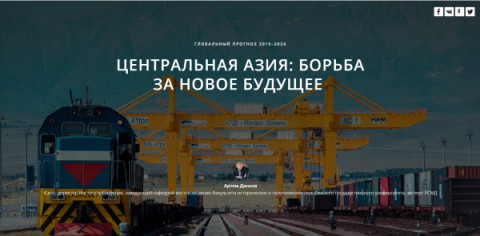 Central Asia: struggle for the new future Year of publication: 2018 Author: A. Dankov The article discusses the social, economic and political prospects of Central Asia (2019-2024). Prognosis also covers the ethnic changes, migration, cultural and language diversity, urbanization, quality of life.
 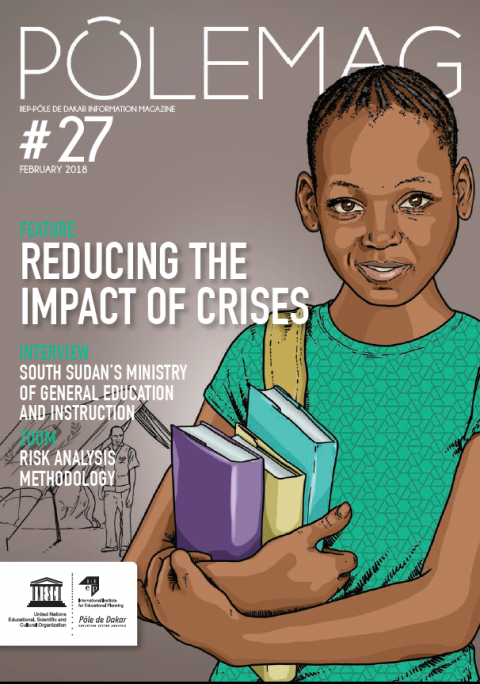 PôleMag n° 27: IIEP Pôle de Dakar information magazine, February 2018 Year of publication: 2018 Corporate author: UNESCO IIEP Regional Office for Africa Strengthening the resilience of education systems through planning that is adapted for crisis situations is a priority for IIEP. Together with our main partners, the institute has developed strategic orientations and tools dedicated to educational planning that is adapted to crisis situations. Based on our experience on this theme in Africa, we are also working with UNICEF to develop a new methodology to analyse risks and vulnerabilities. Mitigating the impact of crises calls for strengthening relationships with partners. Planning adapted to vulnerabilities should facilitate dialogue between development and humanitarian actors so that intervention plans are coordinated and aligned with government priorities. A dollar invested in risk reduction could save up to seven dollars in rebuilding costs. Taking the risks into account in the analysis and planning of education systems is therefore a wise investment.
  Global Citizenship Education in Latin America and the Caribbean: Towards a World without Walls: Global Citizenship Education in the SDG 4 - E2030 Agenda Year of publication: 2018 Corporate author: UNESCO Santiago The Latin America and the Caribbean Regional Network Meeting on Global Citizenship Education “Towards a World without Walls: Global Citizenship Education in SDG 4 – Agenda E2030”, was organized by the UNESCO Regional Bureau for Education in Latin America and the Caribbean (OREALC / UNESCO Santiago) and the Asia – Pacific Centre of Education for International Understanding (APCEIU), in collaboration with the Chilean Observatory of Educational Policies (OPECH) of the University of Chile. The event, held on October 23 and 24, 2017, in Santiago, Chile, brought together regional researchers, members of civil society organizations and activists, educational communities, social movements, government educational authorities and universities. The objective of the meeting was to promote dialogue on the concept of Global Citizenship Education (GCED), deepen the regional perspective on the topic and create a network that helps strengthen the implementation of GCED in the context of the Latin America and the Caribbean region. This document summarizes the main topics addressed and issues discussed at the meeting. Subsequently, the founding document of the Regional Global Citizenship Education Network for Latin America and the Caribbean, which was elaborated in light of the meeting’s discussions, is presented.
 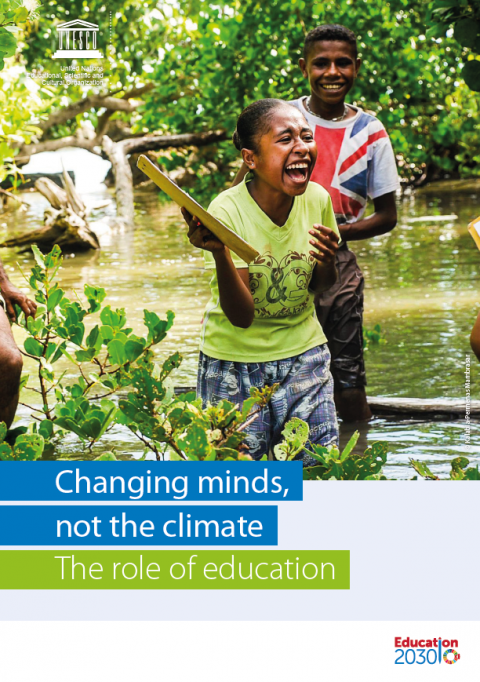 Changing minds, not the climate: the role of education Year of publication: 2017 Corporate author: UNESCO Education is the most powerful element in preparing societies for the global challenges that climate change brings. It equips individuals, communities and the wider world with the understanding, skills and attitudes to engage in shaping green, low emission and climate-resilient societies. Education for Sustainable Development (ESD) is not an ‘extra’ but rather an integral part of any strategy to combat the effects of climate change, put into practice a global agreement and achieve the Sustainable Development Goals (SDGs). It acts to raise awareness and change behaviours and attitudes and enables people to make informed decisions about their lives. The heads of UNESCO and UNFCCC agree that “education provides the skills people need to thrive in the new sustainable economy, working in areas such as renewable energy, smart agriculture, forest rehabilitation, the design of resource-efficient cities, and sound management of healthy ecosystems. Perhaps most important, education can bring about a fundamental shift in how we think, act, and discharge our responsibilities toward one another and the planet.” ESD is increasingly recognized around the world as a key enabler for a more sustainable future.
 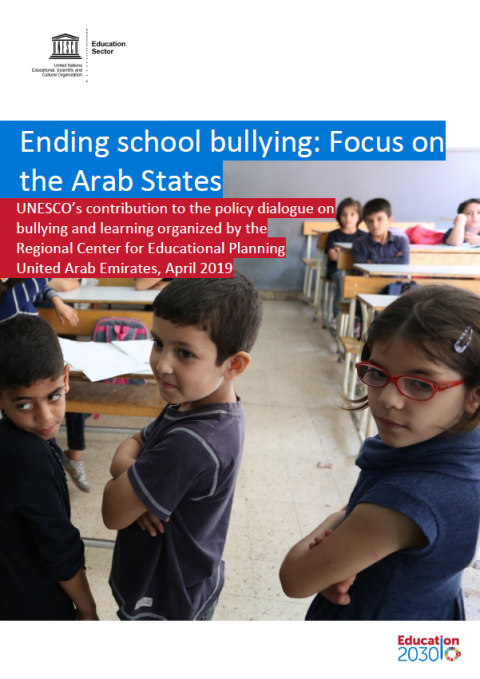 Ending school bullying: Focus on the Arab States and North Africa UNESCO’s contribution to the policy dialogue on bullying and learning organized by the Regional Center for Educational Planning United Arab Emirates Year of publication: 2019 Corporate author: UNESCO Bullying is a form of school violence. According to an agreed international definition, bullying is characterised by aggressive behaviour that involves unwanted, negative actions and an imbalance of power or strength between the perpetrator or perpetrators and the victim. Unlike isolated incidents of school violence, bullying is also characterised by repetition over time. The number of repetitions may vary and, for example, major surveys that collect data on bullying measure the frequency of bullying in different ways. The international Sustainable Development Goal Thematic Indicator 4.a.2 that measures the ‘percentage of students who experienced bullying during the past 12 months, by sex’, which was adopted in 2018, defines that the frequency of aggressions should be at least once or twice a month or more for a student to be considered a victim of bullying. It is important to note that here is no standard definition of bullying across the six international surveys that collect data on the prevalence of bullying. Some of them do not even provide a definition. These surveys are the following:Two international surveys that measure the health behaviours of students as well as protective factors including school climate: the WHO Global School-based Student Health Survey (GSHS) and the Health Behaviours in School-aged Child survey (HBSC) conducted by the HBSC Consortium.Four international surveys that focus mostly on the measurement of learning outcomes of students but also ask questions on the school climate including bullying: the Regional Comparative and Explanatory Study in Latin America (Estudio Regional Comparativo y Explicativo, ERCE in Spanish); theProgress in International Reading Literacy Study (PIRLS); the Programme for International Students Assessment (PISA); and the Trends in Mathematics and Science Study (TIMSS).