
Resources
Explore a wide range of valuable resources on GCED to deepen your understanding and enhance your research, advocacy, teaching, and learning.
8,364 Results found
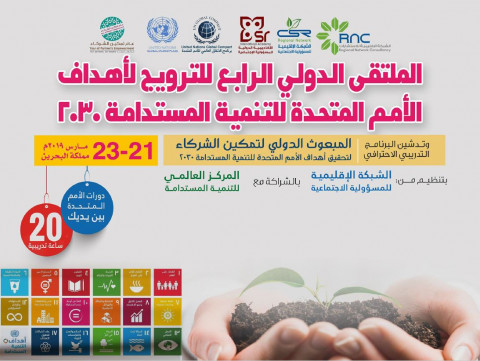 The Fourth International Forum to Promote the United Nations Sustainable Development Goals 2030 Year of publication: 2019 Corporate author: Regional Network for Social Responsibility This forum was organized in the Kingdom of Bahrain with the aim of shedding light on the sustainable development goals 2030, which was launched by the United Nations in 2015. The forum is aimed to the present the principles of the SDGs.
 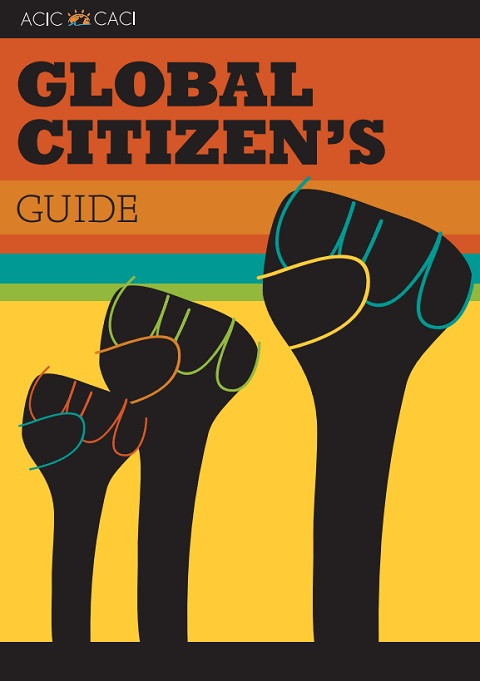 Global Citizen’s Guide Year of publication: 2014 Corporate author: Atlantic Council for International Cooperation (ACIC) ACIC’s Global Citizen’s Guide has some great ideas for you to get participate in local and global communities. It offers tips on volunteering, ethical consumption, engaging in democracy, organizing events, internships, and much more. The guide also profiles a number of Atlantic Canadians that are working to make the world a better place.
  Theoretical Basis and Training System of Digital Citizenship Year of publication: 2020 Author: Zheng Yunxiang | Zhong Jinping | Huang Liuhui | Yanghao Corporate author: China Educational Technology Nowadays, cases of abuse and misuse of information technology are not uncommon, causing many negative effects and social problems that are extremely harmful to people, such as Internet fraud and cyberbullying. Practice all over the world shows that enhancing digital citizenship is an effective way to solve these problems. In order to call for emphasis on digital citizenship, this paper discussed its theoretical basis and training system in detail. Specifically, it firstly defined the concept of digital citizenship, then comprehensively discussed the content of digital citizenship through literature research, which constituted four first-level content indicators and eleven sub-indicators. After clarifying the connotation and extension of digital citizenship, this paper continued to discuss its uniqueness and irreplaceability, so as to highlight its necessity. Then the importance and meaning of implementing digital citizenship education were stated respectively. Based upon this theoretical foundation and our national conditions, a three-oriented digital citizenship training system was finally proposed. The cultivation of qualified digital citizens is imperative, as it helps to enhance the overall improvement of core literacy and Digital Intelligence Quotient, and facilitate the construction of a civilized and harmonious digital society and the achievement of Lide Shuren goal as well.
  The Intersection and Division between Ideological and Political Education and Civic Education: Starting from the question of the Jewish Question (Journal of North Minzu University; No. 2) Year of publication: 2020 Author: Liu Yan Corporate author: North Minzu University Based on the analysis of Marx’s critique of western citizenship contained in On the Jewish Question, ideological and political education and citizenship education have overlaps and divergences in three aspects, core content, basic attributes and value orientation:the difference between actual and expected of citizenship, the difference between the unity and fragmentation of political personality and social personality, the difference between the authenticity and contradiction of patriotism education and the cultivation of international vision. Compared with civic education, ideological and political education does not have any regrets, but has characteristics and advantages that civic education does not have.
  A Study on Variables Related to Global Citizenship Teaching Efficacy of Secondary School Pre-service Teachers and In-service Teachers (Global studies Education; Vol. 9, No. 3) Year of publication: 2017 Author: MiSeok Yang | JeongKyoum Kim | KiDuck Kim Corporate author: Association of College and Research Libraries (ACRL) This study explores relations between global citizenship and global citizenship education attitude of pre-service and in-service secondary teachers and their global citizenship education teaching efficacy. The subjects of this study were 233 students majoring in education of University C as pre-service secondary teachers and 216 teachers of 11 middle schools in City D as in-service teachers. of whom questionnaires were used for final analysis. The final analytic methods of data include frequency analysis. reliability analysis. T-test. correlations and multiple regression analysis. First. the result of difference analysis of the two groups of pre-service and in-service teachers shows that in-service teachers are more scored in social responsibility. global capacity and global participation among the lower factors of the global citizenship and in teacher role attitude and global citizenship education teaching efficacy among the lower factors of the global citizenship education attitude than pre-service teachers are. Second. the result of analysis of correlations among global citizenship. global citizenship education attitude and global citizenship education teaching efficacy for pre-service teachers shows that the factors of pre-service teachers have mutually significant correlations except for curriculum attitude among the lower factors of the global citizenship education teaching efficacy and of the global citizenship education attitude. Furthermore. global citizenship and global citizenship education attitude of pre-service teachers affect significantly their global citizenship education teaching efficacy. Third. the result of analysis of correlations among global citizenship. global citizenship education attitude and global citizenship education teaching efficacy for in-service teachers shows that all the factors of in-service teachers have mutually significant correlations. And global citizenship of in-service teachers has significant influence on their global citizenship education teaching efficacy. The results of this study are expected to help provide fundamental data for curriculums required in teacher training courses and enhance teachers’ professionalism on global citizenship education in the future.
 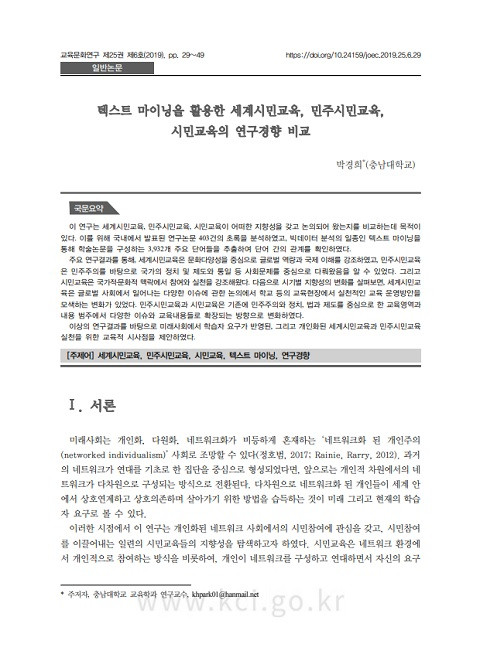 The Comparison of Research Trends on Global Citizenship Education, Democratic Civic Education, and Civic Education Using Text Mining Techniques (Journal of Education & Culture; Vol. 25, No. 6) Year of publication: 2019 Author: Kyunghee Park Corporate author: Education Research Institute of Inha University The purpose of this study is to compare the research trends of global citizenship education(GCED), democratic civic education(DCED), and civic education(CIED). For this purpose, it was analysed into abstracts of 403 articles, extracted 3,932 key-words through text mining analysis. The results of the study are as follows. First, GCED emphasized global competence and international understanding centering on cultural diversity. DCED was d iscussed mainly on the problems of national politics, and the unification issues on the democracy. CIED emphasized participation and practice in the national and cultural context. Second, with regard to the changes of orientation, GCED has changed to explore the practical education design. And DCED and CIED have changed to deal with various issues and contents. Based on these results, implications of this study were discussed for civic educations reflected future learner's diversity and personality.
  Economic, Social and Cultural Rights: Handbook for National Human Rights Institutions (Professional Training Series No.12) Year of publication: 2005 Corporate author: UN. Office of the United Nations High Commissioner for Human Rights (UN. OHCHR) This publication reviews economic, social and cultural human rights. It is a guide to national institutions produced by the United Nations. The guide is a reference in all matters related to human rights to create a decent life for people, and to clarify the role that governments should play in this regard.This handbook is intended to help national human rights institutions maximize the effectiveness of their functions and powers in addressing economic, social and cultural rights. Its aim is to assist national human rights institutions in the development of policies, processes and skills to integrate economic, social and cultural rights further into their work, thereby enabling them to address poverty and development, for example, through an economic, social and cultural rights framework.This handbook will discuss ways in which national human rights institutions can become more effective in protecting and promoting economic, social and cultural rights. It will examine how national institutions’ legal mandates can be interpreted to incorporate economic, social and cultural rights within their jurisdictions, how their functions and powers can be exercised more appropriately in regard to these rights, how they can use their resources most efficiently and effectively and how they can implement economic, social and cultural rights in the political and social contexts in which they operate.
  How Does Peer-Mentoring Contribute to Education for Sustainable Development in Schools?: Study & Analysis; France Year of publication: 2020 Author: Carole Coupez | Jérémie Morfoisse Corporate author: Solidarité Laïque | Peerment | Erasmus+ This document reports the findings of a study surveying French teachers about practices in education for sustainable development within France’s formal education system, and the development of educational approaches to peer-mentoring.
 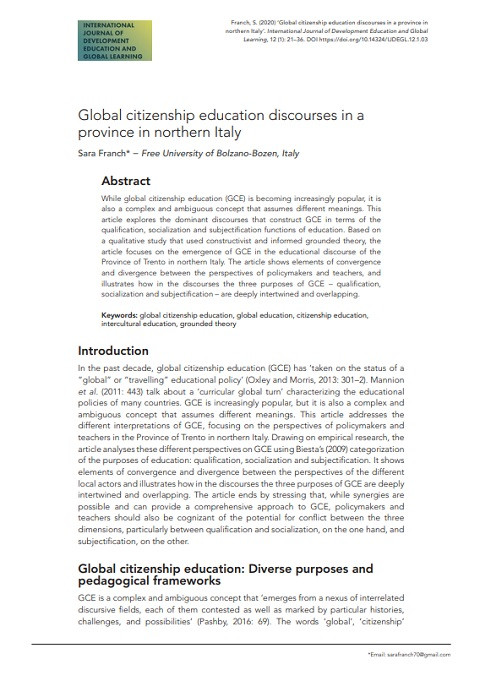 Global Citizenship Education Discourses in a Province in Northern Italy (International Journal of Development Education and Global Learning; Vol. 12, No. 1) Year of publication: 2020 Author: Sara Franch Corporate author: UCL Press While global citizenship education (GCE) is becoming increasingly popular, it is also a complex and ambiguous concept that assumes different meanings. This article explores the dominant discourses that construct GCE in terms of the qualification, socialization and subjectification functions of education. Based on a qualitative study that used constructivist and informed grounded theory, the article focuses on the emergence of GCE in the educational discourse of the Province of Trento in northern Italy. The article shows elements of convergence and divergence between the perspectives of policymakers and teachers, and illustrates how in the discourses the three purposes of GCE – qualification, socialization and subjectification – are deeply intertwined and overlapping.
 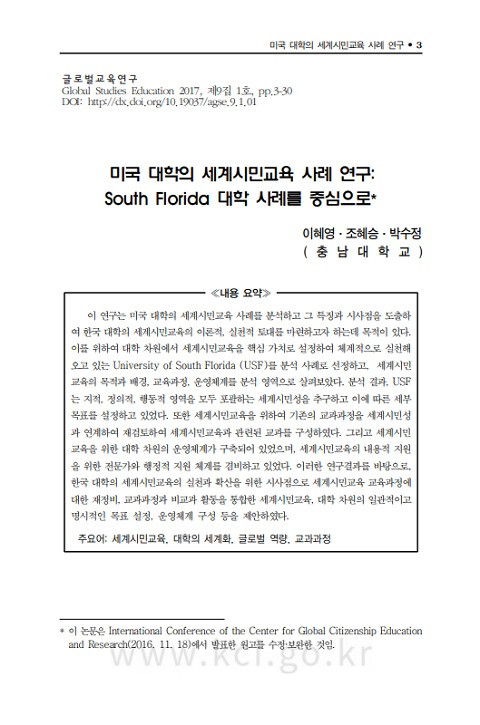 A Case Study on Global Citizenship Education of University of South Florida (Global Studies Education; Vol. 9, No. 1) Year of publication: 2017 Author: Hyeyoung Lee | Hyeseung Cho | Soojung Park Corporate author: Global Studeis Education Association This study investigates the issues for the practice of global citizenship education in universities and analyses a case study of the university in US. The University of South Florida (USF), which defines global citizen education as one of the core strategic plans of the university, is selected. Global citizenship education at USF is aimed at strengthening students' global competencies; global awareness, responsibility and participation. The goals of the practice are globalization of the undergraduate general education curriculum, extra-curricular activities in connection with the curriculum, globalized curriculum leading to graduate courses, and enhancing global competencies of all university members. It is reported that USF dedicated special organizations and systematic operation to support these goals. Based on our investigation and analysis, a reform of the global citizen education curriculum, a global citizenship education that integrates the curriculum and the extra-curricular activities, a coherent and explicit goal setting at the university level, and an operating system structure are required for universities in Korea to promote global citizenship education.