
Resources
Explore a wide range of valuable resources on GCED to deepen your understanding and enhance your research, advocacy, teaching, and learning.
8,364 Results found
 Constructing the Global Dimension of Ideological and Political Education From the Perspective of “Community With a Shared Future for Mankind” (Ideological and Political Education Research; Vol. 36, No. 2) Year of publication: 2020 Author: Cao Qingyan | Peng Jiaojiao Corporate author: Harbin University of Science and Technology In the context of building a community with a shared future for mankind, issues such as “global crisis”, the negative impact of ultra-nationalism and the conflicts in the confrontation of “multi-cultures” all challenge the ideological and political education in the context of nation-states. Therefore, it is necessary and urgent to pay attention to the global dimension of ideological and political education. The global dimension of ideological and political education is guided by the concept of “a community with a shared future for mankind” and aims to cultivate social members with global awareness, recognition of global common values and global participation ability. It is not the rejection and denial of the national dimension of ideological and political education, and it is also different from the western global citizenship education in essence. The global dimension of ideological and political education needs to be promoted from three aspects: policy design, multi-force participation and network technology.
  Digital Citizenship Education: The Policy and Practice in Asia-Pacific Region (International and Comparative Education; Vol. 8) Year of publication: 2019 Author: Zhou Xiaoli | Wang Fangzhou Corporate author: Beijing Normal University With the advent of the network informational age, digital citizenship has gradually become a concept for in-depth exploration. At the same time, the education of digital citizenship has also increasingly become an important part of the education system of many countries around the world. In Asia-Pacific area, UNESCO Bangkok has started to launch the digital citizenship project, while those member states are actively exploring and working on all aspects of relevant policy and practice. As the countries with high information level, Singapore, Australia and Korea have been carrying out better digital citizenship educations, especially in terms of cyber wellness courses, cyber security education and internet addiction prevention and treatment. The status and experience of the digital citizenship education in Asia-Pacific countries can provide some enlightenment for the future advancements of digital citizenship education in China.
  A Desirable and Practical Approach to Global Citizenship Education: An Exploration of “Global Storylines” in Scotland (Studies in Foreign Education; Vol. 47, No. 3) Year of publication: 2020 Author: Rao Shuqi Corporate author: Northeast Normal University The problems that global citizenship education has to deal with are threefold. “Global Storylines”, which provides corresponding solutions to practical difficulties, has emerged as the most effective approach to global citizenship education in Scotland. Firstly, global citizenship education has enjoyed a long continuity of government support. Through integrating with the current curriculum landscape, “Global Storylines” experiences secure curriculum status. Secondly, by utilizing “storylines” and educational drama, global society and global issues are introduced in subtle forms, which benefits students’ experienced-based learning. The contradiction between students’ cognitive need and ability is resolved accordingly. Thirdly, WOSDEC as the co-creator of “Global Storylines” offers a professional learning program. Teachers are universally supported in terms of theoretical knowledge, practical skills and being involved in the teaching community of global citizenship education.
  Global Citizenship Education and Ecopedagogy at the Intersections: Asian Perspectives in Comparison (Asian Journal of Education; Vol. 17, Special Issue) Year of publication: 2016 Author: Greg William Misiaszek | Lauren Ila Misiaszek Corporate author: Seoul National University. Education Research Institute This article provides a preliminary comparative analysis of environmental pedagogies in the context of widening spheres of citizenship due to intensifying globalization, with a particular focus on the East Asian context. In it, the authors specifically focus on Global Citizenship Education models and critical, Freirean-based ecopedagogies. The article includes analysis of research with expert scholars of citizenship and/or environmental pedagogies from six continents that focused on the intersectionalities between these two pedagogies and the effects of globalization on this work. The authors further explore the ways self-identified East Asian participants perceive differences in conceptualizations of citizenship between East Asia and the “West.”
  Comparison on Educational Discourses About Global Citizenship Education Using Network Text Analysis (Global Studies Education; Vol. 11, No. 2) Year of publication: 2019 Author: Kyunghee Park | JiEun Shin Corporate author: Association of | Global Studies Education The purpose of this study is to analyze the differences between ‘global citizenship education’, ‘democratic civic education’, ‘multicultural education’, ‘education for international understanding’, and ‘peace education’. For this, 3,072 research papers from 2000 to 2018 selected, and network text analysis(NTA) was conducted to confirm the characteristics and changes of the five educational discourses. As a result, the commonness and specificities of them were derived through the ‘closeness centrality’ and ‘betweenness centrality’ on the NTA. ‘Global citizenship education’, ‘multicultural education’, and ‘education for international understanding’ have crossed the content area. And ‘education for international understanding’ was based on a multicultural society. The values-oriented between ‘global citizenship education’ and ‘democratic civic education’ were distinguished. Finally, it is suggested that the five educational discourses need to be on the approach of lifelong learning, and they are education oriented toward change in consciousness.
  Deleuze’s Experimental Apprenticeship and Global Citizenship Education Year of publication: 2017 Author: Seunghyun Choi Corporate author: Korean Philosophy of Education Society The purpose of this study is to examine the implications of Deleuze’s apprenticeship for Global Citizenship Education. Nowadays, many researchers are interested in the meaning of learning as a bridge between ideal and practice. Deleuze’s apprenticeship suggests the logic of the ‘composition’ with others in the context of overcoming ‘the societies of control’. The structure of this argument consists in ‘process’ including involution and in ‘signs’ that are not reduced to information. It aims at ‘becoming’. The global citizenship lesson focusing on the element of multi-cultural experience of Korean elementary school students has a well-balanced relationship with Deleuze’s apprenticeship as experimentation. Lastly, we are able to understand the meaningful implications for the aporia in Global Citizenship Education, that is the uncertainty of academic conceptualization and the contingency of practice.
 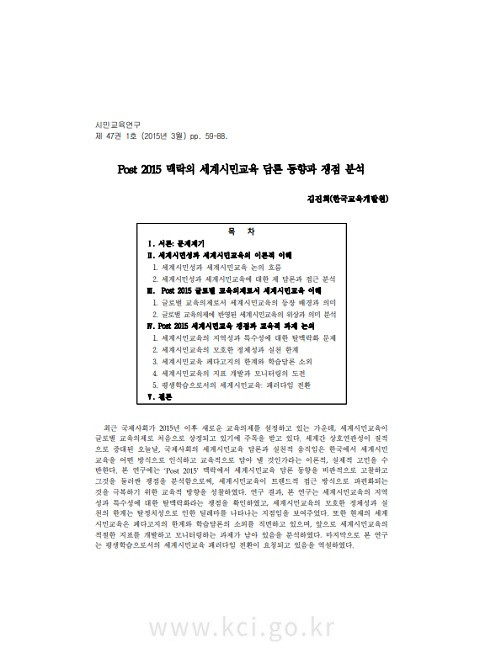 Critical Understanding on Global Citizenship Education in Post 2015 Context (Theory and Research in Citizenship Education; Vol. 57, No. 1) Year of publication: 2015 Author: Jinhee Kim Corporate author: Korea Association of Social Education It is notable that global citizenship education has recently gained prominence in Post 2015 context. This study attempted to explore diverse discourses of global citizenship education in theoretical dimension and it also analyzed the current status of global citizenship education as a new global education agenda. Major findings displayed issues and challenges; de-contextualization against local dimension; vague conceptualization of global citizenship education; limitation of transformative pedagogy and learning discourse; indicator development and monitoring issues; a paradigm shift for global citizenship education engaging with lifelong learning. Eventually, this study argues that comprehensive vision and long term road-map should be established to enhance global citizenship education. Lifelong learning approach is crucial to reshape global citizenship education while interacting with life-world context and life experience, which can promote an epistemology of learning to live together.
 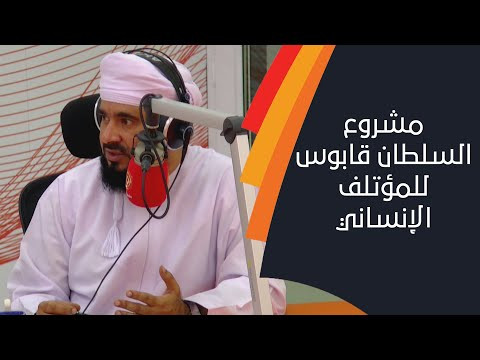 The Sultan Qaboos Project for the Humanitarian Year of publication: 2019 Corporate author: Al Shabiba The program deals with the Human Recombinant Project, its importance and objectives. The project came with the blessing of the late Sultan in order to gather the efforts of nations to improve human lives, and to raise human awareness of the importance of a shared global ethics system.
  World Report on the Culture of Peace: Civil Society Report at Midpoint of the Culture of Peace Decade Year of publication: 2005 Corporate author: Foundation for a Culture of Peace The year 2005 marks the midpoint of the International Decade for a Culture of Peace and Non-Violence for the Children of the World (2001-2010) as proclaimed by the United Nations General Assembly.The present report has been submitted to the UN Secretary-General for the General Assembly's consideration at its next session under the relevant agenda item which will review the midpoint of the Culture of Peace Decade. This initiative responds to the invitation contained in operative paragraph 10 of General Assembly resolution A/59/143.The report is based on the accounts submitted by 700 organizations from all regions of the world. From the information received, it can be concluded that the culture of peace is advancing.The report provides the first comprehensive view of the progress made by the global movement for a culture of peace, since it was called for in 1999 by General Assembly resolution A/53/243 (annexed to the end of this report).
 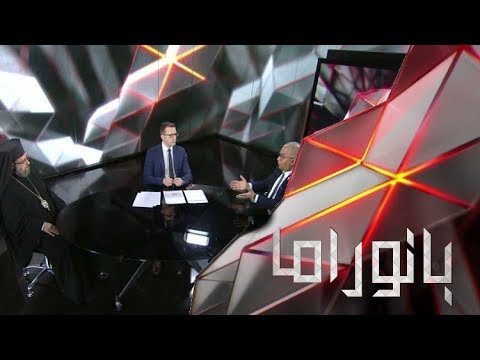 Interfaith Dialogue .. Dialogue of Life and Wise People Year of publication: 2019 Corporate author: RT Arabic Online Through this program, RT channel provides a seminar by hosting speakers to discuss the importance of interfaith dialogue and coexistence between all people from different religions.