
Resources
Explore a wide range of valuable resources on GCED to deepen your understanding and enhance your research, advocacy, teaching, and learning.
8,364 Results found
 Treaties on Teachers for Global Citizenship Education (Korean Journal of Teacher Education; Vol. 31, No. special) Year of publication: 2015 Author: Kioh Jeong Corporate author: Korea National University of Education This article examines the nature of Global Citizenship Education (GCE) and the qualification of the teacher for the GCE. GCE means post-modern education beyond modern public education. In the latter, teachers used to have been affiliated with nation-building mission, professional service to learners, and sometimes teacher unionism. These affiliations are typically of modern nationalism and industrialism. Teachers for GCE stand on different ground for their professional practice: global civil right to teach, global civil right to learn, and finally peoples’ fundamental right for development. Their sight extends beyond national territory up to global world and cyber space. They overcome modernity to practice transformative pedagogy accommodating multi-cultural dimensions. The image can be summarized as a model global citizen who serves highly for the benefit of mankind, which characterizes Korean educational ideal as provided by the foundation law of education Korea.
  From Teaching Craftsmen to Lamplighters: Ignorance and Recovery of Teachers’ Citizenship Education Consciousness (Forum on Contemporary Education; No. 296) Year of publication: 2020 Author: Hu Chaoxia | Tang Songlin Corporate author: Hunan Academy of Educational Science From the perspective of curriculum, there are two major shortcomings of citizenship education in schools in China: civic education replaces complete citizenship education with citizenship cognition, and the path development is inadequate; the concentric focus of citizenship education with other courses is inadequate, and the path expansion is inadequate. From the perspective of teachers, the reason is that the professional orientation of “teaching craftsmen” ignores the self-consciousness of their functions under the background of modern education, which restricts the expansion of their educational horizons. Teachers should be conscious of citizenship education, teach for social harmony and citizen happiness, expand the field of citizenship education, form a learning community, develop toward nature, society and life, build a panoramic, multi-level interlaced world of citizenship education, expand the horizon of disciplinary education, and explore reveal or conceal in subject curriculum resources. The curriculum resources of citizenship education should build a general pattern of citizenship education through the whole staff and the whole curriculum.
  Investigation and Analysis on the Service Status of University Libraries in Digital Citizen Education (Library Work in Colleges and Universities; No. 4) Year of publication: 2020 Author: Tangyi | Liulu Corporate author: College library and Information Committee of Hunan Provincial This paper investigated the status of the service provided by university libraries in China to cultivate digital citizens and the cognition of responsibility of cultivating digital citizens provided by university libraries. The survey found that: firstly, the number of service in the digital citizen education provided by the university library is related to the university’s level; secondly, university libraries provide the most abundant service in the areas of digital literacy, digital access and digital communication, and less service in the areas of digital law, digital etiquette and digital power; thirdly, university libraries provide the scarcest service in the area of digital trade and most university libraries consider it is no responsible to provide this service or just hold an uncertain attitude; fourthly, there is no significant correlation between the service on digital citizen education provided by university libraries and the cognition status of responsibility.
  Understanding Global Citizenship Education as Critical Pedagogy (Journal of the Korea Contents Association; Vol. 17, No. 9) Year of publication: 2017 Author: Changsoo Hur Corporate author: Korea Contents Association Scholars suggests global citizenship education(GCE) as an important direction for the future education. Although many academic discussions have been internationally going on, the studies in Korea are still on the beginning stage. Thus, it is asserted that studies for GCE should be proceeded more actively and widely, especially for a theoretical background because it might give a concrete direction for GCE. In the international trend, studies suggest that GCE should be discussed among post-modernism, post-colonialism, and critical theory as theoretical framework. So, this study purports to find a theoretical framework which represents those three. It is critical pedagogy (CP) which also includes educational values for GCE. The reason is because CP tries to achieve emancipation in terms of consciousness, reason and rationality through educational praxis and it should be a background for GCE in terns of current situation in the world. Therefore, this study asserts and tries to prove that CP is currently at the center of theoretical backgrounds for GCE.
  A Comparative Analysis on Content Elements of Global Citizenship Education in 2009 and 2015 Revised Middle School Social Studies Curriculum (Education Research; Vol. 74) Year of publication: 2019 Author: Kyunghee Sung | Soyeon Lee Corporate author: Sungshin Women's University Educational Research Institute This study is a follow-up study of the 2017 research which analyzed content elements of global citizenship education in elementary school Social Studies. Based on the global citizenship education index, the content elements of are analyzed in the 2009 and 2015 revised middle school Social Studies curriculum, and then it was compared to the results of previous research in elementary school. As a result, it can be found that the content elements of global citizenship education in the middle school Social Studies are not increased or strengthened. In terms of 'strong connection', there was almost no change in the proportion of the cognitive domain and the socio-emotional domain, but rather it decreased in the behavioral domain. Compared with the results of elementary school, it is appeared that elementary school showed a larger increase than the middle school in the proportion of content elements depending on the change of curriculum. Through this, it can be confirmed that the global citizenship education was strengthened in elementary school in the 2015 revised Social Studies curriculum. At the time of next curriculum revision, it will be necessary to consider adding and revising the content elements related to global citizenship education to meet the needs of international community.
 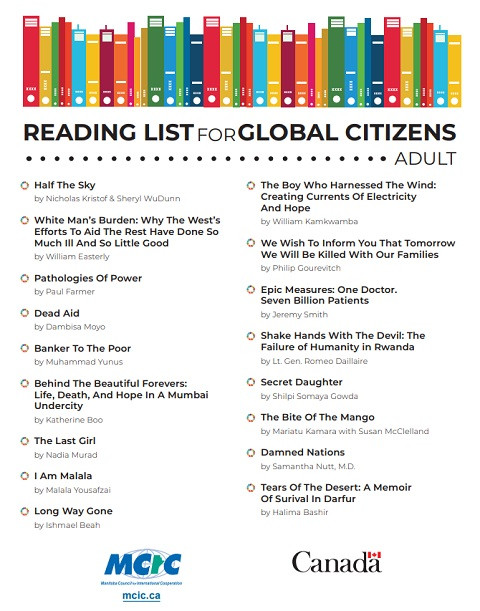 Reading List for Global Citizens: Adult Year of publication: 2020 Corporate author: Manitoba Council for International Cooperation (MCIC) | Global Affairs Canada (GAC) This reading list helps readers to be a global citizen by reading books that are informative and inspiring.
 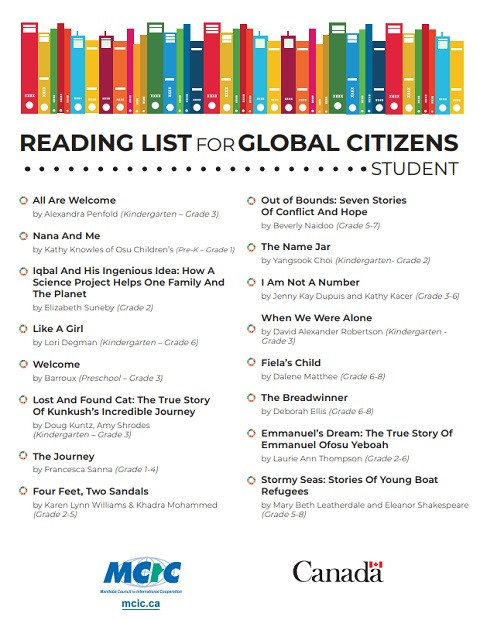 Reading List for Global Citizens: Student Year of publication: 2020 Corporate author: Manitoba Council for International Cooperation (MCIC) | Global Affairs Canada (GAC) This is a reading list for global citizens from Kindergarten to Grade 12. These books will inspire students to take action whether they are passionate about food security, ending poverty, supporting women’s rights, or protecting the environment.
 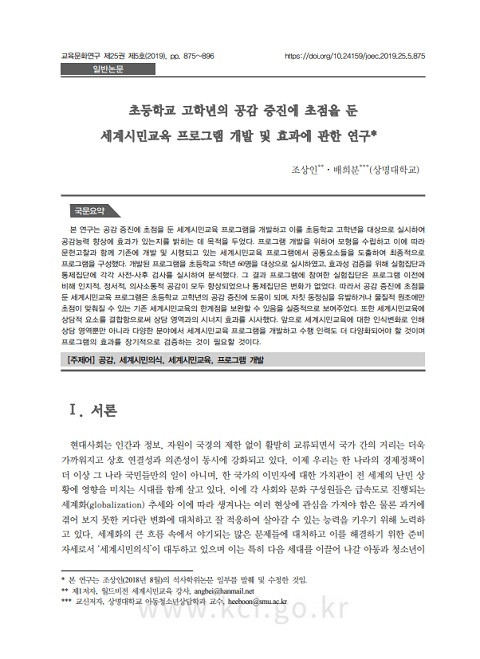 A Study on the Development and Effects of the Global Citizenship Education Program Focusing on Improving Empathic Ability of Higher Grade Elementary School Students (Journal of Education & Culture; Vol. 25, No. 5) Year of publication: 2019 Author: Cho Sangin | Bae Heeboon Corporate author: Inha University. Education Research Institute This study aims to develop a global citizenship education program focused on empathy enhancement, apply it to Elementary School Students in Higher Grade, and reveal whether it has an effect on empathic ability improvement. A program development model was established for program development and along with literary review and common elements were drawn from global citizenship education programs that had previously been developed and applied to construct the final program. The developed program was applied to 60 fifth grade students and for effectiveness verification, pre and post tests were conducted on both the test group and control group. As a result, the test group participating in the program displayed more improvement in cognitive, emotional, and communicative empathy than the group before participating the program but the control group showed no change. Therefore, it was empirically shown that global citizenship education programs focusing on empathy enhancement do help to enhance the empathy of higher grade elementary school students and that they overcome the limitations of previous global citizenship education that simply provokes sympathy or only focuses on material support. Also, by combining counseling elements with global citizenship education, it implied synergy effects with counseling domains.
  Sustainable Foundations: A Guide for Teaching the Sustainable Development Goals Year of publication: 2018 Author: Keana Rellinger | Grace Van Mil Corporate author: Manitoba Council for International Cooperation (MCIC) This guide is designed for educators or anyone who would like to teach young people about the United Nations Sustainable Development Goals. The Sustainable Development Goals — also known as the SDGs or the Global Goals —cover a wide range of sustainability issues; highlighting local, national and international priority areas to end poverty and hunger, improve health and education, make cities more sustainable and combat climate change. This guide will provide you with clear information, educational resources and other supports to help you in your efforts to educate and engage young people so that they support the Sustainable Development Goals and are inspired to turn their support into action. This guide will also explore how you can incorporate the different topics covered by each goal into your lessons across multiple subjects.
 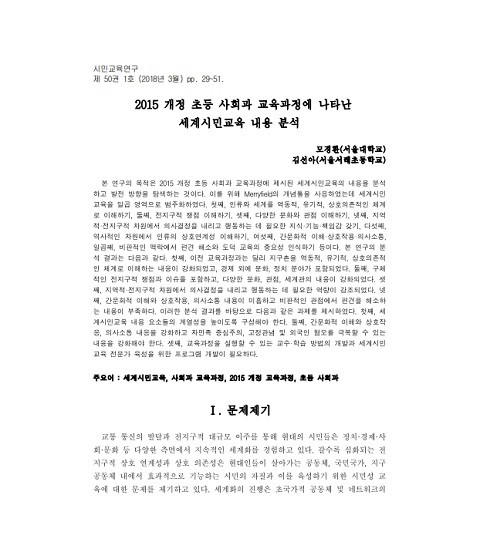 A Critical Analysis of Global Citizenship in 2015 Revised Elementary Social Studies Curriculum (Theory and Research in Citizenship Education; Vol. 50, No. 1) Year of publication: 2018 Author: Kyunghwan Mo | Sunah Kim Corporate author: Korea Association of Social Education The purpose of this study was to examine how global citizenship is reflected in the 2015 revised social studies curriculum. The study used the conceptual framework of Merryfield(1998) to analyze the national curriculum. The results of the analysis are as follows. First, in terms of understanding of the world as interdependent systems, contents on politics and culture as well as economy increased. Second, more global issues and problems were included. Third, contents on sustainable development increased. Fourth, the scope of diversity expanded. Fifth, interconnectedness of humans through time was inadequately reflected in the current social studies curriculum. Sixth, contents on values and attitudes, and actions were strengtened. Sixth, contents of cross-cultural understanding, interaction, and communication are not adequately included. The elementary social studies curriculum should strengthen cross-cultural understanding and interaction and prejudice reduction. Also, more instructional methods for global citizenship education should be developed and teacher education programs should be overhauled.