
Resources
Explore a wide range of valuable resources on GCED to deepen your understanding and enhance your research, advocacy, teaching, and learning.
8,364 Results found
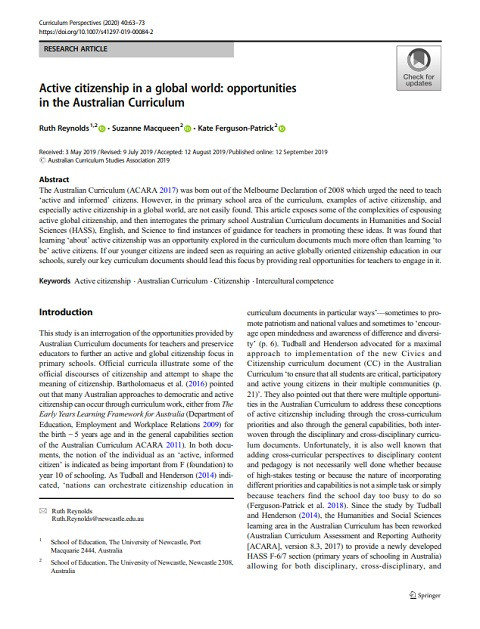 Active Citizenship in a Global World: Opportunities in the Australian Curriculum (Curriculum Perspectives; Vol. 40) Year of publication: 2019 Author: Ruth Reynolds | Kate Ferguson-Patrick | Suzanne MacQueen Corporate author: Australian Curriculum Studies Association (ACSA) The Australian Curriculum (ACARA 2017) was born out of the Melbourne Declaration of 2008 which urged the need to teach ‘active and informed’ citizens. However, in the primary school area of the curriculum, examples of active citizenship, and especially active citizenship in a global world, are not easily found. This article exposes some of the complexities of espousing active global citizenship, and then interrogates the primary school Australian Curriculum documents in Humanities and Social Sciences (HASS), English, and Science to find instances of guidance for teachers in promoting these ideas. It was found that learning ‘about’ active citizenship was an opportunity explored in the curriculum documents much more often than learning ‘to be’ active citizens. If our younger citizens are indeed seen as requiring an active globally oriented citizenship education in our schools, surely our key curriculum documents should lead this focus by providing real opportunities for teachers to engage in it.
 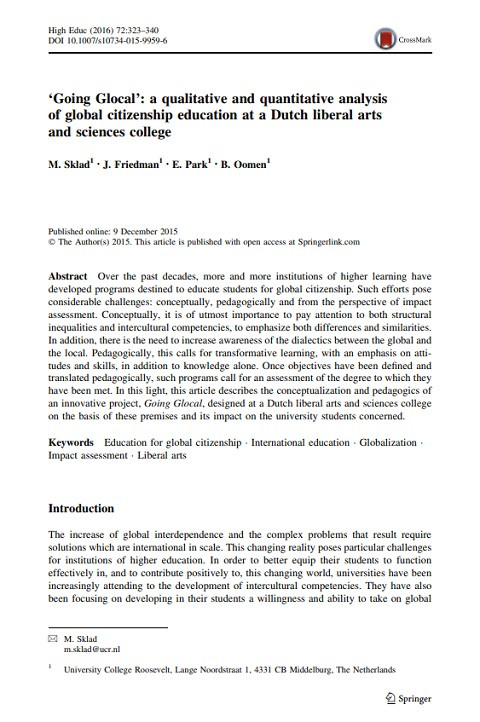 ‘Going Glocal’: A Qualitative and Quantitative Analysis of Global Citizenship Education at a Dutch Liberal Arts and Sciences College (High Education; Vol. 72, No. 3) Year of publication: 2015 Author: Marcin Skald | John Friedman | Eri Park | Barbara Oomen Corporate author: Springer Nature Over the past decades, more and more institutions of higher learning have developed programs destined to educate students for global citizenship. Such efforts pose considerable challenges: conceptually, pedagogically and from the perspective of impact assessment. Conceptually, it is of utmost importance to pay attention to both structural inequalities and intercultural competencies, to emphasize both differences and similarities. In addition, there is the need to increase awareness of the dialectics between the global and the local. Pedagogically, this calls for transformative learning, with an emphasis on attitudes and skills, in addition to knowledge alone. Once objectives have been defined and translated pedagogically, such programs call for an assessment of the degree to which they have been met. In this light, this article describes the conceptualization and pedagogics of an innovative project, Going Glocal, designed at a Dutch liberal arts and sciences college on the basis of these premises and its impact on the university students concerned.
  Human Resources Development Journal Vol. 6, no. 2, 2015 Year of publication: 2015 Corporate author: University Mohamed Lamine Debaghine - Setif2 A set of scientific papers for a number of researchers. These papers are published in the Human Resources Development Magazine, Issue 2, 2015. All these papers focus on citizenship, and they use different methodologies.
 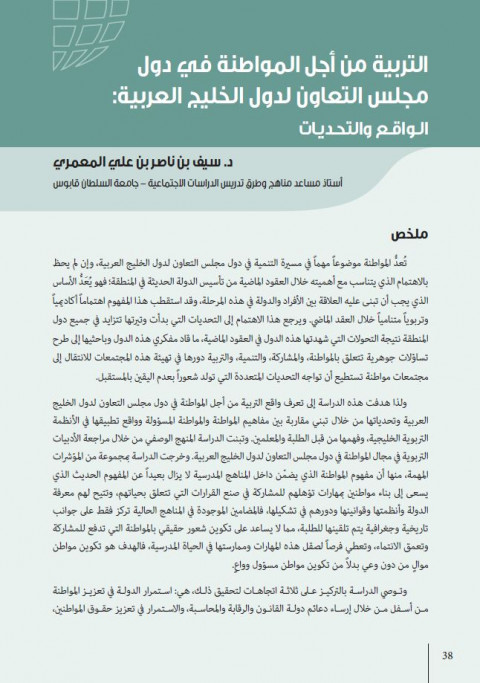 Education for Citizenship in the Arab Gulf Cooperation Council States: Reality and Challenges Year of publication: 2014 Author: Saif Al-Maamari Corporate author: Emirates Center for Strategic Studies and Research This study aimed at identifying the reality of education for citizenship in the Gulf Cooperation Council states and its challenges by adopting an approach between the concepts of citizenship and responsible citizenship and the reality of its application in the Gulf educational systems, and its understanding by students and teachers. The study adopted the descriptive approach by reviewing the educational literature in the field of citizenship in the countries of the Cooperation Council for the Arab Gulf States.
  Gulf Society .. and the Multiplicity of Foreign Cultures Year of publication: 2014 Corporate author: Sky News Arabia This video is a TV program discussing the case of multiculturalism in the Arab Gulf countries. The multiculturalism is brought to the Gulf by foreign workers. There program is having guests discussing the issue. What are the negative and positive effects of foreign cultures on local culture in the countries of the region? What are the ways to preserve the identity and values of society?
  Multicultural Education between Theoretical Modeling and Problematic Practices: A Comparative Study between Egypt, France, and Japan Year of publication: 2006 Author: Ahmed Aidrous | Mohammed Awad Corporate author: Zagazig University This paper focuses on studying multiculturalism as a concept, theories, frameworks and associated applied models. The study reviews the experience of France, Japan and Egypt, and makes comparisons between them. The study ends with a proposed vision for multicultural education in light of the experiences presented.
  Examining the Citizenship Education in the UK from Perspective of Solidarity (Studies in Foreign Education; Vol. 46, No. 7) Year of publication: 2019 Author: Tang Kejun Corporate author: Northeast Normal University It is claimed to build a cohesive community in plural society because of diversity undermining social cohesion. According to communitarianism, the grounds of solidarity include shared values, loyalty and civic trust. Britain is seen as a plural society which made up of a diverse range of ethnicities, cultures nations and religions. So citizenship education are expected to place emphasis on promoting the fundamental British values national loyalty or patriotism and social trust in schools of the UK, which has caused a number of criticism. It is concluded from examining the approaches of citizenship education and its criticism that a cohesive society depends on an inclusive citizenship.
  Multicultural Education and Its Implications for Educational Leadership as an Introduction to Stimulating Management Quality: A Proposed Vision Year of publication: 2011 Author: Essam Jamal Selim Ghanem Corporate author: Al-Azhar University The study discusses multiculturalism. It also works as an analytical review of the literature that dealt with multicultural education in terms of historical development, concept, dimensions, fields, roles of teachers, students, and multicultural educational programs, and the implications of that for educational leadership and the role they can play in activating the application of education multicultural.
 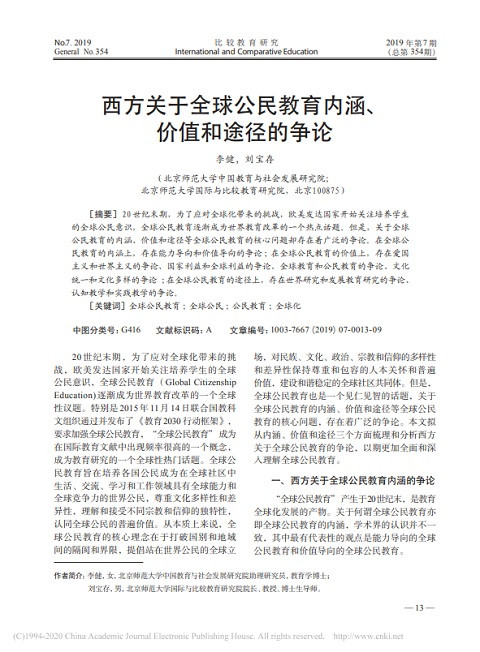 Western Debates on Global Citizenship Education: Definition, Value and Practice (International and Comparative Education; No. 7) Year of publication: 2019 Author: Lijian | Liu Baocun Corporate author: Beijing Normal University In the late twentieth century, in order to deal with the opportunities and challenges came from the globalization to all the countries worldwide, the developed countries in Europe and the United States began to focus on cultivating students’ global citizenship consciousness and global citizenship practice. Since 1990s, the western debate on global civic education has been widely spread among scholars and practitioners worldwide. The global citizenship education debate focuses on global citizenship education value and practice in three aspects: the connotation of global citizenship education debate on the ability-oriented, value-oriented definition, and the comprehensive-based definition. The value debate on the global citizenship education mainly includes: patriotism and the world socialist argument, national interests and global interests, the global education debate and the civic education debate and unified culture and cultural diversity debate. The global citizenship education practice debate involves the research and development of world education and cognitive education and behavior education.
 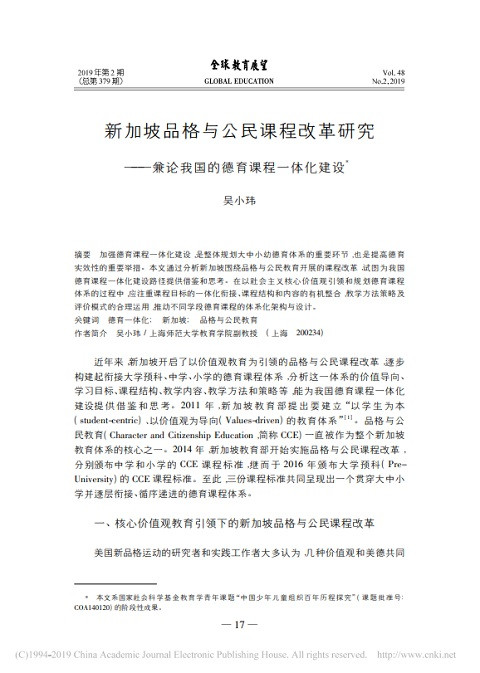 Study on Singapore’s Character and Citizenship Education Curriculum Reform: Discuss the Design of the Integration of Moral Education Curriculum from Primary School to University (Global Education; Vol. 48, No. 2) Year of publication: 2019 Author: Wu Xiaowei Corporate author: East China Normal University Strengthening the integration of moral education curriculum is an important part of the overall planning of a moral education system from primary school to university, which also is an important method to improve the effectiveness of moral education. Singapore’s curriculum reform reviving around character and citizenship education can provide reference and enlightenment for the integration of moral curriculum from primary school to university in China. Using the socialist core values to lead and plan the moral education curriculum system, we should focus on the systematic of curriculum objectives, the organic integration of curriculum structure and content, the rational use of teaching methods and strategies and evaluation models, so as to promote the coordinated connection and development of moral education courses from primary school to university.