
Resources
Explore a wide range of valuable resources on GCED to deepen your understanding and enhance your research, advocacy, teaching, and learning.
8,364 Results found
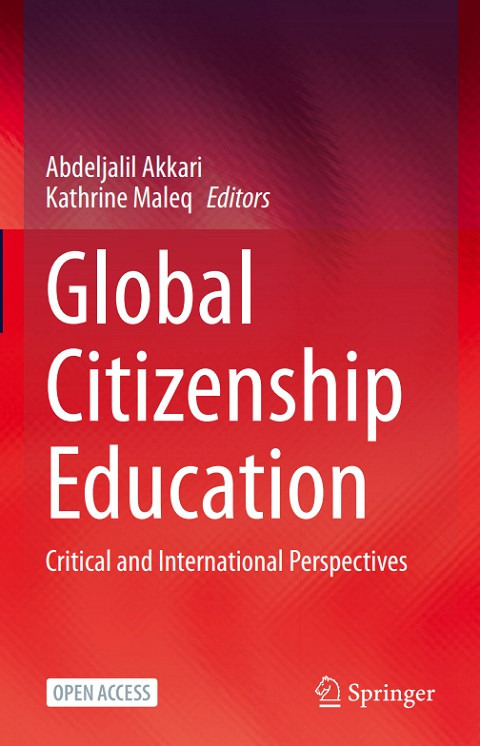 Global Citizenship Education: Critical and International Perspectives Year of publication: 2020 Author: Abdeljalil Akkari | Kathrine Maleq Corporate author: Springer Nature | Swiss National Science Foundation This open access book takes a critical and international perspective to the mainstreaming of the Global Citizenship Concept and analyses the key issues regarding global citizenship education across the world. In that respect, it addresses a pressing need to provide further conceptual input and to open global citizenship agendas to diversity and indigeneity.Social and political changes brought by globalisation, migration and technological advances of the 21st century have generated a rise in the popularity of the utopian and philosophical idea of global citizenship. In response to the challenges of today’s globalised and interconnected world, such as inequality, human rights violations and poverty, global citizenship education has been invoked as a means of preparing youth for an inclusive and sustainable world.In recent years, the development of global citizenship education and the building of students’ global citizenship competencies have become a focal point in global agendas for education, international educational assessments and international organisations. However, the concept of global citizenship education still remains highly contested and subject to multiple interpretations, and its operationalisation in national educational policies proves to be challenging.This volume aims to contribute to the debate, question the relevancy of global citizenship education’s policy objectives and to enhance understanding of local perspectives, ideologies, conceptions and issues related to citizenship education on a local, national and global level. To this end, the book provides a comprehensive and geographically based overview of the challenges citizenship education faces in a rapidly changing global world through the lens of diversity and inclusiveness.
  International Exchange and Cooperation Programs as Global Citizenship Education: A Case Study of the Gyeonggi Provincial Office of Education (Journal of Education for International Understanding; Vol. 14, No. 2) Year of publication: 2019 Author: Inyoung Lee | Youyeon Kim | Jeongmin Moon | Kyubin Lee | Sungsang Yoo Corporate author: Korean Society of Education for International Understanding (KOSEIU) This study examines the implementation of international exchange programs conducted within public education, focusing on the Gyeonggi Provincial Office of Education from the standpoint of global citizenship education. It also proposes the feasibility and direction of international exchange programs based on the analytical framework that analyses the global citizenship education as the competency-based approach, moral approach, and critical approach. The research questions are: first, 'what is the aspects of the implementation of international exchange programs in terms of global citizenship education?' and second, 'what is the possibility of implementing international exchange programs as global citizenship education?' To find the answer to the questions, documents related to the international exchange program and data from interviews with the person in charge and the participants of programs were analyzed. This paper found that there is a feasibility for implementing the competency-based approach and moral approach in the international exchange programs. However, in order to invigorate international exchange as the practice of global citizenship education, it is recommended that: first, international exchange from the viewpoint of critical approach should be developed. Second, every student should have the opportunity to participate in the programs regardless of their economic status. Lastly, target nations for international exchange should be chosen not only from the competency-based approach but from the various perspective of global citizenship education.
  The Development of a Middle School Social Studies Instructional Module for Place-Based Global Citizenship Education: The Case of Jeju Island (Journal of Education for International Understanding; Vol. 14, No. 2) Year of publication: 2019 Author: Han Sanghee Corporate author: Korean Society of Education for International Understanding (KOSEIU) This study aims to develop an instructional module for middle school social studies as part of place-based global citizenship education. The main contents of this study are as follows:first, the methods used in developing an instructional module for middle school social studies in global citizenship education; second, the method applied in the module for middle school classes. The study was mainly based on reference research and action research. The place-based class module developed for this study is the case of Jeju Island and is focused on middle school social studies classes as oriented to the integrated curriculum. The results are as follows: First, I developed a class module for place-based global citizenship education. For this module, I created principles for the class module for place-based global citizenship education and compose the class module by focusing on the case of Jeju Island. The design of this module went through 3 stages. The first stage explores regional issues by considering mutual relationships and the context from which suitable themes to foster global citizenship in the region are uncovered. The second stage explores the geological, historical, social, and cultural contexts of the place-based issues. The third stage expands on the contexts of the regional issues and practice to exercise global citizenship. Through the application of the principles and developmental stages for the class module, I then compose three Jeju-based modules. Second, I developed and conducted a Jeju-based instructional module for global citizenship education. For the themes and Jeju cases of the place-based module, I present sympathy for universal values through the life of Kim Mandeok who gave aid to the poor in the late Joseon era; respect for diversity and difference through the history of Haenamcheon, the Jeju immigrant community during early industrialization; and solidarity and practice through the Jeju 4·3 Uprising and Massacre. These three class modules can be utilized independently or stage by stage. I concede that this study has spatial and content limitations due to the fact that the Jeju cases are only presented among domains relating to global citizenship education which means that follow-up research is required to expand into relating domains and other regions. In addition, this study has other limits in that it hasn’t been verified quantitatively by presenting the effects of global citizenship education only through the stories of students who attended this class and the follow-up educational activities through this module.
  A Study on the Objectives and Contents of ESD Reflected in the 2015 Revised Curriculum of Primary School (Journal of Education for International Understanding; Vol. 15, No. 1) Year of publication: 2020 Author: 김다원 Corporate author: Korean Society of Education for International Understanding (KOSEIU) This study analyzed the objectives, core contents, and terms of use of sustainable development education reflected in elementary school curriculum to find ways to effectively implement ESD in conjunction with the curriculum. For this purpose, the contents described in objectives and achievement standards of the 2015 revised curriculum were analyzed, focusing on 8 subjects. Based on the results of the previous studies, the contents of ESD were selected and used as a reference. The results of the analysis are as follows. First, all eight subjects analyzed in this study include ESD-related goals in curriculum objectives. This shows that ESD can be implemented in the subject. Second, the terms reflected in the curriculum were used as ‘sustainable global village’, ‘sustainable future construction’, and ‘sustainable future society’ in social studies and practical arts. This shows positiveness in learning from the perspective of sustainable development. However, in both subjects, sustainable development is focused on future society, and it has a limitation in that sustainable development is a concept that looks at both the present and future generations at the same time. Third, the eight subjects include all the core contents except for ‘gender equality’ among 22 core contents of ESD. This is a positive indicator that ESD can be implemented in the curriculum.
  Didactic Sequences of Education for Peace Year of publication: 2016 Author: Enrique Chaux | José Fernando Mejía | Juanita Lleras | David Guáqueta | Andrea Bustamante | Gloria Inés Rodríguez | Paula Andrea Pineda | Alexander Ruiz-Silva | Carolina Valencia | Charlotte Greniez | Daniel García | Sara Victoria Alvarado | Ana María Velásquez Corporate author: Colombia. Ministerio de Educación Nacional This document proposes examples of didactic sequences of Peace Education for all grades from 1st to 11th. A didactic sequence can be understood as the detailed description of a series of articulated lesson organized in a coherent way. The proposed sequences include between 4 and 7 class sessions of approximately 50 minutes each. They seek to be consistent with the General Guidelines for the Implementation of the Peace Law and with the Proposed Performances.
  Peace Education Performances Year of publication: 2016 Author: Enrique Chaux | José Fernando Mejía | Juanita Lleras | David Guáqueta | Andrea Bustamante | Gloria Inés Rodríguez | Paula Andrea Pineda | Alexander Ruiz-Silva | Carolina Valencia | Charlotte Greniez | Daniel García | Sara Victoria Alvarado | Ana María Velásquez Corporate author: Colombia. Ministerio de Educación Nacional This document presents a proposal for Peace Education performances for grades k to 11th. This proposal seeks to be an illustration of a curricular design consistent with the Guidelines for the Implementation of the Peace Law.
  General Guidelines for the Implementation of the Peace Class in Preschool, Elementary and Middle School in Colombia Year of publication: 2016 Author: Enrique Chaux | Ana María Velásquez Corporate author: Colombia. Ministerio de Educación Nacional This document presents the general guidelines for educational communities in Colombia to carry out their peace education projects within the framework of the Peace Law.
  Landmarks of Mercy between Islam and Multiculturalism Year of publication: 2016 Author: Abdel Karim Osman Ali Corporate author: Nile Valley University Conference paper in which the researcher sought to: Explaining the greatness and comprehensiveness of the Allah’s path Disclosure of the features of mercy through the Qur’anic intentions to recognize and respect cultural diversity Show the distinction of Islam over the latest political theories in the West.
 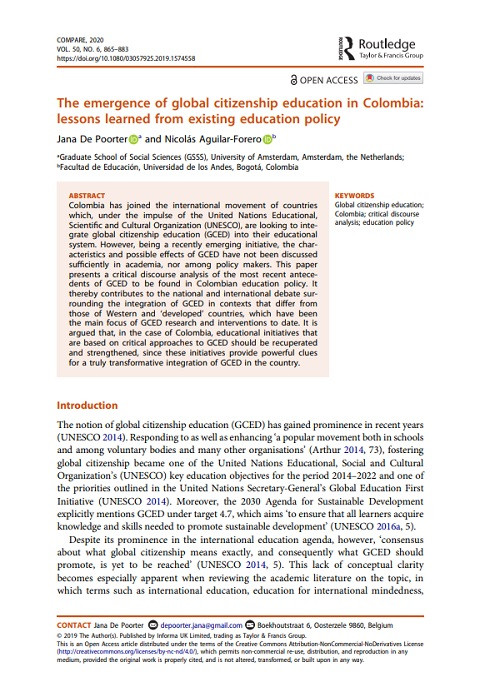 The Emergence of Global Citizenship Education in Colombia: Lessons Learned From Existing Education Policy (Compare: A Journal of Comparative and International Education; Vol. 50, No. 6) Year of publication: 2019 Author: Jana De Poorter | Nicolás Aguilar-Forero Corporate author: Taylor & Francis Colombia has joined the international movement of countries which, under the impulse of the United Nations Educational, Scientific and Cultural Organization (UNESCO), are looking to integrate global citizenship education (GCED) into their educational system. However, being a recently emerging initiative, the characteristics and possible effects of GCED have not been discussed sufficiently in academia, nor among policy makers. This paper presents a critical discourse analysis of the most recent antecedents of GCED to be found in Colombian education policy. It thereby contributes to the national and international debate surrounding the integration of GCED in contexts that differ from those of Western and ‘developed’ countries, which have been the main focus of GCED research and interventions to date. It is argued that, in the case of Colombia, educational initiatives that are based on critical approaches to GCED should be recuperated and strengthened, since these initiatives provide powerful clues for a truly transformative integration of GCED in the country.
 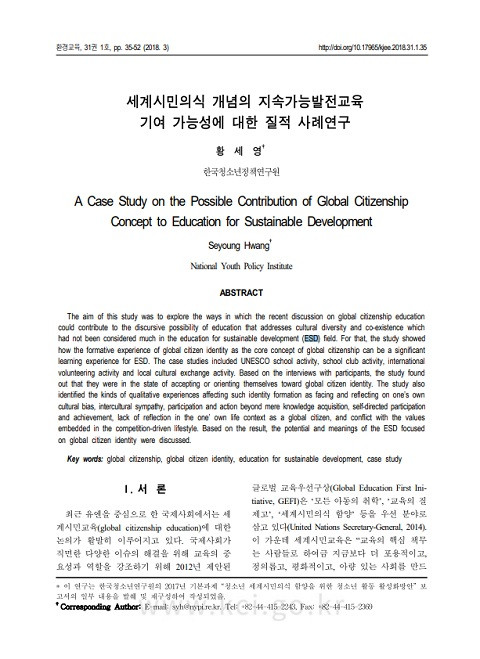 A Case Study on the Possible Contribution of Global Citizenship Concept to Education for Sustainable Development (Environmental Education; Vol. 31, No.1) Year of publication: 2018 Author: Seyoung Hwang Corporate author: Korean Society for Environmental Education The aim of this study was to explore the ways in which the recent discussion on global citizenship education could contribute to the discursive possibility of education that addresses cultural diversity and co-existence which had not been considered much in the education for sustainable development (ESD) field. For that, the study showed how the formative experience of global citizen identity as the core concept of global citizenship can be a significant learning experience for ESD. The case studies included UNESCO school activity, school club activity, international volunteering activity and local cultural exchange activity. Based on the interviews with participants, the study found out that they were in the state of accepting or orienting themselves toward global citizen identity. The study also identified the kinds of qualitative experiences affecting such identity formation as facing and reflecting on one’s own cultural bias, intercultural sympathy, participation and action beyond mere knowledge acquisition, self-directed participation and achievement, lack of reflection in the one’ own life context as a global citizen, and conflict with the values embedded in the competition-driven lifestyle. Based on the result, the potential and meanings of the ESD focused on global citizen identity were discussed.