
Resources
Explore a wide range of valuable resources on GCED to deepen your understanding and enhance your research, advocacy, teaching, and learning.
8,364 Results found
 Understanding Multicultural Education and Global Citizenship Education: Characteristics, Conceptual Relations and Educational Implications (Journal of Korean Education; Vol. 40, No. 3) Year of publication: 2013 Author: Jinhee Kim | Jinhee Kim Corporate author: Korean Educational Development Institute (KEDI) Thanks to the impact of globalized educational discourses and the resulting changes, much attention has been paid to multicultural education and global citizenship education in Korea. This study attempted to demonstrate the characteristics and conceptual relations of similarity and differences between multicultural education and global citizenship education. Finally, the study sought to produce educational implications and policy recommendations in response to a change in global education discourse and the accompanying practices. The major findings of the study showed that multicultural education and global citizenship education could be conceptualized as mechanisms for “learning to live together,” emphasizing diversity, equality and involvement in a global community. This type of education should be promoted while espousing an epistemology of lifelong learning, not only within the formal education system, but also in society as a whole. Despite the differences between multicultural education and global citizenship education, both fields are capable of continuously complementing each other. The study shows that multicultural education and global citizenship education emphasize critical reflection and engagement (praxis) by the learner rather than the formulation of knowledge and skills. It was argued that teacher education and teacher training is a very important part of nurturing multicultural education and global citizenship education in practice, which can bring about changes for the better in the current field of education. As democratic citizenship education, both educations could play an important role in reshaping Korean education.
  A Study on Global Citizenship Education Based on Scaffolded Reading Activities Utilizing a ‘fair travel’ Book in a High School (Journal of Korean Education; Vol. 41, No. 3) Year of publication: 2014 Author: Jinhee Kim | Mieun Lim Corporate author: Korean Educational Development Institute (KEDI) This study investigated the guiding principles associated with global citizenship education and their educational implications as they are engaged through scaffolded reading activities using a ‘fair travel’ book in a high school at Gyeonggi-do. The reading activities were designed to cultivate global citizenship for high school students. This study defined five major themes/subjects within global citizenship education such as ‘human rights,’ ‘economy,’ ‘culture,’ ‘politics,’ and ‘environment.’ The study sought to explore the learning domains of global citizenship education by considering the ‘knowledge,’ ‘value,’ and ‘function’ of each domain. To conduct this study, researchers selected a book with a specialized focus on ‘fair travel’ and analyzed how its contents if utilized in a 12 week program relate to the learning domains in global citizenship education. The activity stage of the program contained a ‘before reading,’ ‘on reading,’ and ‘after reading’ sections based on the Scaffolded Reading Experience Program. Embracing open-coding methodology, researchers produced 70 concepts within 10 subcategories of 5 categories in the 3 dimensions, ‘knowledge,’ ‘value,’ and ‘function.’ Major findings showed that the constructive model of scaffolded reading activities could be used as a meaningful program for global citizenship education at the high school level. This activity encouraged learners to engage in reflective thinking in a critical manner. Second, this study indicated that collective classroom activities using ‘fair travel’ contents enabled learners to acquire reshaped learning domains in the areas of global awareness, international knowledge, sense of global connectedness and local involvement. This study’s findings underscore the idea that practicing reflective critical thinking is required to enhance global citizenship education in practice. Lastly the findings support that the notion that effective educational provisioning and long-term implementation are both required to foster global citizenship education.
  UNESCO-UNEVOC Study on the Trends Shaping the Future of TVET Teaching (Trends Mapping Studies) Year of publication: 2020 Author: Gita Subrahmanyam Corporate author: UNESCO International Centre for Technical and Vocational Education and Training (UNEVOC) This report presents the results of the trends mapping study on the future of technical and vocational education and training (TVET) teaching, conducted by UNESCO-UNEVOC. The study aimed to engage the international TVET community to: (i) improve the understanding of the implications of global disruptions; (ii) gather knowledge, insights, experiences; and (iii) highlight promising practices in preparing TVET teaching staff to deliver the skills needed in the 21st century and beyond. Coordinated by UNESCO-UNEVOC, trends mapping studies aim to further the international community's understandings on contemporary key issues concerning TVET. The studies review existing literature and policies, and engage TVET stakeholders from around the world through surveys and virtual conferences.
 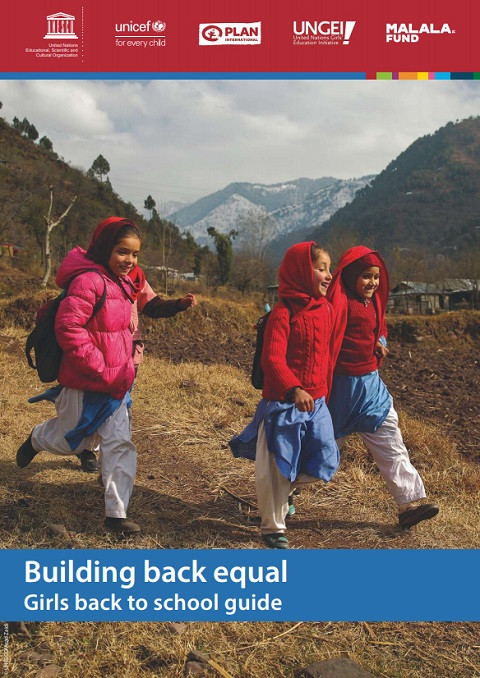 Building Back Equal: Girls Back to School Guide Year of publication: 2020 Corporate author: UNESCO | United Nations Children's Fund (UNICEF) | Plan International | United Nations Girls' Education Initiative (UNGEI) | Malala Fund The guide provides targeted inputs to ensure continuity of learning during school closures, and comprehensive, timely and evidence-based plans for reopening schools in a way that is safe, gender-responsive and child-friendly, and meets the needs of the most marginalised girls. This guide emphasizes an approach to ‘build back equal’ through gender-responsive measures that transform education systems, prioritise resilience and address the key bottlenecks and barriers to girls’ education, including: Gender-responsive data and evidence to inform action, including data disaggregated by sex and gender-responsive monitoring to identify promising practices to promote gender equality. Policies, laws and plans to advance girls’ rights, including the removal of discriminatory practices that impede girls’ educational participation and completion, and ability to apply their learning. Sustained financing to achieve results, protecting education financing for girls’ education, alongside health, social protection and economy recovery initiatives with an equity lens.
 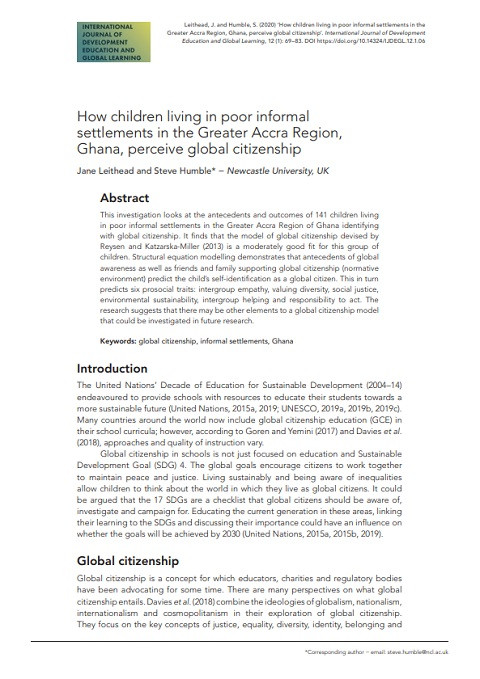 How Children Living in Poor Informal Settlements in the Greater Accra Region, Ghana, Perceive Global Citizenship (International Journal of Development Education and Global Learning; Vol. 12, No. 1) Year of publication: 2020 Author: Jane Leithead | Steve Humble Corporate author: UCL Press This investigation looks at the antecedents and outcomes of 141 children living in poor informal settlements in the Greater Accra Region of Ghana identifying with global citizenship. It finds that the model of global citizenship devised by Reysen and Katzarska-Miller (2013) is a moderately good fit for this group of children. Structural equation modelling demonstrates that antecedents of global awareness as well as friends and family supporting global citizenship (normative environment) predict the child’s self-identification as a global citizen. This in turn predicts six prosocial traits: intergroup empathy, valuing diversity, social justice, environmental sustainability, intergroup helping and responsibility to act. The research suggests that there may be other elements to a global citizenship model that could be investigated in future research.
 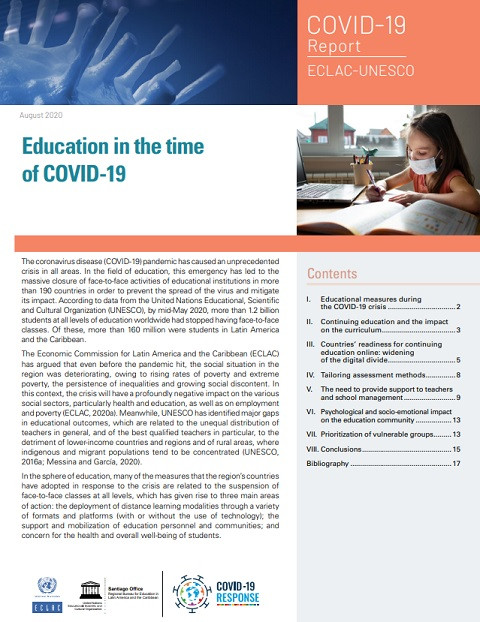 Education in the Time of COVID-19 (COVID-19 Report; ECLAC-UNESCO) Year of publication: 2020 Corporate author: Economic Commission for Latin America and the Caribbean (ECLAC) | UNESCO Santiago The coronavirus disease (COVID-19) pandemic has caused an unprecedented crisis in all areas. In the field of education, this emergency has led to the massive closure of face-to-face activities of educational institutions in more than 190 countries in order to prevent the spread of the virus and mitigate its impact. The Economic Commission for Latin America and the Caribbean (ECLAC) has argued that even before the pandemic hit, the social situation in the region was deteriorating, owing to rising rates of poverty and extreme poverty, the persistence of inequalities and growing social discontent. In this context, the crisis will have a profoundly negative impact on the various social sectors, particularly health and education, as well as on employment and poverty. Meanwhile, UNESCO has identified major gaps in educational outcomes, which are related to the unequal distribution of teachers in general, and of the best qualified teachers in particular, to the detriment of lower-income countries and regions and of rural areas, where indigenous and migrant populations tend to be concentrated.In the sphere of education, many of the measures that the region’s countries have adopted in response to the crisis are related to the suspension of face-to-face classes at all levels, which has given rise to three main areas of action: the deployment of distance learning modalities through a variety of formats and platforms (with or without the use of technology); the support and mobilization of education personnel and communities; and concern for the health and overall well-being of students.The aim of this document is to shed light on various consequences that these measures will have on educational communities in the short and medium term, and to offer key recommendations on how to manage those consequences in the best possible manner, drawing attention to opportunities for learning and innovation in the post-pandemic education system.
  A Case Study on Teaching and Learning Process for Global Citizenship Education: Focused on Classes on the Refugee Disputes (Journal of Educational Innovation Research; Vol. 26, No. 3) Year of publication: 2016 Author: Junho Choi Corporate author: Pusan National University. Educational Development Institute Purpose: With the advent of the global civil society, this study is initiated from the necessity to design and make practical educational contents and methods which help us find relevant social studies’ topics and deal with them profoundly. For this reason, this study, in relation to our Global Citizenship Education(GCE) at school, was to focus on finding out practical strategies for the solutions to the refugee disputes and to find practical syllabuses. Method: This study was performed by using a literature research methods. I collected and examined relevant existing paper materials such as journals, reports, and books. Thereby, I searched a related topic and extracted meanings, values, perspectives on the topic which each materials contained. And then, I analyzed them by categorizing, integrating, and comparing the each extracted content. Based on this method, I can find the general characteristics and present practical strategies on the global citizenship education. Results: This study makes it possible to be well organized, based on self-directed and small group cooperative learning process by utilizing the PBL method(Problem Based Learning). In particular, this method allows students to make ‘Virtual Commission of Refugees’, and to debate and negotiate issues on their own. Conclusion: This process intends for students to recognize that the refugee disputes are the problem which as a member of the global civil society, all of the people should consider and overcome for the public welfare and developments. For this reason, this study, in relation to our Global Citizenship Education(GCE) at school, tries to focus on finding out practical strategies for the solutions to the refugee disputes and to find practical syllabuses.
  The Tasks for Future Education through the Analysis of Educational Innovation Cases Year of publication: 2019 Author: Eunhee Hwang | Sujin Choi | Jongheon Lim | Heejin Park | Jaeduck Lee | Sungki Kim | Giljae Lee | Hunho Kim | Ammi Jang Corporate author: Korean Educational Development Institute (KEDI) It is predicted that the future society will be low populated of the school-age but high populated of the elderly, intelligent information centered, and multicultural society. According to these changes of the society, it is time for education to shift to preparing for a future education system rather than growth from competition. Based on this perspectives, this study aims to explore the tasks of the future education by analyzing domestic and international cases of educational innovations. Specifically, this study suggests several practical tasks that general high schools can implement for the future education, analyzing the selected cases contributed to the educational innovation. This is because the cases of educational innovation are the stepping stones for general high school to move forward to the future education, although the cases are not perfect examples.
 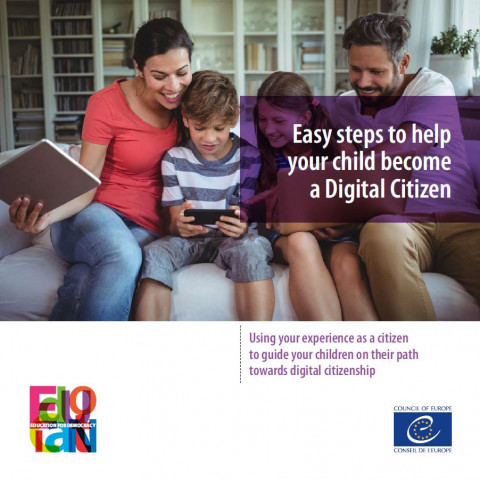 Easy Steps to Help Your Child Become a Digital Citizen Year of publication: 2020 Author: Janice Richardson | Veronica Samara Corporate author: Council of Europe A guide to help you use your experience as a citizen to guide your children on their path towards digital citizenship.Young people today inhabit a world that has been transformed by digital technologies, effortlessly enabling connectedness through social media and access to vast quantities of information. Making sense of this hyper rich information and engaging effectively and responsibly poses a whole set of new challenges for educators as they seek to prepare young people as citizens, exercising their rights and participating effectively in the affairs of the community.Parents, and “non-tech” grandparents too, can help children become digital citizens. In this guide, we explain some of the easy steps to follow, to help children master what it takes to act responsibly and respectfully online.
  Personalized Learning within Teacher Education: A Framework and Guidelines Year of publication: 2020 Corporate author: UNESCO International Bureau of Education (IBE) This paper explores the theoretical and practice elements that together inform the concept of personalised learning. These insights are then used to develop a Framework for Personalized Learning within Teacher Education. In addition, the final chapter outlines pedagogical strategies to support the development of personalised learning that were tested during the project within the participating universities.The Framework and Guidelines are intended for use by to teacher educators and their students, as well as by teachers and students in schools, to support the on‐going shift towards a personalised learning and collaborative paradigm which forefronts learner agency and autonomy and encourages learners of all ages to assume increased responsibility for their own learning and achievements.