
Resources
Explore a wide range of valuable resources on GCED to deepen your understanding and enhance your research, advocacy, teaching, and learning.
8,364 Results found
 Arab Sustainable Development Report 2020 Year of publication: 2020 Corporate author: United Nations Economic and Social Commission for Western Asia (ESCWA) The 2030 Agenda calls for transformative change and paradigm shifts. Mobilizing domestic and external resources is a pressing challenge in the Arab region, and the pace of efforts on the SDGs must accelerate. However, transformative change not only requires financial resources and an acceleration of efforts but, above all, demands a shift in orientation and approach towards policy integration, environmental sustainability, and universal human rights with their emphasis on equality, justice, inclusion, fundamental freedoms and participatory politics.The story of the SDGs in the Arab region, therefore, is also a story of human rights, gender equality, sustainability and integrated development. The gravity of the task, and the scale of the ambition, are greater than measuring progress at goal, target and indicator level. Five years into the era of the 2030 Agenda and the SDGs, the present report is a reminder that the starting point for implementation and the horizon for achievement must be aligned for change to be transformative. It is only through the alignment of policies and other interventions with the overarching framework of the 2030 Agenda that the region, and the world, can hope to achieve the 2030 Agenda. How close, or how far, the Arab region is from this alignment is the story the present report aims to tell.
  An Analysis on the Types of Global Citizenship Among the Pre-Service Secondary Teachers and the Determinant Factors (Journal of Education for International Understanding; Vol. 15, No. 1) Year of publication: 2020 Author: Hwanbo Park | Jinyoung Im | Kyunghee Park Corporate author: Korean Society of Education for International Understanding (KOSEIU) This study aims to investigate the types of global citizenship among pre-service teachers based on the level of global citizenship and to explore the factors effect on each types. Especially, this study focus on the action area among the three dimension of global citizenship. For this purpose, 180 students were surveyed A university in Daejeon metro city with measurement tool developed by Korea Institute for Research in the Behavioral Sciences (KIRBS). The results show that the types of pre-service teachers divided into 3 group, ‘active global citizenship (52.1%)’, ‘passive global citizenship (22.5%)’, and ‘immature global citizenship (25.4%)’. fluency of English language, experience of volunteer and overseas, institutional trust, and communication with friends about political issues were significant factor effect on the practical type of global citizenship. The findings suggest that it is necessary to provide global citizenship education based on the characteristics of the pre-service teachers.
  Global Citizenship Education: Solidar Foundation Policy Paper Year of publication: 2020 Corporate author: Solidar Foundation | Erasmus+ The purpose of this paper is to provide recommendations supported by our members, based on their work in formal, non-formal and informal education, to expand GCE at national and European level. Considering how GCE is linked many times with formal education, the recommendations reveal the work of our members outside of this, building upon the need for a multi-stakeholder approach that spans across the entire learning process. This policy paper guides SOLIDAR Foundation’s work in influencing developments related to the EU’s Updated Skills Agenda, European Education Area, Action Plan for the Implementation of the European Pillar of Social Rights, and the European Green Deal, given how all provide an opportunity for GCE to be embraced as a necessity rather than an added-value.
  Youth and Violent Extremism on Social Media: Mapping the Research Year of publication: 2017 Author: Séraphin Alava | Divina Frau-Meigs | Ghayda Hassan Corporate author: UNESCO | Information for All Programme (IFAP) Does social media lead vulnerable individuals to resort to violence? Many people believe it does. And they respond with online censorship, surveillance and counter-speech. But what do we really know about the Internet as a cause, and what do we know about the impact of these reactions? All over the world, governments and Internet companies are making decisions on the basis of assumptions about the causes and remedies to violent attacks.The challenge is to have analysis and responses firmly grounded. The need is for a policy that is constructed on the basis of facts and evidence, and not founded on hunches – or driven by panic and fearmongering.It is in this context that UNESCO has commissioned the study titled Youth and Violent Extremism on Social Media – Mapping the Research. This work provides a global mapping of research (mainly during 2012-16) about the assumed roles played by social media in violent radicalization processes, especially when they affect youth and women. The research responds to the belief that the Internet at large is an active vector for violent radicalization that facilitates the proliferation of violent extremist ideologies.Indeed, much research shows that protagonists are indeed heavily spread throughout the Internet. There is a growing body of knowledge about how terrorists use cyberspace. Less clear, however, is the impact of this use, and even more opaque is the extent to which counter measures are helping to promote peaceful alternatives. While Internet may play a facilitating role, it is not established that there is a causative link between it and radicalization towards extremism, violent radicalization, or the commission of actual acts of extremist violence.
  The Effects of Service Learning Program on Medical Students' Perceptions of Global Citizenship and Sustainable Development (Journal of Educational Innovation Research; Vol. 29. No. 1) Year of publication: 2019 Author: Sojung Yune | Kwi Hwa Park Corporate author: Pusan National University. Educational Development Institute Purpose: Recently, the concept of 'service learning', which is a curriculum and a program of service learning suitable for medical college, has begun to be introduced. The purpose of this study were to develop a service learning program for medical school and to explore its effects. The research problems set in this study are as follows. First, what is the demand of medical students for service learning education? Second, how does the service learning education program affect students' perception of global citizenship and awareness of sustainable development? Method: In order to investigate the demand for service training of medical students, 99 students in a third grade department of medicine were surveyed. Based on the results of the questionnaires and literature review, we developed a service learning program suitable for medical schools. The developed program was validated by a specialist and then conducted in 2017 during the first semester of a medical school and 88 second grade students at a medical school. The final 78 post - test results were used for the analysis. Results: The service learning education in this study was developed and operated as a course of 1 credit for the major in the second grade. After selecting and exploring the topics, they were asked to perform 6-week project-based volunteer activities. As a result, the service learning program developed in this study was found to be effective in medical students' perception of global citizenship, and sustainable development. Conclusion: In order to improve the professionalism of medical students, it is necessary to educate social contribution and service consciousness, which is expected to be possible through service learning education.
  An Analysis of the Global Citizenship of Youth Participated in Global Citizenship Education (Journal of Education for International Understanding; Vol. 13, No. 1) Year of publication: 2018 Author: Kyunghee Park | Hwanbo Park | Namsoon Kim Corporate author: Korean Society of Education for International Understanding (KOSEIU) The purpose of this study is to analysis characteristics of the global citizenship for youth participated in global citizenship education and the factors influencing for global citizenship. To achieve this, the study surveyed around 300 youth participated in global citizenship education. The results of the analysis are as follows. First, global citizenship of youth participated in global citizenship education are generally higher than those of ordinary youth. Second, it was analyzed that the global citizenship was significantly higher for girls than boys; for the lower school level than higher; and for the ones having the greater experience with the mass media, overseas visits, and family communication. Factors influencing the global citizenship of youth participated in global citizenship education were influenced by school class, experience in mass media, gender, communication with family, and experience of visiting abroad. The results suggest that there is a need to think about ways to educate the global citizenship through everyday life, such as using various media and communicating with family as well as participating in education programs to improve the level of global citizenship.
  Ensuring Inclusive and Equitable Quality Education: Sustainable Development Goal 4 in Canada Year of publication: 2020 Corporate author: Council of Ministers of Education, Canada (CMEC) This report provides a framework to share information at the pan-Canadian and international levels on work underway in Canada to achieve SDG 4. The report builds on SDG 4 data and indicators and includes, where possible, provincial and territorial data.
  Advancing Global Citizenship Education Through Global Competence and Critical Literacy: Innovative Practices for Inclusive Childhood Education (SAGE Open; Vol. 9, No. 1) Year of publication: 2019 Author: Alida Anderson Corporate author: SAGE Publications This article presents a critical policy overview of inclusive education and global citizenship education (GCED) and offers two innovative childhood education practices that support inclusion of children with disabilities through dimensions of physical and conceptual access, both noted implementation barriers to inclusive education across the globe. The first section summarizes global human rights and education initiatives that support GCED through access for children with disabilities in education and in societies. This section addresses questions of how inclusion plays a central role to the advancement of GCED, summarizing major global policy advances to inclusion, and highlighting how advancement of inclusive childhood education supports GCED. This article concludes with two innovative childhood education practices, global competence and critical literacy, which offer critical potential to contribute to GCED through conceptual and physical dimensions of access, and ultimately promote inclusive education.
  Achieving and Monitoring Education for Sustainable Development and Global Citizenship: A Systematic Review of the Literature (Sustainability 2020; Vol. 12, No. 4) Year of publication: 2020 Author: Brent Edwards | Manca Sustarsic | Mina Chiba | Mark McCormick | Melissa Goo | Sara Perriton Corporate author: Multidisciplinary Digital Publishing Institute (MDPI) This paper presents the results of a systematic review of literature (56 studies) related to Sustainable Development Goal 4.7. The goal of the research reported on here is to contribute to the discussion around strategies for working towards and monitoring SDG4.7 at the institutional level. Within this overarching focus, our review of the literature was designed to identify studies that have looked at both student learning and teacher education related to SDG4.7. This twin focus stems from the recognition that achieving the SDGs will be particularly difficult if policymakers are not attentive to both sides of the learning equation—that is, first, to the ways that teachers learn to teach about issues related to SDG4.7 and, then, the ways that students acquire this knowledge and are assessed. The five findings sections of this review correspond to the five areas of emphasis embedded in the language of SDG4.7, namely, education for (a) sustainable development, (b) human rights, (c) gender equality, (d) promoting of a culture of peace and non-violence, and (e) appreciation of cultural diversity. In accordance with the purpose of this review, the synthesis for each area of emphasis digs into the details of the educational interventions, monitoring and evaluation strategies, and results that are documented in the publications analyzed. Thus, this review can be useful for informing educational or pedagogical approaches related to SDG4.7, as well as for designing monitoring and evaluation tools for the SDGs.
 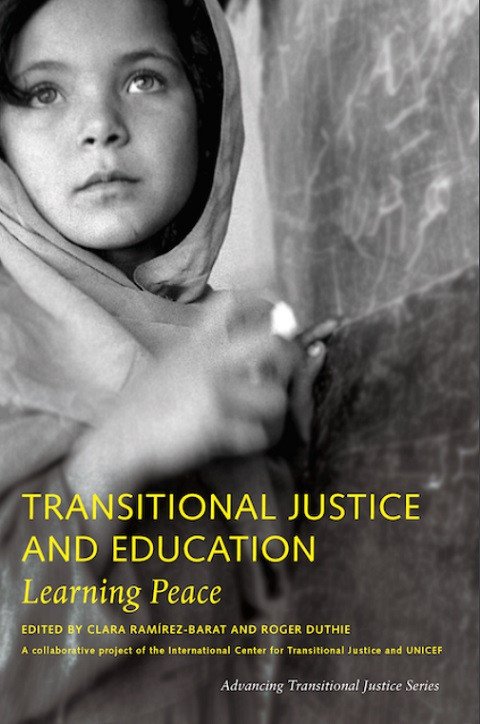 Transitional Justice and Education: Learning Peace (Advancing Transitional Justice Series) Year of publication: 2017 Author: Clara Ramírez-Barat | Roger Duthie Corporate author: Social Science Research Council (SSRC) | United Nations Children's Fund (UNICEF) After periods of conflict and authoritarianism, education institutions often need to be reformed or rebuilt. But in settings where education has been used to support repressive policies and human rights violations, or where conflict and abuses have resulted in lost educational opportunities, legacies of injustice may pose significant challenges to effective reform. Peacebuilding and development perspectives, which normally drive the reconstruction agenda, pay little attention to the violent past. Transitional Justice and Education: Learning Peace presents the findings of a collaborative research project of the International Center for Transitional Justice and UNICEF on the relationship between transitional justice and education in peacebuilding contexts. The book examines how transitional justice can shape the reform of education systems by ensuring programs are sensitive to the legacies of the past, how it can facilitate the reintegration of children and youth into society, and how education can engage younger generations in the work of transitional justice.