
Resources
Explore a wide range of valuable resources on GCED to deepen your understanding and enhance your research, advocacy, teaching, and learning.
8,364 Results found
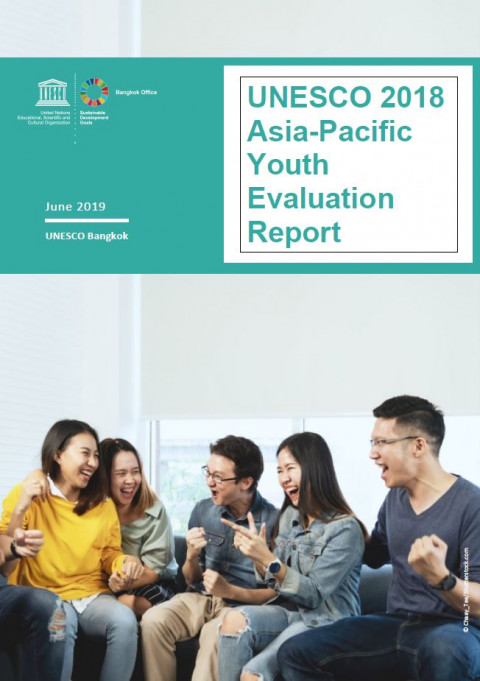 UNESCO 2018 Asia-Pacific Youth Evaluation Report Year of publication: 2020 Author: Rebecca Barr | Sue Vize Corporate author: UNESCO Bangkok In March 2019 UNESCO conducted the first ever “youth evaluation” of the youth programmes implemented during 2018. This evaluation is a pilot for integrating youth-led evaluation as part of UNESCO’s programming cycle as part of our commitment to meaningfully engaging with youth.This evaluation was developed by UNESCO staff in partnership with youth who have been involved in UNESCO’s work in a variety of ways. It consists of three parts: an online survey, focus group discussions and stories written by young people about their experiences being part of a UNESCO project.
  Development Education in Theory and Practice: An Educator’s Resource Year of publication: 2016 Author: Michal Cenker | Louiza Hadjivasiliou | Patrick Marren | Niamh Rooney Corporate author: UNIDEV | NGO Support Centre (Cyprus) | Pontis Foundation (Slovakia) | Kimmage Development Studies Centre (Ireland) This publication has been produced to provide a new teaching resource for academics and educators active in the field of Development Education and related disciplines. It covers twelve themes, each chapter includes both a conceptual overview and a teaching methodology section. The conceptual overview introduces the topic, explores the key concepts, theories and current debates. The teaching methodology section gives educators a set of tools that could help them introduce the topic in both formal and non-formal settings.
  Action on Global Goals: Community Toolkit Year of publication: 2019 Author: Julia Haimlinger Corporate author: Global Action Plan (GAP) Ireland This toolkit aims to bring Development Education (DevEd) and Education for Sustainable Development (ESD), already established in the formal education sector, to the non-formal adult and community sector. Our toolkit is based on the idea to not have knowledge for knowledge sake, but through critical thinking and reflection we can aim to work towards taking action for positive change. For the goals to be reached, everyone needs to do their part: governments, the private sector, civil society and you! These are universal goals for all countries to be achieved. This resource pack will give you some fun and creative ideas on how to get informed about the Sustainable Development Goals, to create active global citizens and do your bit for the planet.
  Reaffirm the Value Position of Cultivating Qualified Socialist Citizens (The Party Building and Ideological Education in Schools; No. 612) Year of publication: 2019 Author: Du Shizhong | Yan Changrui Corporate author: Hubei Education Press Based on the historical achievements of human democracy practice, especially the arduous course of Chinese patriots’ bloody struggle, the article points out that the citizenship of ordinary Chinese has not come easily. Citizenship means people’s sovereignty, equality between the state and citizens, equality between citizens and citizens, and symmetry of rights and obligations. It has rich connotations in many aspects of law, politics and society. Cultivating qualified socialist citizens is the historical necessity of the development of contemporary China’s democracy, market economy and information society. It is also the most important, fundamental and zeitgeist characteristic of Chinese education. It is the mission of the times to promote the transformation of the Chinese people from subjects to citizens and realize the modernization.
  Citizenship Competencies: From the Standards to the Classroom; Proposal for Integration into Academic Areas Year of publication: 2004 Author: Enrique Chaux | Juanita Lleras | Ana María Velásquez Corporate author: Colombia. Ministerio de Educación Nacional | Universidad de los Andes This book presents a proposal on how citizenship education can be promoted in schools. It offers ideas on how to integrate citizenship education within the daily life of educational institutions and, in particular, with education in traditional academic areas, with concrete examples of activities that can be implemented in the classroom.
  Training for Citizenship, Yes it Is Possible !: What We Need to Know and Know How to Do; Standards Basic Citizenship Skills Year of publication: 2004 Corporate author: Colombia. Ministerio de Educación Nacional This document presents the national standards of education for citizenship in Colombia, from a competency development approach. It includes the learning standards to be promoted in all grades, from basic to secondary education. Which are organized into three groups: Peaceful coexistence, identity and respect of differences, and democratic participation and responsibility.
  Homophobic and Transphobic Bullying in Educational Centers: Awareness Workshop for its Prevention; Facilitation Guide Year of publication: 2015 Corporate author: UNESCO This publication presents strategies for teachers and educational authorities with the aim of addressing homophobic and transphobic violence from a Human Rights perspective. Through lessons that incorporate concepts, activities and reflections, it underlines the importance of respect for sexual diversity through the acquisition of knowledge, and the strengthening of teaching skills to overcome stigmas and prejudices.
  Using Civic Participation and Civic Reasoning to Shape Our Future and Education (Background Paper for the Futures of Education Initiative) Year of publication: 2020 Author: Sarah M. Stitzlein Corporate author: UNESCO Actualizing a preferred future relies on citizens who are prepared to effectively engage perhaps the most fundamental civic question: ‘What should we do?’ (Levine, 2016; Dishon & Ben-Porath, 2018). It is a question that arises when people face a problem, must reach a decision, or must figure out how to flourish together as a group. This question is closely tied to the key question posed by the International Commission on the Futures of Education: ‘What do we want to become?’ Engaging both questions is a useful way for us to envision education in the future. These questions push us to consider not only what we merely can do, but also what is right for us to do in light of our responsibilities to others.Civic reasoning is the sort of reasoning we do as we answer the question, ‘What should we do?’ Civic discourse is a means or method by which people engage in civic reasoning. Efforts to envision improved education and futures should foreground civic reasoning and discourse as both a means and ends of citizen participation. They are important for the ways in which they directly engage citizens and for their products, which lead to future civic action and better futures.
 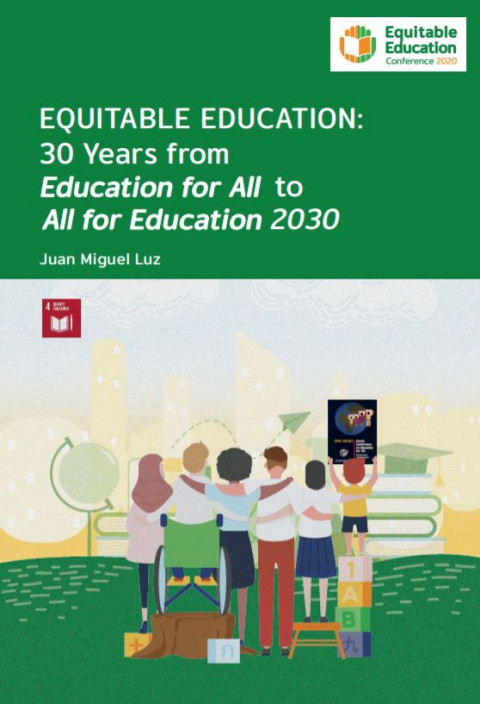 Equitable Education: 30 Years from Education for All to All for Education 2030 Year of publication: 2020 Author: Juan Miguel Luz Corporate author: Equitable Education Fund In the 30 years since the World Declaration on Education for All (Jomtien Declaration, Thailand), the world has made enormous strides in achieving the target of universal primary education.Total enrolment rates in developing regions reached 91 percent in 2015 and the worldwide number of children out of school has dropped by almost half. However, large disparities remain. Children from the poorest households are up to five times more likely to be out of school than those of the richest households. Disparities between rural and urban areas also remain high.As education inequality threatens to widen because of the COVID-19 pandemic, and with only 10 years to go to achieve the Sustainable Development Goals (SDGs), now, more than ever, is the time for the world to come together and accelerate change through innovative and sustainable solutions.
 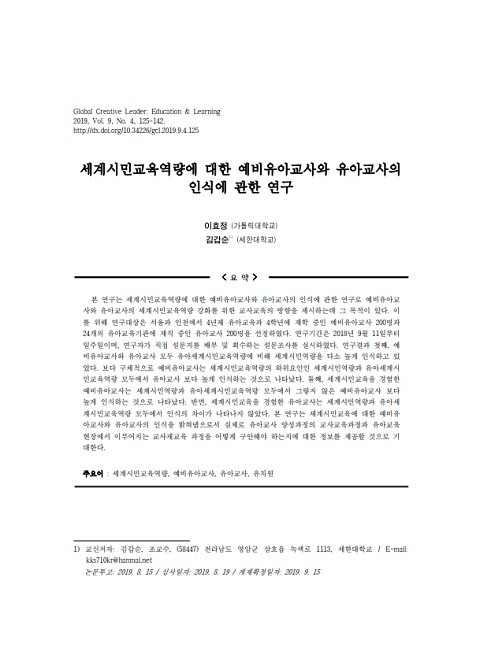 Perception on Global Citizenship Education Competence between Pre-service Teachers and In-service Teachers in Kindergarten (Global Creative Leader: Education & Learning; Vol. 9, No. 4) Year of publication: 2019 Author: Hyojeong Lee | Kabsoon Kim Corporate author: Soongsil University. Research Institute for Gifted & Talented Education The purpose of this study was to establish the direction of teacher education based on global citizenship education competence studying the perception of pre-service teachers and in-service teachers on global citizenship education competence. The 2018 survey was conducted for a week beginning September 11. The respondents who were 200 pre-service teachers and 200 in-service teachers were selected from Seoul and Incheon. The researcher distributed and collected the questionnaire directly. The results of the study were as follows. First, pre-service teachers showed higher cognition than in-service teacher in both global citizenship competence and early childhood global citizenship competence. Second, among pre-service teachers, ones who had experienced global citizenship education showed higher cognition level in both categories than others. On the other hand, in-service teachers who had experienced global citizenship education did not show any difference of cognition in both global citizenship competence and early childhood global citizenship competence. This study was expected to reveal the perceptions of pre-service teachers and when training teachers, the data provided more specific details for early childhood educator curriculums about global citizenship education.