
Resources
Explore a wide range of valuable resources on GCED to deepen your understanding and enhance your research, advocacy, teaching, and learning.
8,364 Results found
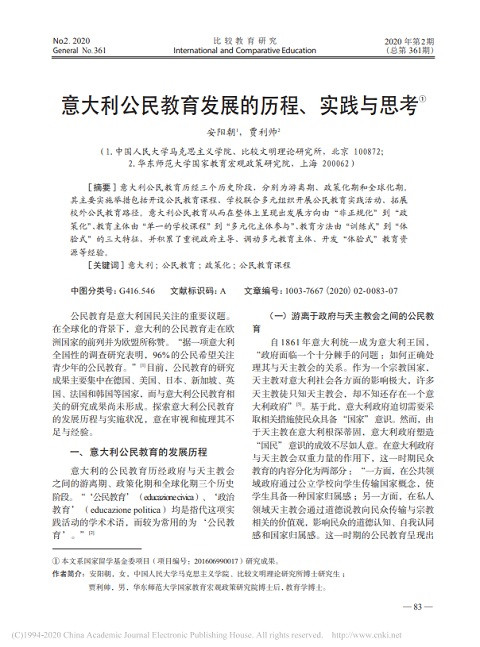 The History, Practice and Thinking of the Development of Italian Civic Education Year of publication: 2020 Author: An Yangchao | Jia Lishuai Corporate author: Beijing Normal University Italian civic education has a long history and has gone through three historical stages, namely, the period of dissociation between the government and the Catholic church, the period of politicization and the period of development under the background of “global citizenship”. Related measures taken by the government include Italian civic education courses, schools and multi-organizations to carry out civic education practice activities, and expanding the off-campus civic education path and other ways. As a whole, it shows the characteristics of changing from “non-standard” to “policy”, from “training learning” to “experiential learning”, from “single school curriculum” to “diversified subject participation”.
 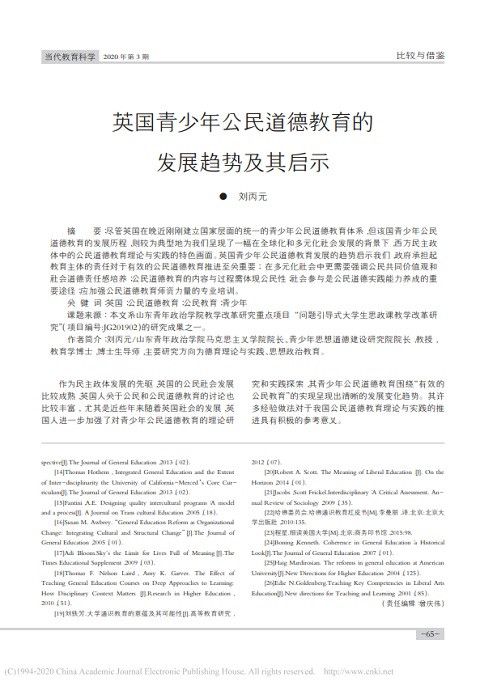 The Development Trend and Enlightenment of Civic Moral Education for British Young People Year of publication: 2020 Author: Liu Bingyuan Corporate author: Contemporary Education Sciences The United Kingdom has launched a national citizenship and moral education curriculum for teenagers has been set up, with emphasis on globalization and diversification of social development. The curriculum is by and large represents citizenship and moral education theory and practice in western democracies. The trend of the development of civic moral education for British young people tells us that it is very important for the government to take the responsibility of education subject to promote effective civic moral education. Nothwithstanding, it is noteworthy the curriculum places significance emphasis on citizenship and moral education in a pluralistic society need to emphasize the cultivation of common values and social moral responsibility of citizens. The content and process of civic moral education should embody citizenship. Social participation is an important way to cultivate citizens' moral practical ability. We should strengthen the professional training of civil moral education teachers.
  The Future of Education in Europe with Brikena Xhomaqi (LLLP) Year of publication: 2020 Author: Brikena Xhomaqi Corporate author: Bridge 47 Brikena Xhomaqi is the director of the Life Long Learning Platform (LLLP), an organisation that promotes life long learning and advocates for access to quality education for all. In this episode, Brikena discusses the future of education in Europe and the challenges and possibilities for global citizenship education.
 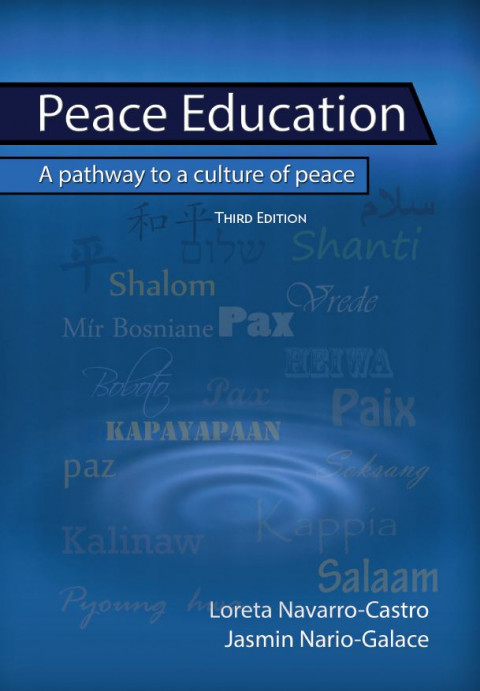 Peace Education: A Pathway to a Culture of Peace; Third Edition Year of publication: 2019 Author: Loreta Navarro-Castro | Jasmin Nario-Galace Corporate author: Miriam College. Center for Peace Education This book is based on author's study and research as well as on experiences as teachers and trainers. By writing about what the authors have come to know and experienced. It is their hope that the ideas contained in this book will circulate widely and promote enthusiasm for both education and action for peace.This book is organized into three sections. Part I aims to develop a holistic understanding of peace and peace education; Part II discusses key peace education themes; Part III focuses on the peaceable learning environment. A "vision for the future" is presented in conclusion.
  Seeds of Hope Year of publication: 2020 Author: Aarya Chavda Corporate author: UNESCO At an age of 10, author and illustrator of her 3 books, Aarya Chavda extends her support by donating her art proceeds to fundraise for the welfare of underpriviledge Cancer patients.Through her campaign on 'Preservation of Cultural Heritage', She also demonstrates her commitment and contributes in spreading awareness through her programs at government and private institutions.In this series of narrative illustrations, she portrays that climate change will not occur at some point in the distance future - "It is happening her and now". She urges everyone to treasure this thought of saving our planet for the future generation.
  Policy Brief: The Impact of Covid-19 on Women Year of publication: 2020 Corporate author: United Nations Entity for Gender Equality and the Empowerment of Women (UN Women) | United Nations (UN) The year 2020, marking the twenty-fifth anniversary of the Beijing Platform for Action, was intended to be ground-breaking for gender equality. Instead, with the spread of the COVID-19 pandemic, even the limited gains made in the past decades are at risk of being rolled back. The pandemic is deepening pre-existing inequalities, exposing vulnerabilities in social, political and economic systems which are in turn amplifying the impacts of the pandemic.Across every sphere, from health to the economy, security to social protection, the impacts of COVID-19 are exacerbated for women and girls simply by virtue of their sex.This policy brief by the UN Secretary-General explores how women and girls’ lives are changing in the face of COVID-19, and outlines suggested priority measures to accompany both the immediate response and longer-term recovery efforts.
  Peace Education and the Pandemic: Global Perspectives Year of publication: 2020 Corporate author: International Institute on Peace Education (IIPE) This April 13 webinar, co-organized by the International Institute on Peace Education and Global Campaign for Peace Education, is an opportunity to learn, hear, and share with and from peace educators from around the world about how they are responding, adapting, and rethinking urgent agendas for peace education revealed by the global coronavirus pandemic.
  The CapED Programme: Annual Report 2019 Year of publication: 2020 Corporate author: UNESCO UNESCO is the United Nation’s specialized agency for education and is mandated to lead and coordinate progress towards Sustainable Development Goal 4 – “Ensure inclusive and equitable quality education and promote lifelong learning opportunities for all”.The CapED Programme is central to delivering on this mandate through capacity development. It mobilizes UNESCO’s worldwide network of specialized Institutes and offices and works with partners to assist countries as they develop and implement national plans to deliver on SDG4 commitments.The Annual Report 2019 provides information on achievements and progress made in the 26 countries where CapED is operational.
 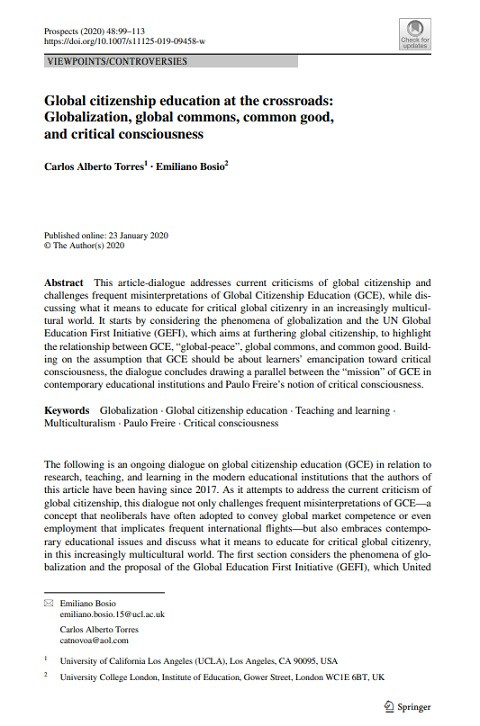 Global Citizenship Education at the Crossroads: Globalization, Global Commons, Common Good, and Critical Consciousness (Prospects; Vol.48) Year of publication: 2020 Author: Carlos Alberto Torres | Emiliano Bosio Corporate author: Springer Nature This article-dialogue addresses current criticisms of global citizenship and challenges frequent misinterpretations of Global Citizenship Education (GCE), while discussing what it means to educate for critical global citizenry in an increasingly multicultural world. It starts by considering the phenomena of globalization and the UN Global Education First Initiative (GEFI), which aims at furthering global citizenship, to highlight the relationship between GCE, “global-peace”, global commons, and common good. Building on the assumption that GCE should be about learners’ emancipation toward critical consciousness, the dialogue concludes drawing a parallel between the “mission” of GCE in contemporary educational institutions and Paulo Freire’s notion of critical consciousness.
 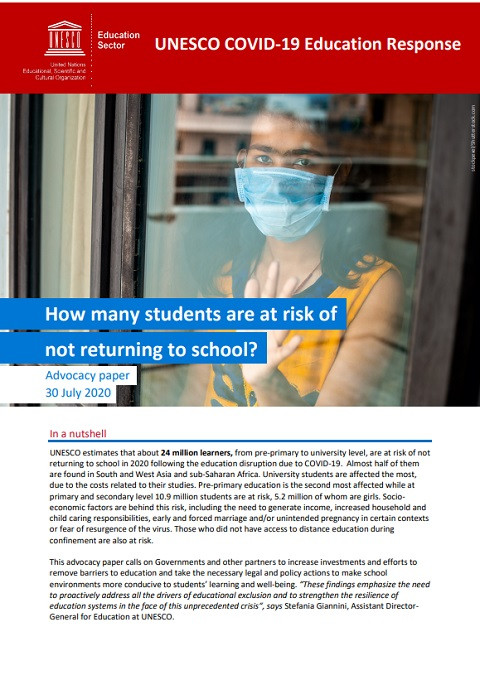 UNESCO COVID-19 Education Response: How Many Students Are at Risk of Not Returning to School?; Advocacy paper Year of publication: 2020 Corporate author: UNESCO UNESCO estimates that about 24 million learners, from pre-primary to university level, are at risk of not returning to school in 2020 following the education disruption due to COVID-19. Almost half of them are found in South and West Asia and sub-Saharan Africa. University students are affected the most, due to the costs related to their studies. Pre-primary education is the second most affected while at primary and secondary level 10.9 million students are at risk, 5.2 million of whom are girls. Socioeconomic factors are behind this risk, including the need to generate income, increased household and child caring responsibilities, early and forced marriage and/or unintended pregnancy in certain contexts or fear of resurgence of the virus. Those who did not have access to distance education during confinement are also at risk. This advocacy paper calls on Governments and other partners to increase investments and efforts to remove barriers to education and take the necessary legal and policy actions to make school environments more conducive to students’ learning and well-being. “These findings emphasize the need to proactively address all the drivers of educational exclusion and to strengthen the resilience of education systems in the face of this unprecedented crisis“, says Stefania Giannini, Assistant DirectorGeneral for Education at UNESCO.