
Resources
Explore a wide range of valuable resources on GCED to deepen your understanding and enhance your research, advocacy, teaching, and learning.
8,364 Results found
 Global Citizenship Education in the Social Studies Curriculum: from the 6th curriculum to the 2015 revised curriculum (Educational Research; Vol. 58) Year of publication: 2017 Author: Jungwoo Lee Corporate author: Sungshin Women's University Educational Research Institute This study is an comparative analysis study about global citizenship education(GCED) in the socials studies curriculum from the 6th curriculum to the 2015 revised curriculum. The main findings of this study are as follows: First, from the 6th curriculum, the themes related with GCED has been appeared in 5th-6th grades and 7th-9th grades. From 2007 revised curriculum, 3rd-4th grades also have dealt with GCED in the standards related with 'culture' or 'minority'. Second, cognitive domain was the most predominant goal of GCED among cognitive, emotional and behavioral domains. Third, overall predominant perception is 'national' but 'world justice and governance', ‘neoliberalism’ are also reflected in the curriculum.
 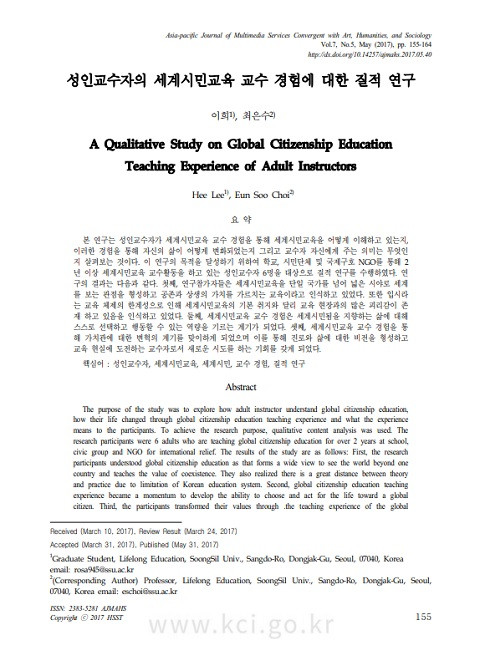 A Qualitative Study on Global Citizenship Education Teaching Experience of Adult Instructors (Asia-pacific Journal of Multimedia Services Convergent with Art, Humanities, and Sociology; Vol. 7, No.5) Year of publication: 2017 Author: Hee Lee | Eunsoo Choi Corporate author: Convergent Research Society Among Humanities, Sociology, Science, and Technology The purpose of the study was to explore how adult instructor understand global citizenship education, how their life changed through global citizenship education teaching experience and what the experience means to the participants. To achieve the research purpose, qualitative content analysis was used. The research participants were 6 adults who are teaching global citizenship education for over 2 years at school, civic group and NGO for international relief. The results of the study are as follows: First, the research participants understood global citizenship education as that forms a wide view to see the world beyond one country and teaches the value of coexistence. They also realized there is a great distance between theory and practice due to limitation of Korean education system. Second, global citizenship education teaching experience became a momentum to develop the ability to choose and act for the life toward a global citizen. Third, the participants transformed their values through .the teaching experience of the global citizenship education. They turned themselves into a teacher who challenges educational obstacles and had an opportunity to form a vision for career and life through global citizenship education teaching experience.
 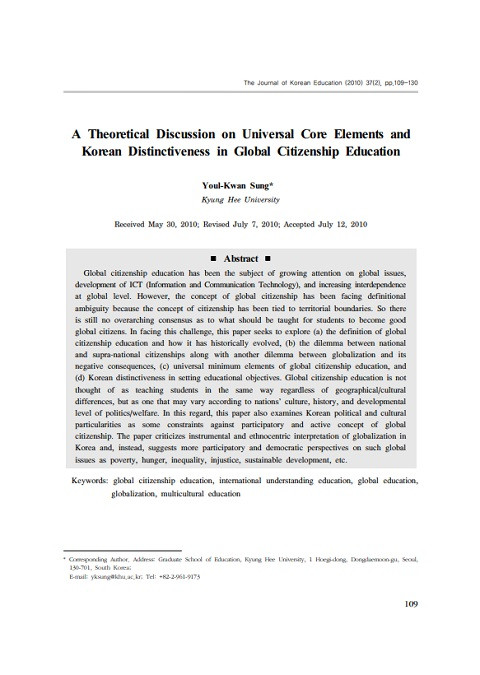 A Theoretical Discussion on Universal Core Elements and Korean Distinctiveness in Global Citizenship Education (The Journal of Korean Education; Vol. 37, No. 2) Year of publication: 2010 Author: Youlkwan Sung Corporate author: Korean Educational Development Institute (KEDI) Global citizenship education has been the subject of growing attention on global issues, development of ICT (Information and Communication Technology), and increasing interdependence at global level. However, the concept of global citizenship has been facing definitional ambiguity because the concept of citizenship has been tied to territorial boundaries. So there is still no overarching consensus as to what should be taught for students to become good global citizens. In facing this challenge, this paper seeks to explore (a) the definition of global citizenship education and how it has historically evolved, (b) the dilemma between national and supra-national citizenships along with another dilemma between globalization and its negative consequences, (c) universal minimum elements of global citizenship education, and (d) Korean distinctiveness in setting educational objectives. Global citizenship education is not thought of as teaching students in the same way regardless of geographical/cultural differences, but as one that may vary according to nations' culture, history, and developmental level of politics/welfare. In this regard, this paper also examines Korean political and cultural particularities as some constraints against participatory and active concept of global citizenship. The paper criticizes instrumental and ethnocentric interpretation of globalization in Korea and, instead, suggests more participatory and democratic perspectives on such global issues as poverty, hunger, inequality, injustice, sustainable development, etc.
  Study on Youth participated on the Development of Global Citizenship: Focused on A case of Community Link Extra Curricular School Activities (Forum for Youth Culture; Vol. 36) Year of publication: 2013 Author: Oksoon Kim | Insoon Shin Corporate author: Research Center for Korean Youth Culture The purpose of this study is to investigate the effects of global citizenship program that had been provided as a CLECSA for creativity to middle school students. Global citizenship program had been administered by the specialists of Hanbart welfare center at Dae Jeon city during the 2nd semester of 2012. Achieving the purpose of study, researchers compare 216 students who had the global citizenship program with 71 student who did not have in terms of ① universal value of human being, ②respect for diversity, ③ interests in global issues, ④ intension of participating in problem solving, ⑤ inclination for globalization. From the analysis of the questionnaires, three important result has been came out. First, female students showed high scores in the area of interests in global issues but low in the area of intension of participating in problem solving. Second, experience of going abroad did not affect the global citizenship, however, the experience of staying foreign countries over one year affected the global citizenship, especially in the area of universal value of human being, respect for diversity, and inclination for globalization. Third, a group of students who had the global citizenship program showed high scores in the area of interests in global issues and intention of participating in problem solving. Based upon the research findings, researchers suggested that CLECSA for creativity should reinforce in terms of quantity and quality and develop the diverse programs for multicultural education on the basis of global education.
  Measuring Intercultural Dialogue: A Conceptual and Technical Framework Year of publication: 2020 Author: Ciara Aucoin | Euan Mackway-Jones | Marcel Smits Corporate author: UNESCO | Institute for Economics and Peace The challenges of addressing growing diversity have amply demonstrated that this vision is needed now more than ever. We all have much to gain from more open and connected societies yet misunderstanding, exclusion and discrimination continue to push identity and culture-based grievances towards conflict and violence, challenging the very foundations of sustainable and inclusive development.This report represents a first step in the UNESCO-IEP joint initiative to strengthen the evidence-base on dialogue for peace and development. Through mobilizing better data on effective dialogue, it is our sincere hope that policymakers and practitioners can better support meaningful and transformative dialogue, holistically supporting the aspirations of the 2030 Agenda. Through this, we hope to elevate dialogue as a connecting enabler of all pillars of UN action, accelerating progress towards the Sustainable Development Goals and making good on the promise of ‘leaving no one behind’.
 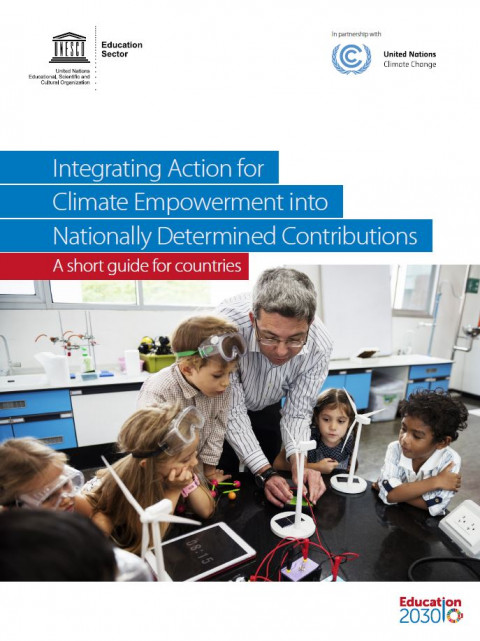 Integrating Action for Climate Empowerment into Nationally Determined Contributions: A Short Guide for Countries Year of publication: 2020 Corporate author: UNESCO In the framework of the 2020 review of Nationally Determined Contributions (NDCs) under the Paris Agreement, this guide aims to provide countries with advice on how to enhance ambition and address the six elements of ‘Action for Climate Empowerment’ (ACE) – Education, Training, Public Awareness, Public Access to Information, Public Participation and International Cooperation – in their respective NDCs.In five simple questions and answers, it provides suggestions for elements that can be integrated into the NDCs in order to make ACE an integral part of countries’ climate responses. The guide also shows why ACE is key to achieve the goals of the Paris Agreement and its greenhouse gas emission targets.
  Guidelines on Human Rights Education for Secondary School Systems Year of publication: 2012 Corporate author: OSCE. Office for Democratic Institutions and Human Rights (ODIHR) These guidelines, which focus on human rights education in secondary schools, aim to support systemic and effective human rights learning for all young people. They were prepared on the basis of broad consultations involving teachers, teachers’ unions, teacher trainers, educational administrators, NGO specialists, and representatives from intergovernmental agencies and national human rights institutions.The current document presents approaches to be adopted when planning or implementing human rights education for secondary schools related to six key structural areas: the human rights-based approach to human rights education; core competencies; curricula; teaching and learning processes; evaluation; and professional development and support of educational personnel. The guidelines also offer a list of key materials to assist in planning, implementing and evaluating human rights education in schools.
  Global Citizenship Education in the Primary Geography Curriculum of the Republic of Korea: Content Analysis Focusing on the Semantic Structure of 2009 Revised School Curriculum (Journal of the Korean Geographical Society; Vol. 49, No. 6) Year of publication: 2014 Author: Dongmin Lee Corporate author: Korean Geographical Society The purpose of this study is to analyze the share of global citizenship education in the 2009 Revised Social Studies (geography area) School Curriculum of the Republic of Korea. I selected the achievement standards of the geography domain in the fifth and sixth grades as the subjects of analysis. The chosen subjects were examined using content analysis: I used KrKwic, a Korean language content analysis tool, to analyze the content and drew a semantic network of the analysis results using UciNet/NetDraw. I found that the geography domain of the 2009 Revised Primary School Curriculum included the concepts of and factors of global citizenship education. However, global citizenship education did not account for a major portion of the curriculum, and the curriculum achievement standards were noticeably nation-state centered. Global citizenship education factors were not closely associated with to other related factors in fact, they even revealed a isolated pattern. These findings suggest that the inclusion of global citizenship education in primary geography education is limited, because the connections between global citizenship education and related contents, such as the environment, sustainable development, conflict, and cooperation, are probably impeded. Globalization accompanies the transformation of territories, identities, and the relations between nation-states and the world, although nation-states continue to play a significant role in the globalized worlds. Therefore global citizenship education, a educational trend focusing on the global community, is particularly important and is required in the geography curriculum of the global era. I expect that the examination undertaken in this study to contribute to future curriculum revisions regarding globalizatin and global citizenship.
 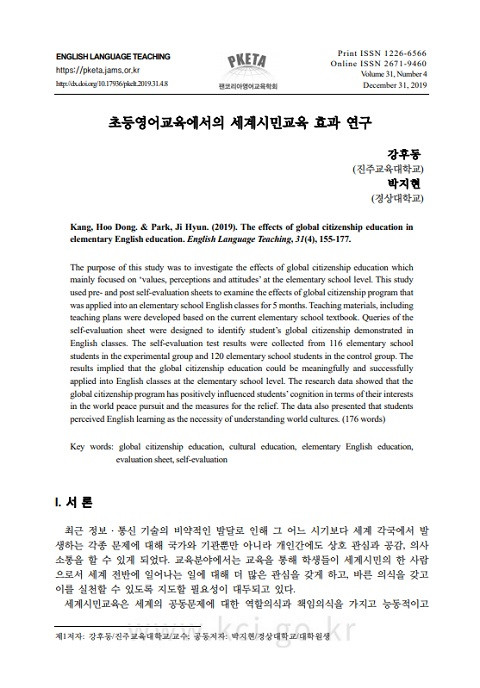 The Effects of Global Citizenship Education in Elementary English Education (English Language Teaching; Vol. 31, No.4) Year of publication: 2019 Author: Hoodong Kang | Jihyun Park Corporate author: Pan-Korea English Teachers Association (PKETA) The purpose of this study was to investigate the effects of global citizenship education which mainly focused on 'values, perceptions and attitudes' at the elementary school level. This study used pre- and post self-evaluation sheets to examine the effects of global citizenship program that was applied into an elementary school English classes for 5 months. Teaching materials, including teaching plans were developed based on the current elementary school textbook. Queries of the self-evaluation sheet were designed to identify student's global citizenship demonstrated in English classes. The self-evaluation test results were collected from 116 elementary school students in the experimental group and 120 elementary school students in the control group. The results implied that the global citizenship education could be meaningfully and successfully applied into English classes at the elementary school level. The research data showed that the global citizenship program has positively influenced students' cognition in terms of their interests in the world peace pursuit and the measures for the relief. The data also presented that students perceived English learning as the necessity of understanding world cultures.
 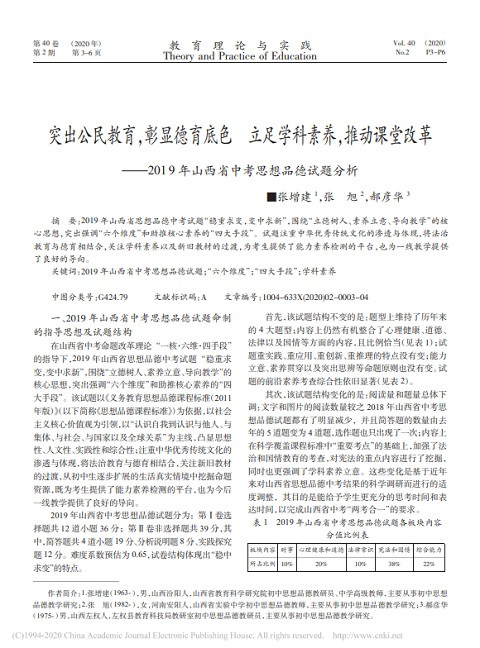 Emphasizing Civic Education, Highlighting Moral Education Background Based on the Subject Quality, Promoting Classroom Reform: Analysis of The Ideological and Moral Tests of Shanxi High School Entrance Examination in 2019 (Vol. 40, No. 2) Year of publication: 2020 Author: Zhang Zengjian | Zhangxu | Hao Yanhua Corporate author: Theory and Practice of Education The 2019 Shanxi Province Ideological and Moral examination questions “seek change steadily, seek new through change”, centered on the core idea of “cultivating people with moral integrity, cultivating people with accomplishment and guiding teaching”, highlighted the “six dimensions” and the “four means” to boost the core quality. The test focuses on the penetration and embodiment of excellent traditional Chinese culture, combines the rule of law education with moral education, pays attention to the subject accomplishment and the transition of old and new textbooks, and provides a platform for students to test their ability and accomplishment, as well as a good guidance for front-line teaching.