
Resources
Explore a wide range of valuable resources on GCED to deepen your understanding and enhance your research, advocacy, teaching, and learning.
8,364 Results found
 Sustainable Development Report 2020: The Sustainable Development Goals and Covid-19; Includes the SDG Index and Dashboards Year of publication: 2020 Author: Jeffrey Sachs | Guido Schmidt-Traub | Christian Kroll | Guillaume Lafortune | Grayson Fuller | Finn Woelm. Corporate author: Cambridge University Press The Sustainable Development Report 2020 (SDR2020) presents some early thoughts on the Covid‑19 crisis and the future of sustainable development and describes how the Sustainable Development Goals (SDGs) can help chart medium-term and longer-term responses to recover from the health, economic, social, and environmental impacts of the pandemic. The report also describes each country’s progress towards achieving the SDGs and indicates areas requiring faster progress by providing an overview of major data and statistics initiatives introduced globally since the adoption of the SDGs in 2015.
  Lifelong Education: Continuous Education for Sustainable Development; The Collection of the 15th International Conference Year of publication: 2017 Corporate author: National Academy for Education (NAE) This edition of the proceedings of international cooperation presents the reports of the participants of the first stage of the 15th (anniversary) international conference “Education Throughout Life: Continuing Education for Sustainable Development”, which was held in Astana, Republic of Kazakhstan. The conference participants focused on the issues of training competent specialists, models, methods, technologies and organizational forms of continuing education used in pedagogical practice. The authors paid special attention to new pedagogical and organizational strategies for continuing education of adults, people with disabilities and the "third age", as well as spiritual, moral, ethical and democratic values in the context of upbringing in continuing education.
 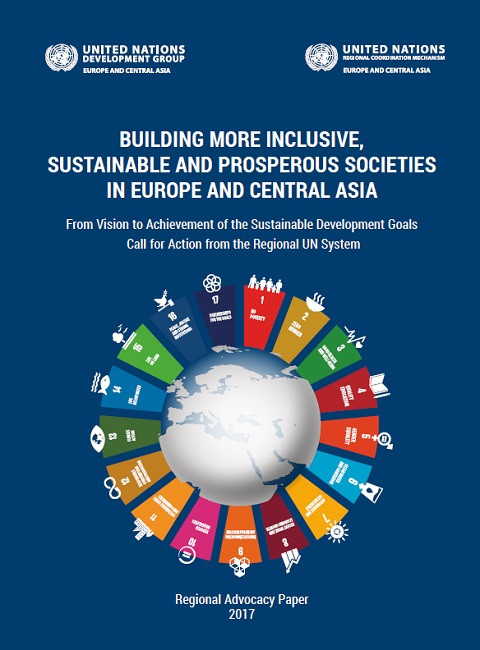 Building More Inclusive, Sustainable and Prosperious Societies in Europe and Central Asia: From Vision to Achievement of the Sustainable Development Goals Call for Action from the Regional UN System (Regional Advocacy Paper 2017) Year of publication: 2017 Corporate author: United Nations Development Group (UNDG) This regional advocacy paper provides key policy recommendations that can help countries of Europe and Central to overcome the existing development bottlenecks and boost the implementation of the 2030 Agenda, leaving no one behind.
 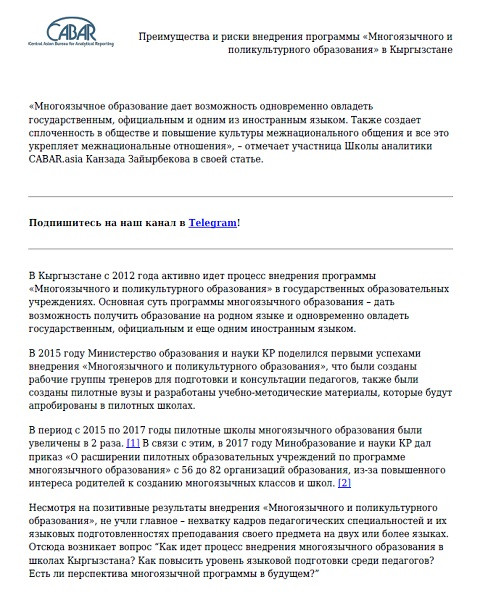 Advantages and Risks of Introducing the “Multilingual and Multicultural Education” Program in Kyrgyzstan Year of publication: 2019 Author: Kanzada Zayirbekova Corporate author: Central Asian Bureau for Analytical Reporting (CABAR) According to the author, multilingual education makes it possible to simultaneously master the state, official and one of the foreign languages, and also creates cohesion in society and enhances the culture of interethnic communication, and all this strengthens interethnic relations.
 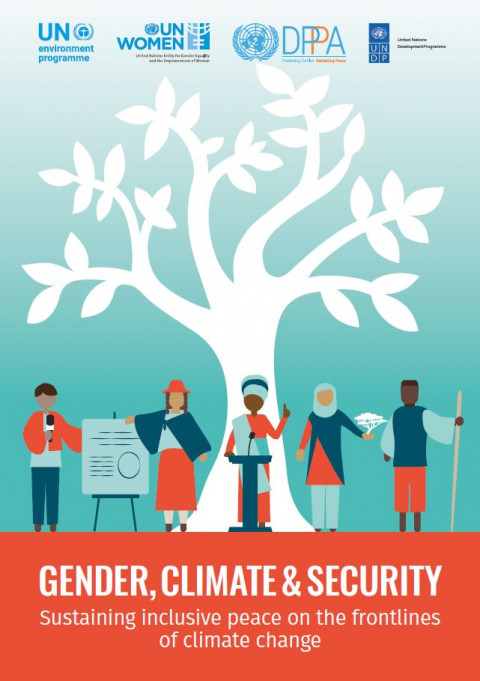 Gender, Climate & Security: Sustaining Inclusive Peace on the Frontlines of Climate Change Year of publication: 2020 Corporate author: United Nations Environment Programme (UNEP) | United Nations Entity for Gender Equality and the Empowerment of Women (UN Women) | United Nations Development Programme (UNDP) Climate change is a defining threat to peace and security in the 21st century – its impacts felt by everyone, but not equally. Gender norms and power dynamics shape how women and men of different backgrounds experience or contribute to insecurity in a changing climate. Grounded in a series of case studies from research and programming experience, this report offers a comprehensive framework for understanding how gender, climate and security are inextricably linked. The report assesses entry points for action across existing global agendas and suggests concrete recommendations for how policymakers, development practitioners and donors can advance three inter-related goals: peace and security, climate action and gender equality.
  Combating Domestic Violence in Kyrgyzstan: Are Victims Protected? Year of publication: 2020 Author: Анна Зубенко Corporate author: Central Asian Bureau for Analytical Reporting (CABAR) The reform of the judicial system, thanks to which a number of new codes appeared in Kyrgyzstan, was aimed primarily at the humanization of legislation and the decriminalization of certain types of crimes. Domestic violence, in the framework of changing the legislation, on the contrary, was criminalized - it was included in the Code of Misconduct, which is part of the criminal law. But the de facto prosecution of perpetrators has become more difficult.
  Uzbekistan Expresses Concerns about School Bullying Year of publication: 2018 Author: Дарина Солод Corporate author: Central Asian Bureau for Analytical Reporting (CABAR) Psychologists will appear in secondary schools in Uzbekistan. The author asks if they will be able to influence the solution of this complex social problem among children.
  Imagining a Post-COVID-19 Global Citizenship Education Year of publication: 2020 Author: Marta Estelles | Gustavo E. Fischman Corporate author: State University of Ponta Grossa The COVID-19 pandemic has created unprecedented conditions in all areas of social life and as the suspension of schooling became “the new normal,” numerous experts and opinion-makers rushed to voice their recommendations to overnments and educational organizations for normalizing schooling operations. In light of this worldwide crisis, we re-evaluate proposals to expand the model of Global Citizenship Education (GCE) that have received increasing attention and support from both international organizations, governments, and scholars.In this article, we argue that the predominately redemptive nature of GCE models and proposals since the mid-1990s cannot handle global problems associated with the current pandemic such as the restriction of citizen’s privacy rights or the strengthening of exclusionary nationalistic messaging. Instead, more realistic models of GCE are needed. This paper concludes with new questions to strengthen the debate and alternatives for imagining a non-redemptive and more realistic GCE.
 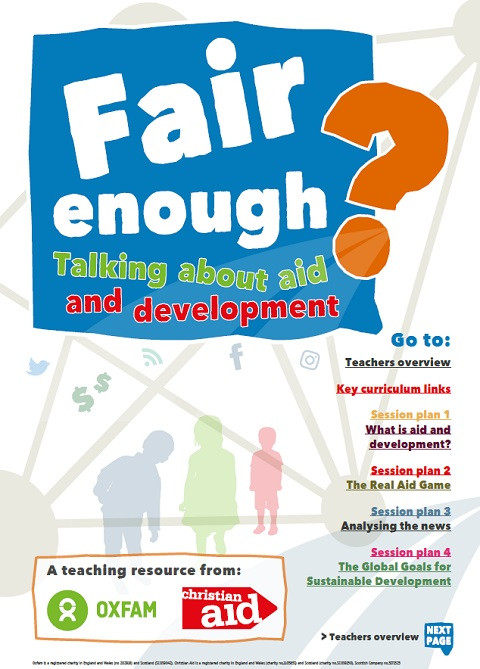 Fair enough? Talking about aid and development Year of publication: 2017 Corporate author: Oxfam | Christian Aid This resource aims to introduce to learners the concepts of aid and development and how these differ; how a limited development budget might be most effectively spent; critically evaluating media stories around development spending and the Global Goals for Sustainable Development. There are four session plans. Each includes an outline of the session with activity description, background information, photocopiable resource sheets for learners and links to online articles and video.
  SDG 4 - Policies for flexible learning pathways in higher education: Taking stock of good practices internationally (IIEP-UNESCO Working Papers) Year of publication: 2020 Author: Michaela Martin | Ana Godonoga Corporate author: UNESCO International Institute for Educational Planning (IIEP) This paper draws on country examples across different UNESCO regions to illustrate policy-relevant as well as practical approaches to developing flexible learning pathways in higher education. It shows that policies can facilitate flexible learning pathways include legislative and regulatory frameworks, articulation and transfer policies, and lifelong learning policies. It also presents a number of supportive policy instruments that can serve to bridge policy and practice, such as national qualifications frameworks, quality assurance and accreditation, credit accumulation and transfer systems, and information and guidance services. Finally, apart from discussing system-wide approaches, this paper also gives examples of more decentralized, institution-led practices that contribute to flexible learning pathways. This paper concludes that well-designed policy frameworks and instruments and targeted measures can create an enabling environment for flexible learning pathways, but their effectiveness requires strong administrative capacity and coordination, as well as the involvement of all relevant stakeholders, including those who design, implement, and benefit from policies. It is also essential that policies, instruments, and practices are in alignment with one another and work towards a common objective. Therefore, a holistic approach, comprising an adequate and well-coordinated mix of policies, instruments, and targeted measures, is required, in order to translate flexible learning pathways from a national priority into an institutionalized practice that reaches its intended beneficiaries.