
Resources
Explore a wide range of valuable resources on GCED to deepen your understanding and enhance your research, advocacy, teaching, and learning.
8,364 Results found
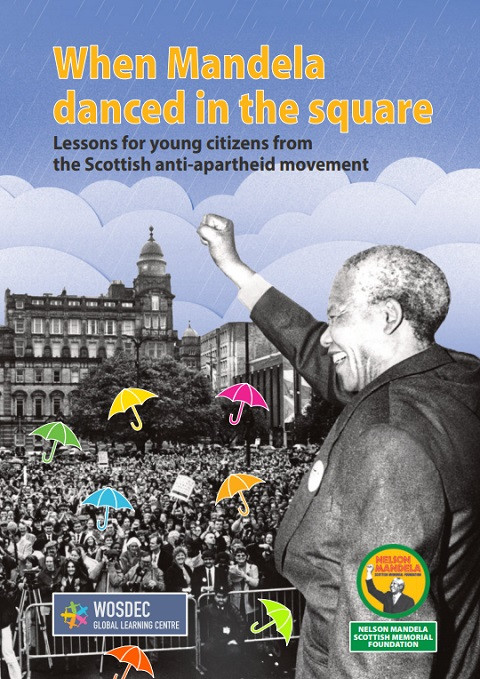 When Mandela Danced in the Square: Lessons for Young Citizens from the Scottish Anti-Apartheid Movement Year of publication: 2020 Corporate author: West of Scotland Development Education Centre (WOSDEC) | Nelson Mandela Scottish Memorial Foundation This resource aims to understand the context of apartheid South Africa, the life of Nelson Mandela and the connections to the Scottish anti-apartheid movement. The activities in this resource support second and third level learners within Scotland's Curriculum for Excellence to explore Scotland’s connection with Nelson Mandela and feel empowered to take action on issues of importance to them today.
  From Volunteers to Active Citizens Year of publication: 2015 Author: Grainne O’Neil Corporate author: Comhlámh This is a practical guide for volunteer sending-organisations, which aims to build capacity to support and deepen volunteers’ ongoing learning and critical engagement with international development issues, and to help volunteers “to address the structural and underlying causes of inequality and injustice to participate in social change making.”
 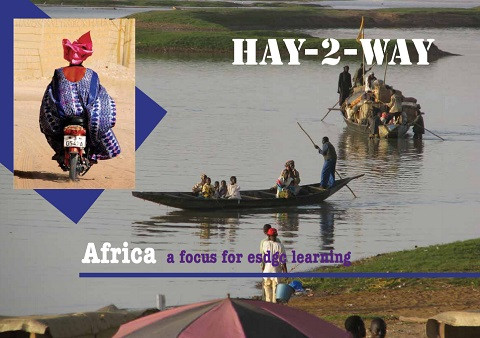 HAY-2-WAY: Africa; A Focus for ESDGC learning Year of publication: 2014 Author: Scott Sinclair Corporate author: Hay 2 Timbuktu This resource describes the education work that was part of the Two Towns One World project. It makes the case for an Africa focus as a significant theme in Education for Sustainable Development and global citizenship learning (ESDGC).The Two Towns One World project had two main strands: Locally in the Hay-on-Wye area with the Gwernfed cluster of schools and Nationally in Wales through a series of workshops and conferences.The scope of the work was enhanced through partnership with other initiatives on the themes ‘Unpacking Africa’ and ‘Debating Development’. A conference in Llandrindod Wells in November 2013 brought the strands of work together and provided the main narrative of this publication.
  Back to School With Global Citizenship Corporate author: Oxfam GB Global citizenship is all about encouraging young people to develop the knowledge, skills and values they need to engage with the world. Ideal for use at the start of the academic year or a new topic, the following activities support learners aged 7 to 14 to develop some of the key elements of responsible global citizenship: to ask questions, make connections, and explore viewpoints and values.
 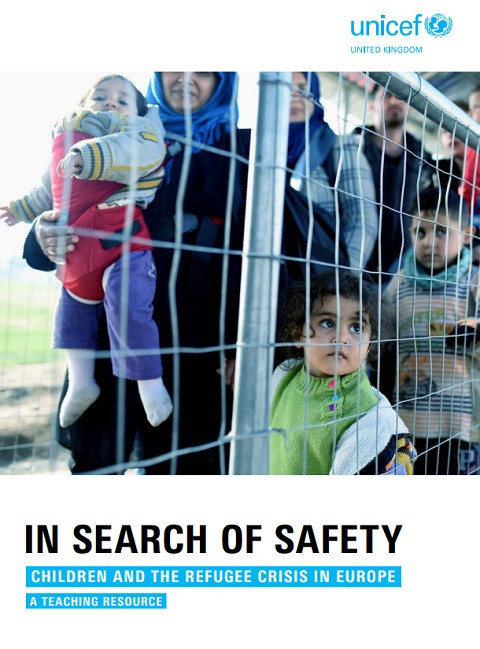 In Search of Safety: Children and the Refugee Crisis in Europe; A Teaching Resource Year of publication: 2016 Author: Carolyne Willow Corporate author: UNICEF UK This resource aims to allow teachers to help their students – primary (age seven upwards) and secondary – make sense of the current refugee and migrant crisis in Europe, within a children’s rights framework. It provides an historical overview of migration, contextualising the challenges we face today with a reminder of what has gone before. Guidance is provided to help you prepare for potentially difficult conversations and situations, and to enable you to be ready to access help for any child that needs it. The resource also includes ideas for extra activities by curriculum area, and ideas for whole-school activities. A range of films, images and information is provided and sign-posted to help you bring these activities to life.
  Towards Compassionate Global Citizenship: Educating the Heart through Development Education and Cognitively-Based Compassion Training (Vol. 19, Autumn, 2014) Year of publication: 2014 Author: Caroline Murphy | Brendan Ozawa-de Silva | Michael Winskel Corporate author: Centre for Global Education (CGE) The authors present an argument for developing emotional literacy which can be applied to critical development education to bring about active citizens who have capacity to take compassionate action for global justice. It is argued that both emotional skills and critical thinking skills are mutually essential, and in fact it is only by cultivating a symbiosis between these, can pedagogy be developed that presents a true transformational agency to people. The paper attempts to synthesise development education (DE) with Cognitively-Based Compassion Training (CBCT), and argues that these are potentially compatible to acquire such pedagogy. While DE can provide individuals with the skills to think critically and react to injustice, CBCT can provide the skills and emotional capacity to intervene for change, without giving in to despair, anger, or burnout. In short, it is argued that DE and CBCT can provide the emotional and intellectual skills necessary for productive social activism and change. Throughout this article it is highlighted how the international development organisation, Children in Crossfire (CIC), has been grappling with the above mentioned and related disciplines, and how it has been working, in partnership with researchers from Emory University and Life University’s Center for Compassion and Secular Ethics, to evolve its DE teacher training practice, Teachers in Development and Learning (TIDAL), towards such a transformative pedagogy, entitled ‘Educating the Heart for Compassionate Global Citizenship’.
  The Role of Teachers in Education and Democracy: The Impact of a Research Project on Preservice Teacher Perceptions Year of publication: 2015 Author: Gina Thésée | Paul R. Carr | Franck Potwora Corporate author: McGill University. Faculty of Education This article presents reflections on a survey questionnaire related to the connection between education and democracy. A sample of 157 teacher-education students in Montreal completed a follow-up questionnaire after having participated in a research questionnaire (first study) concerning their perception and experience of the linkage between education and democracy. The first study underscored a weak democratic experience as well as an educational journey without a strong linkage to democracy, which concurs with our previous findings. However, the results of the follow-up survey indicate that participation in this inquiry generated socio-educational, epistemological, pedagogical, and methodological reflections, which could have significant implications for the perception of the role of educators.
  Political Thought at School: Problem and Theoretical Foundations Year of publication: 2019 Author: Olivier Lemieux | Denis Simard Corporate author: Éducation et francophonie At a time when voter turnout is apparently declining, many are wondering what actions to take to curb the political alienation and rise of cynicism among younger generations. In this context, the school seems to be an important nerve centre for action. Although Quebec schools do not specifically offer political education, we believe that some knowledge, subject-specific skills, cross-curricular competencies and general areas of training are likely to contribute to the formation of political thought. But what exactly do we mean by «political thought»? The purpose of this article is to propose a construction of this concept, notably by situating it and distinguishing it from other central concepts of human sciences. We therefore believe that this article will provide a theoretical foundation for a broader research project on citizens’ «political competence», which adds to political thought the tendency to take an interest in and participate in public life.
 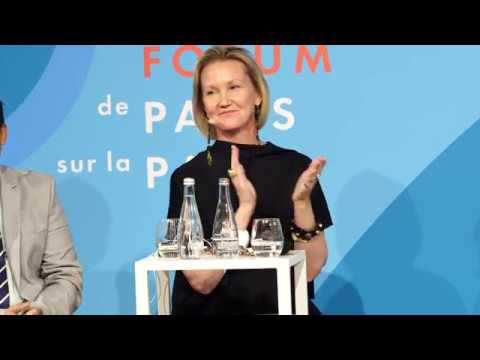 How Can Pluralism Strengthen Peace?: Global Centre for Pluralism at the 2019 Paris Peace Forum Year of publication: 2019 Author: Meredith P. Mcghie | Aung K. Moe | Bojana Dujkovic Corporate author: Global Pluralism Award Many of the most intractable challenges we face today − from entrenched poverty to conflict-driven migration − stem from the exclusion and resentment of groups defined as “the other”.Group-based grievances arising from inequality, exclusion and feelings of injustice increase the risk of instability and conflict. Pluralism is the choice to see diversity contribute to the common good. Making this choice is essential to building more secure, peaceful and resilient societies.Meredith Preston McGhie, the Secretary General of the Global Centre for Pluralism, was joined by two winners of the 2019 Global Pluralism Award to discuss how history education and community-based reconciliation can help strengthen pluralism, sustain peace and prevent conflict in diverse societies.
 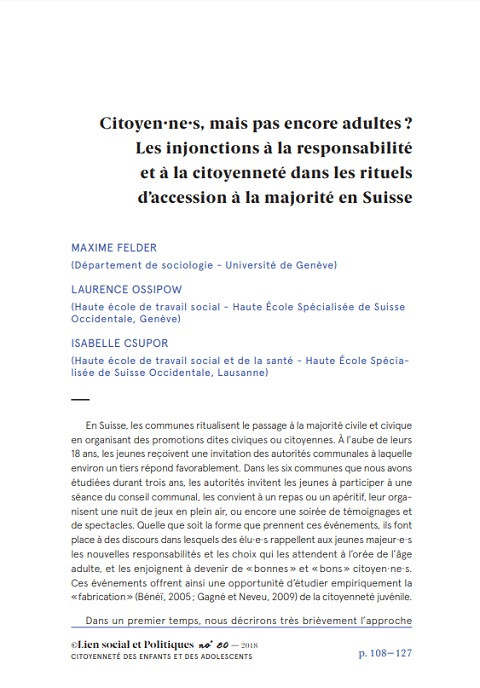 Citizens but Not Adults? Injunction to Be Responsible and Citizens in Official Coming of Age Rituals in Switzerland Year of publication: 2018 Author: Maxime Felder | Laurence Ossipow | Isabelle Csupor Corporate author: Lien social et Politiques Swiss municipalities organize ceremonies for their residents reaching the official age of full citizenship. In the six studied municipalities, local authorities invite them to a municipal council’s meeting, offer them a dinner or an aperitif, or organize them a show and a debate with role models. Speeches are central to these ceremonies, and authority representatives encourage their audience to be “good” citizens. Call to vote is the leitmotiv, but discourses reveal broader definitions of citizenship, insisting sometimes on a local commitment and volunteering, and sometimes on the necessity to fight climate change and inequalities. Comparing officials’ speeches to statements of young people participating in these events reveals “tensions”. Indeed, authority representatives address young citizens without considering them as fully adult, and they do not consider themselves as such neither. However, some of them are already involved in forms of vernacular citizenship, and are progressively leaving the municipality to study, work or travel. Ultimately, these ceremonies allow officials to stage their interest in the youth, which they consider as both uncompleted and essential to the renewal of democracy.