
Resources
Explore a wide range of valuable resources on GCED to deepen your understanding and enhance your research, advocacy, teaching, and learning.
8,363 Results found
 Situation Assessment: Comprehensive Sexuality Education in Digital Spaces – Opportunities for Formal Education in Thailand Year of publication: 2021 Corporate author: UNESCO Bangkok This rapid situation assessment of comprehensive sexuality education across digital spaces in Thailand aims to understand the opportunities for using digital sexuality education spaces and content in formal education. The report analyses original data drawn from young people, teachers, education officials, and representatives of organizations engaged in young people’s health and well-being, and consolidates these with learnings from earlier studies both locally and further afield. It offers recommendations for capacity-building and other efforts to expand access to innovative teaching and learning on sexuality education by leveraging digital spaces both in and out of the classroom.
 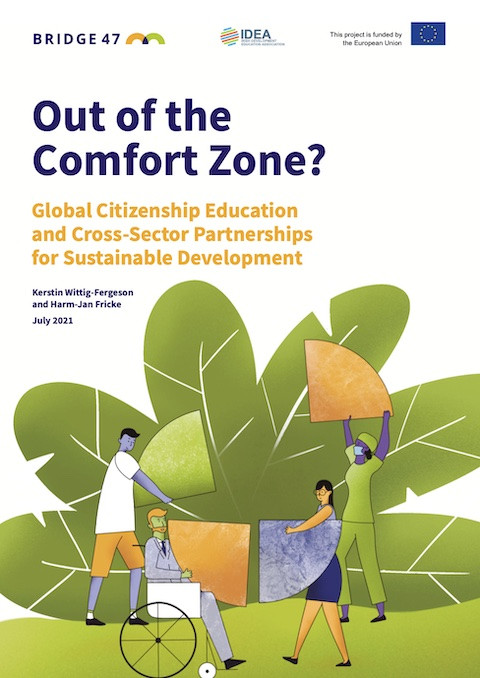 Out of the Comfort Zone?: Global Citizenship Education and Cross-Sector Partnerships for Sustainable Development Year of publication: 2021 Author: Kerstin Wittig-Fergeson | Harm-Jan Fricke Corporate author: Bridge 47 This publication provides examples of partnerships involving civil society and a wide range of actors in different sectors: from policy makers to academia, from media to health services, from businesses to museums. The partnerships, initiated by Bridge 47, promoted learning about and for sustainable development using a variety of Global Citizenship Education (GCE) methods. Their experiences form the basis for suggestions that aim to encourage further explorations of cross-sector collaborations.
  A Coherent European Approach to SDG Target 4.7 Year of publication: 2021 Author: Ana Teresa Santos Corporate author: Bridge 47 This document aims to showcase why a coherent approach to Target 4.7 of the Sustainable Development Goals’ (SDG) will strengthen the European Union’s role in achieving the targets and goals set out in Agenda 2030. The report suggests some pathways to follow in order to make this coherent approach a reality.It explores: Relevance of a coherent European approach to SDG Target 4.7 and connections with other EU processes Funding lines Possible pathways to make the coherent approach a reality
 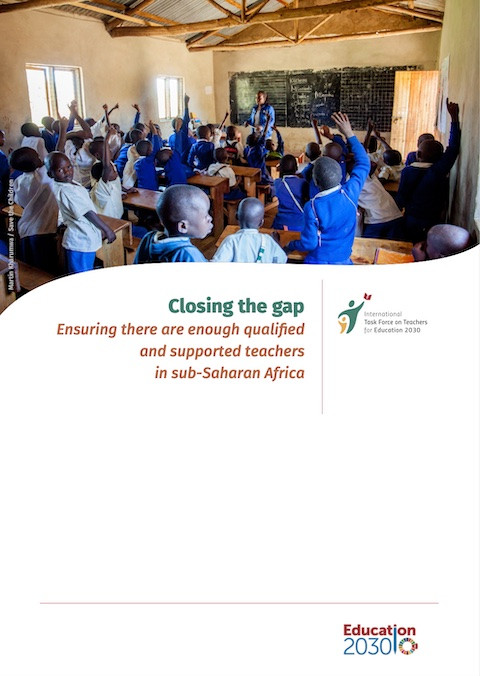 Closing the Gap: Ensuring There Are Enough Qualified and Supported Teachers in Sub-Saharan Africa Year of publication: 2021 Corporate author: International Task Force on Teachers for Education 2030 | UNESCO The fourth Sustainable Development Goal (SDG 4) aims to ensure better learning opportunities and outcomes and more equitable and inclusive education for all. SDG target 4.c calls for an increase in the supply of qualified teachers, particularly in low-income countries. To achieve this ambitious target, the international community needs to pay renewed attention to teacher support and preparation.This advocacy brief considers what it will take to increase the supply of qualified teachers in sub-Saharan Africa, the region where the teacher shortage is most acute. It analyses the causes for teacher shortages, looks at trends affecting the region and describes the scale of the shortages. It examines the fiscal pressures on low-income countries to cover salary costs and the costs of initial teacher education and continuing professional development, and it proposes some recommendations for governments and the international community to achieve the essential target of substantially increasing the supply of well qualified teachers.
  Tween Cyberbullying in 2020 Year of publication: 2020 Author: Justin W. Patchin | Sameer Hinduja Corporate author: Cyberbullying Research Center | Cartoon Network This report presents the results of a nationally representative survey of 1,034 children between the ages of 9 and 12 years-old. The survey was conducted online from June 19 through July 6, 2020, and was fielded by Ipsos using their probability-based KnowledgePanel. KnowledgePanel is the largest online panel that is representative of the U.S. population. KnowledgePanel recruitment employs an addressed-based sampling methodology from the United States Postal Service’s Delivery Sequence File—a database with full coverage of all delivery points in the U.S. As such, samples from KnowledgePanel cover all households regardless of their phone status. Member households without Internet access are furnished with a free computing device and Internet service. KnowledgePanel members are randomly recruited through probability-based sampling, and panel members are randomly selected so that survey results can properly represent the U.S. population with a measurable level of accuracy, features that are not obtainable from nonprobability panels. Ipsos currently recruits panel members by using address-based sampling methods (the firm previously relied on random-digit dialing for recruitment). Households without Internet connection are provided with a web-enabled device and free Internet service. In contrast, “convenience” or “opt-in” surveys recruit participants through emails, word-of-mouth, pop-up ads online, or other non-scientific methods.
  [Summary] Media and Information Literacy: The Time to Act is Now! Year of publication: 2021 Corporate author: UNESCO UNESCO has developed a comprehensive Curriculum which provides a framework for training teachers. But it is also a foundation that will also be of help to others: to learners, to content providers like internet companies and news media outlets, and to citizens of all ages as they consume, create and use content, including information.The second edition of the learning resource has been significantly expanded since the first publication in 2011. The MIL Curriculum reflects the changing nature of the information landscape. It now includes insight from a broader range of content providers than before, including libraries, archives, museums, media, and digital communications companies.The Curriculum is designed to empower educators and learners in general – from schoolteachers to those involved in training, the media and libraries, governments, and NGOs – to train people to spot misrepresentations and disinformation, and most importantly develop critical thinking competencies.
  Silver Lining of Pandemic: Redefining Civil Society in Tajikistan Year of publication: 2020 Author: Muslimbek Buriev Corporate author: Central Asian Bureau for Analytical Reporting (CABAR) | Institute for War and Peace Reporting (IWPR) “Non-governmental organizations, mass media, community groups and initiatives have emerged amidst lockdown as actors actively engaged in assisting the population and addressing the crisis,” political scientist Muslimbek Buriev examines the role of civil society in Tajikistan in an article just for the CABAR.asia.
  Discourses and Strategies for Solving Environmental Issues in Central Asia Year of publication: 2020 Author: Muslimbek Buriev Corporate author: Central Asian Bureau for Analytical Reporting (CABAR) | Institute for War and Peace Reporting (IWPR) The representative office of the Institute for War and Peace Reporting (IWPR) in Central Asia and CABAR.asia present an analytical note entitled “Discourses and Strategies for Solving Environmental Issues in Central Asia”. This work is an effort to outline the most significant environmental issues in the region and to analyze measures to solve them. In addition, it attempts to highlight cases of successful practice as well as to identify existing programs with significant shortcomings.The work is meant for young experts and consultants, researchers, decision-makers, as well as a wide range of readers interested in environmental issues and governance in Central Asia.
  The Art of Mythmaking as a Solution to Gaps in PVE Projects in Kyrgyzstan Year of publication: 2020 Author: Kunduz Kydyrova Corporate author: Central Asian Bureau for Analytical Reporting (CABAR) | Institute for War and Peace Reporting (IWPR) Currently, projects aimed at countering extremism are being implemented according to the same scheme. However, much is not considered in such projects. In particular, no attention is paid to the psychological component, while the perception of ideas and information received is key in the spread of radical ideologies. Kunduz Kydyrova, an analyst at M-Vector and a member of the CABAR.asia School of Analytics, discusses the need to apply a transdisciplinary approach in PVE projects and how mythmaking can help increase the effectiveness of such initiatives.
  Formalism, Tribalism, and Nationalism in the Protection of Children’s Rights in Kazakhstan Year of publication: 2020 Author: Aigerim Musabalinova Corporate author: Central Asian Bureau for Analytical Reporting (CABAR) | Institute for War and Peace Reporting (IWPR) Aigerim Musabalinova, an expert on children’s rights tries to find an answer to the question of how the social and cultural aspect of the country affects the well-being of children and the observance of their rights and interests, in an article for CABAR.asia.