
Resources
Explore a wide range of valuable resources on GCED to deepen your understanding and enhance your research, advocacy, teaching, and learning.
8,363 Results found
 Values Education in Primary and Secondary School of Japan: Approach, Orderliness and Dilemma (Primary & Secondary Schooling Abroad; No. 1) Year of publication: 2019 Author: Sun Cheng | Karaki Kiyoshi Corporate author: Shanghai Normal University Values education is an important part of primary and secondary education in Japan. It has two teaching approaches: curriculum teaching and practical teaching. After the Second World War, it has formed a political service orderliness which is unified with the national dominant ideology, a cultivating orderliness which is from the “Imperial People” to the “New Citizen”, a practical orderliness which is developing around the “Social Participation”. At present, Japan’s values education in primary and secondary schools mainly faces the dual dilemma of historical cognition and public value, especially in the aspect of historical cognition, which deserves our constant vigilance and attention.
  Preparation of National Action Plans Against Racial Discrimination: Practical Guide Year of publication: 2014 Corporate author: United Nations (UN) This publication is a practical guide for the development of national plans of action against racial discrimination. National action plans are the basis for the development of a comprehensive public policy against racial discrimination and therefore can help States to comply with their international human rights obligations related to the elimination of racial discrimination.
  Thinking of Democracy: Thirty Exercises to Work on in the Classroom Year of publication: 2013 Author: María Celeste Adamoli | Cecilia Flachsland | Violeta Rosemberg Corporate author: Argentina. Ministry of Education This book presents tools for education for democratic citizenship. The text proposes thirty exercises, short texts that link and put in counterpoint two precise events of the last three decades (phrases, slogans, laws, facts, dates, mobilizations, objects, songs, films, proper names, life stories, etc. ) that allow us to reflect on different facets of the Argentine democratic experience that began in 1983.
 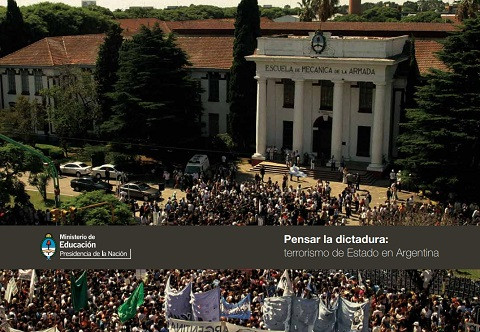 Thinking of the Dictatorship: State Terrorism in Argentina Year of publication: 2010 Corporate author: Ministry of Education (Argentina) This book presents, in questions and answers format, basic information and the enumeration of the main historical and theoretical problems that arise from dictatorship and State Terrorism, to accompany teachers in the complex task of teaching this subject.
  Holocaust and Genocides of the 20th Century: Questions, Answers and Proposals for Your Teaching Year of publication: 2014 Author: María Celeste Adamoli | Cecilia Flachsland Corporate author: Argentina. Ministry of Education This book presents, in questions and answers format, basic information and the enumeration of the main historical and theoretical problems that arise from the Holocaust and other genocides of the 20th century, to accompany teachers in the complex task of teaching this subject.
  The Remapping and Analysis of Human Rights and Peace Education in ASEAN/Southeast Asia Year of publication: 2019 Corporate author: Strengthening Human Rights and Peace Research/Education in ASEAN/Southeast Asia (SHAPE-SEA) | AUN Human Rights Education Network (AUN-HRE) This book is the result of SHAPE-SEA’s Research Project on “The Remapping and Analysis of Human Rights and Peace Education in ASEAN/Southeast Asia.” It is a follow-up to the 2013 report on “The Mapping and Analysis of Human Rights and Peace Education in Southeast Asia.” It aimed at establishing a systematic updating of developments in human rights and peace education/studies in ASEAN/Southeast Asia. The study investigated courses and programmes on human rights and peace & conflict being undertaken by higher education institutions in all ASEAN member countries and Timor Leste. It had also identified new developments and/or setbacks in human rights and peace education. Researchers located existing academic institutions that have been running programmes and courses on human rights and/or peace. The analysis of existing course syllabi and curriculum in the region was also conducted. To a certain extent, materials being used by instructors were also examined.
  Returning to Learning During Crises: Decision-Making and Planning Tools for Education Leaders Year of publication: 2020 Corporate author: United States Agency for International Development (USAID) This toolkit is for USAID Mission staff and their partner national and local education officials, implementing partners, and administrators and educators of education institutions. It helps education planners plan and make key decisions on the return to learning during and after education disruptions caused by crises, such as COVID-19, in a way that is equitable, inclusive, and builds the resilience of education systems. To provide timely support to the field, this toolkit includes a first set of tools and identifies several tools that are forthcoming. The toolkit is expected to be updated with the full set of tools in late 2020.
  Inclusive Schools: Making a Difference for Roma Children (Inschool) Corporate author: European Union (EU) | Council of Europe This leaflet presents a joint project of the European Union and the Council of Europe on “Inclusive schools: making a difference for Roma children” targeting schools where Roma children learn, in the Czech Republic, Hungary, Romania, Slovak Republic and United Kingdom. The project aims at enhancing social inclusion of Roma by promoting inclusive education policies and practices in Europe.
 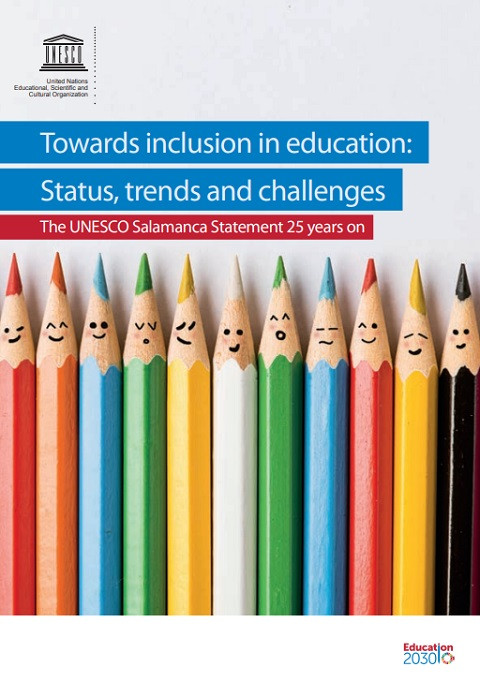 Towards Inclusion in Education: Status, Trends and Challenges: The UNESCO Salamanca Statement 25 Years on Year of publication: 2020 Corporate author: UNESCO The 2030 Agenda for Sustainable Development focuses on leaving no one behind with its Goal 4 on education calling upon education systems ‘to ensure inclusive and equitable quality education and promote lifelong learning opportunities for all’. With ten years remaining to the target date of 2030, countries need to step up e¬orts to reach out to all learners, respect their diverse needs, abilities and characteristics and eliminate all forms of discrimination in the learning environment. This requires adopting an inclusive approach whose foundations have been laid by the UNESCO World Conference on Special Needs Education held in Salamanca, Spain, in 1994. The publication looks at the past, present and future since Salamanca. It provides examples from around the world and make recommendations to guide the further development of inclusive national policies and practices.
 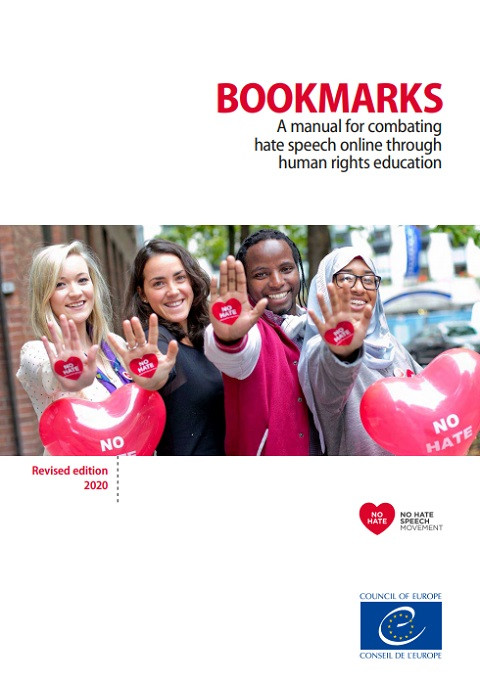 Bookmarks: A Manual for Combating Hate Speech Online Through Human Rights Education Year of publication: 2020 Author: Ellie Keen | Mara Georgescu Corporate author: Council of Europe The work of the Council of Europe for democracy is strongly based on education: education in schools, and education as a lifelong learning process of practising democracy, such as in non-formal learning activities. Human rights education and education for democratic citizenship form an integral part of what we have to secure to make democracy sustainable. Hate speech is one of the most worrying forms of racism and discrimination prevailing across Europe and amplified by the Internet and social media.Hate speech online is the visible tip of the iceberg of intolerance and ethnocentrism. Young people are directly concerned as agents and victims of online abuse of human rights; Europe needs young people to care and look after human rights, the life insurance for democracy.Bookmarks was originally published to support the No Hate Speech Movement youth campaign of the Council of Europe for human rights online. Bookmarks is useful for educators wanting to address hate speech online from a human rights perspective, both inside and outside the formal education system. The manual is designed for working with learners aged 13 to 18 but the activities can be adapted to other age ranges.This edition of Bookmarks reflects the end of the coordination of the youth campaign by the Council Europe. The campaign may be officially over, but the education and awarenessraising to counter hate speech and promote human rights values remain an urgent task for young people of all ages.