
Resources
Explore a wide range of valuable resources on GCED to deepen your understanding and enhance your research, advocacy, teaching, and learning.
8,364 Results found
 Media and Information Literacy: Policy and Strategy Guidelines Year of publication: 2013 Author: Alton Grizzle | Penny Moore | Michael Dezuanni | Sanjay Asthana | Carolyn Wilson | Fackson Banda | Chido Onumah | Maria Carme Torras Calvo Corporate author: UNESCO This resource aims to treat MIL as a composite concept, unifying information literacy and media literacy as well as considering the right to freedom of expression and access to information through ICTs. It is divided into two parts. Part 1 is the MIL Policy Brief, and is designed for policy or decision makers and can serve as a summary of the publication. Part 2 is divided into several comprehensive chapters and suggests: 1) how to enlist MIL a development tool; 2) conceptual frameworks for MIL policies and strategies; and 3) model MIL policy and strategies that can be adapted by countries globally.
  Media and Information Literacy: Non-Formal Education Guide for All Platforms Year of publication: 2019 Author: Nosa Owens-Ibie | Ifedolapo Ademosu | Abiodun Oyeleye Corporate author: UNESCO Dakar The aim of this book is to provide a basic understanding of the idea of media and information literacy (MIL). This book is meant to teach people how to access, understand and evaluate information, the different types of governance systems that exist and how it affects them as citizens. It is also meant to ensure that users know how to use and share information responsibly.
  Africa SDG Index and Dashboards Report 2020: Leave No One Behind to Achieve the SDGs in Africa Year of publication: 2020 Author: Ambrose Rwaheru Aheisibwe | Eve de la Mothe Karoubi | Olive Dushime | Grayson Fuller | Enock Nyorekwa Twinoburyo | Abigail Simkoko | Belay Begashaw | Guido Schmidt-Traub Corporate author: Sustainable Development Goals Center for Africa | Sustainable Development Solutions Network (SDSN) | Mo Ibrahim Foundation The 2020 Africa SDG Index and Dashboards Report provides an assessment of where African countries stand with respect to the SDGs and their progress toward the goals, with the additional lens of “leave no one behind.” The report also includes a preliminary analysis of the impact of COVID‑19 on the SDGs in Africa.
  Opening Eyes and Minds: Inspiring, Educating and Engaging Third Level Students in Global Education (Policy and Practice: A Development Education Review; Vol. 19, Autumn) Year of publication: 2014 Author: Joanne Malone | Gráinne Carley | Meliosa Bracken Corporate author: Centre for Global Education (CGE) Suas has worked since its inception to engage Irish third level students in global citizenship education. This article focuses on the Suas Global Citizenship Programme, setting out the purpose and context of the programme, its innovative design and educational approach and its comprehensive monitoring and evaluation framework. The article presents an analysis of key findings from Suas’ evaluation process and a summary of our learning to date on the challenges of supporting third level students in reflecting, learning and acting on global justice issues.
  Education for Social Change: The Global Learning Programme in the North of Ireland (Policy and Practice: A Development Education Review; Vol. 23, Autumn) Year of publication: 2016 Author: Stephen McCloskey Corporate author: Centre for Global Education (CGE) The Global Learning Programme (GLP) is a four-year initiative funded by the UK government that aims ‘to support schools to teach about global poverty and international development, with a particular focus on upper primary and early secondary school’ (DfID, 2013). The overarching outcome for the project in Northern Ireland is ‘increased and improved delivery of development education in 50% of grant aided primary, secondary and special schools’. It seeks ‘to embed development education and global citizenship as regular practice across curriculum subjects and through whole school initiatives’. The GLP in the north of Ireland is managed by the Centre for Global Education and this article outlines the programme of support provided to schools including Continuing Professional Development (CPD), twilight training, senior leadership seminars and a designated website. The article will also describe the mixed methods approach used to evaluate the impact of the GLP on schools and, in particular, its effectiveness in implementing global learning in the classroom. The article will summarise research findings to date and what they reveal about how teachers have perceived the value of the support provided. The article will conclude by considering the positive impact of the GLP on the wider global education non-governmental sector in Northern Ireland.
  Role of Universities in Implementing the SDGs in Afghanistan: Conference Report (2019) Year of publication: 2019 Corporate author: Kateb University On August 29, 2019, Kateb University, in partnership with the Sustainable Development Solutions Network (SDSN) and Ministry of Economy of Afghanistan (MoEC), UNDP, and Afghanistan Research and Evaluation Unit (AREU), organized a one-day conference titled ‘Role of Universities in Implementation of the SDGs in Afghanistan’. The event was held at Government Media and Information Center with over 250 participants from different universities, CSOs, Development Organizations and the government organizations. They came together to discuss the current status quo of the SDGs in Afghanistan and to discuss the role universities can play in achieving the SDGs in Afghanistan. The conference was a gateway for further cooperation among universities in Afghanistan to play their roles in the fields of Teaching and Learning, Research, External Leadership and Operation and Governance. This report provides a summary of the key issues discussed at the conference and abstracts every presentation.
  Sustainable Development in the European Union: Monitoring Report on Progress Towards the SDGs in an EU Context (2020) Year of publication: 2020 Corporate author: European Union (EU) Sustainable development is firmly anchored in the European Treaties and has been at the heart of European policy for a long time. The 2030 Agenda for Sustainable Development and its 17 Sustainable Development Goals (SDGs), adopted by the UN General Assembly in September 2015, have given a new impetus to global efforts for achieving sustainable development. The EU is fully committed to playing an active role to maximise progress towards the Sustainable Development Goals. This publication is the fourth of Eurostat’s regular reports monitoring progress towards the SDGs in an EU context. The analysis in this publication builds on the EU SDG indicator set, developed in cooperation with a large number of stakeholders. The indicator set comprises around 100 indicators and is structured along the 17 SDGs. For each SDG, it focuses on aspects which are relevant from an EU perspective. The monitoring report provides a statistical presentation of trends relating to the SDGs in the EU over the past five years (‘short-term’) and, when sufficient data are available, over the past 15 years (‘long-term’). The indicator trends are described on the basis of a set of specific quantitative rules.
  Implementing Pedagogical Approaches for ESD in Initial Teacher Training at Spanish Universities (Sustainability 2019; Vol. 11, No. 18) Year of publication: 2019 Author: Sílvia Albareda-Tiana | Esther García-González | Rocío Jiménez-Fontana | Carmen Solís-Espallargas Corporate author: Multidisciplinary Digital Publishing Institute (MDPI) Within the framework of the United Nations 2030 Agenda for Sustainable Development, four case studies of the degree in Primary Education at three Spanish universities are analyzed. The aim is to study the suitability of three different active teaching-learning strategies: problem-based learning (PBL), project-oriented learning (POL), and a cross-disciplinary workshop. Another goal is to promote the integration of education for sustainable development (ESD) and measure the level of acquisition of several competencies of sustainability and the change in consumption habits of future teachers after implementing those pedagogical approaches. Initial and final ecological footprint (EF) as well as a rubric to measure the level of acquisition of competencies of sustainability were used as data collection instruments. The conclusions related to the research objectives show that when sustainability is implemented in the curriculum through active teaching-learning strategies, future teachers acquire competencies of sustainability. They also reveal that said strategies contribute to a change in consumption habits as a reduction in the EF is observed. There exists a relation between EF reduction and high levels of acquisition of competency in sustainability.
 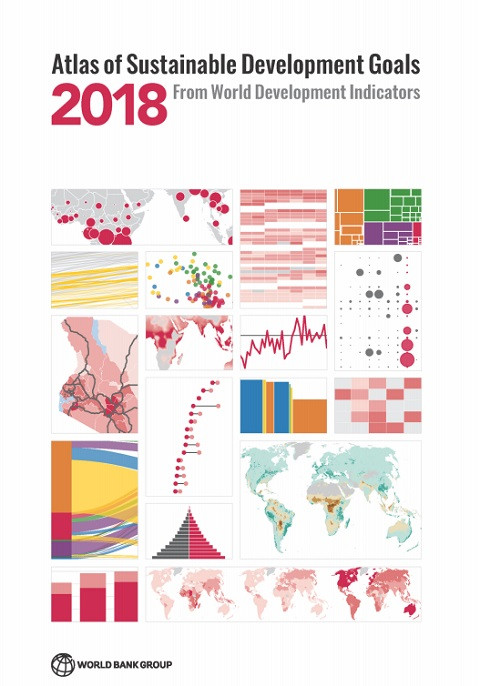 Atlas of Sustainable Development Goals 2018: From World Development Indicators Year of publication: 2018 Corporate author: World Bank The Atlas of Sustainable Development Goals 2018 is a visual guide to the trends, challenges and measurement issues related to each of the 17 Sustainable Development Goals. The Atlas features maps and data visualizations, primarily drawn from World Development Indicators (WDI) - the World Bank’s compilation of internationally comparable statistics about global development and the quality of people’s lives. Given the breadth and scope of the SDGs, the editors have been selective, emphasizing issues considered important by experts in the World Bank’s Global Practices and Cross Cutting Solution Areas. Nevertheless, The Atlas aims to reflect the breadth of the Goals themselves and presents national and regional trends and snapshots of progress towards the UN’s seventeen Sustainable Development Goals related to: poverty, hunger, health, education, gender, water, energy, jobs, infrastructure, inequalities, cities, consumption, climate, oceans, the environment, peace, institutions, and partnerships.
  Accelerating Education for the SDGs in Universities: A Guide for Universities, Colleges, and Tertiary and Higher Education Institutions Year of publication: 2020 Corporate author: Sustainable Development Solutions Network (SDSN) The aim of this guide is to help accelerate the institutional process of mainstreaming ESDGs in universities, by helping stakeholders within and outside universities understand why they should pursue this goal, and how. It aims to expand, update and refine the information provided in the previous guide based on new resources, tools, thinking, and learnings from universities working to implement ESDGs, to consider what ESDGs mean for universities. The guide touches on the pedagogical aspects of ESDGs, in terms of how they affect institutional approaches to ESDGs, but does not attempt to provide a comprehensive review of them. The Guide outlines the case for mainstreaming education for the SDGs at universities, what this does and could look like in practice, and the processes and activities universities can take to support implementation. It also provides practical guidance, resources, and case studies to inspire universities to take action and deepen their practice.